
Introduction
Many Canadian small business owners use the words bookkeeping and accounting like they mean the same thing.
They are connected, but they are not exactly the same.
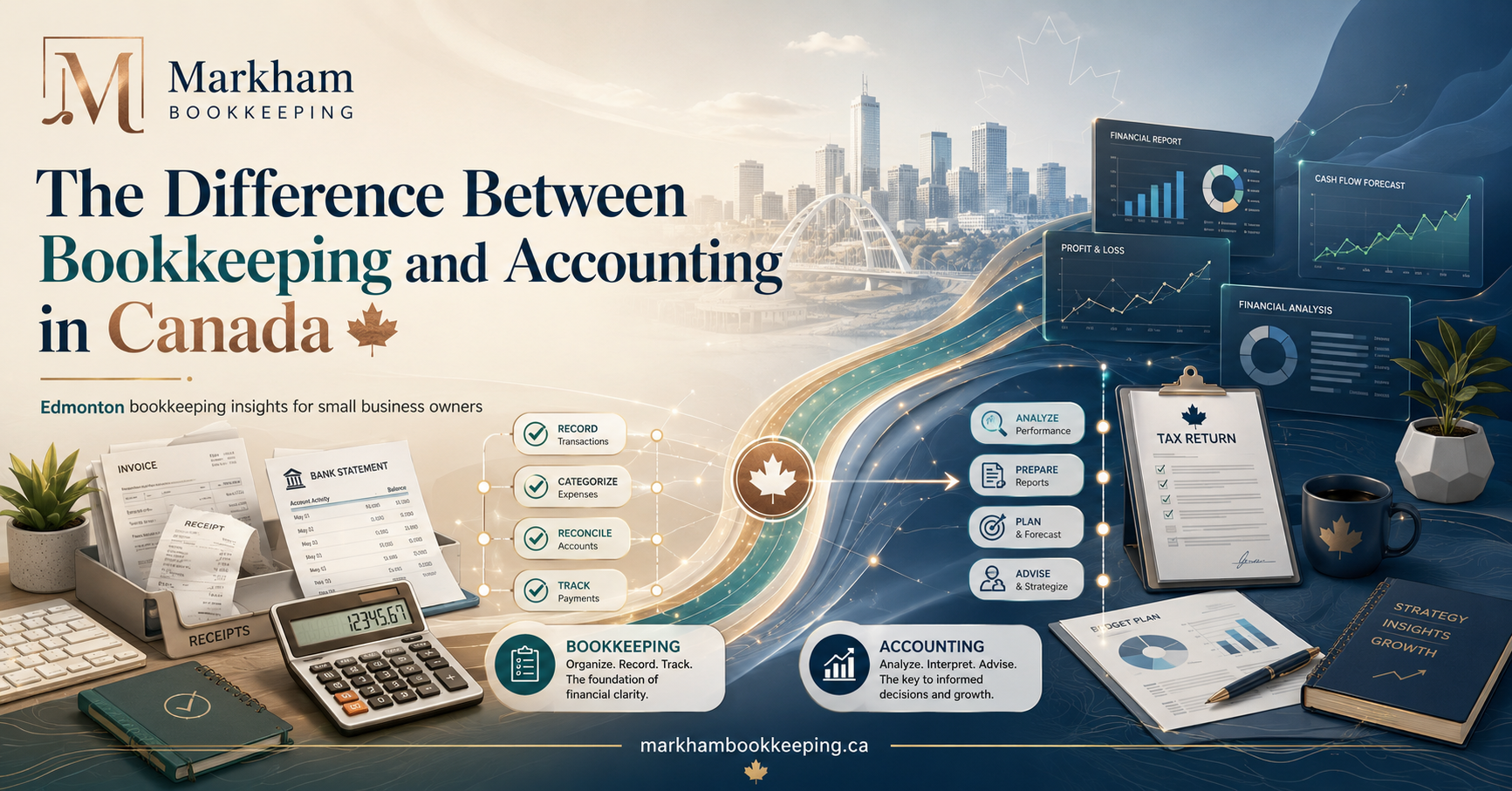
Bookkeeping is about keeping your financial records clean, organized, and up to date. Accounting is about using those records to prepare financial statements, file taxes, review performance, and make bigger financial decisions.
In simple terms:
Bookkeeping records what happened. Accounting explains what it means.
For Edmonton small businesses, understanding the difference matters because clean books are the starting point for almost everything else. Your tax return, GST/HST filing, payroll records, financial statements, loan applications, cash flow reports, and year-end accounting all depend on accurate bookkeeping.
If the bookkeeping is messy, the accounting becomes harder, slower, and more expensive.
Whether you run a construction company, restaurant, consulting business, ecommerce store, trucking business, clinic, real estate business, or professional service company in Edmonton, you need both bookkeeping and accounting at the right time.
The key is knowing what each one does and how they work together.
What Is Bookkeeping?
Bookkeeping is the day-to-day or month-to-month process of recording business transactions.
Every time money comes in or goes out of your business, it needs to be recorded properly. That includes customer payments, supplier bills, bank fees, payroll withdrawals, GST/HST payments, loan payments, credit card charges, owner draws, transfers, and other transactions.
A bookkeeper helps organize these activities so your financial records stay accurate.
Common bookkeeping tasks include:
- Recording sales and income
- Categorizing business expenses
- Reconciling bank accounts
- Reconciling credit cards
- Tracking accounts receivable
- Tracking accounts payable
- Recording payroll entries
- Organizing receipts and invoices
- Posting loan payments correctly
- Tracking GST/HST collected and paid
- Preparing monthly reports
- Keeping QuickBooks, Xero, Sage, or other software updated
For many Edmonton business owners, bookkeeping is the part that gets ignored because they are busy running the business. But this is also the part that creates the biggest mess when delayed.
If transactions are not recorded properly every month, the business owner may not know how much profit they are making, how much GST/HST they owe, which customers still owe money, or which bills are unpaid.
That is why bookkeeping is the foundation of clean financial records.
What Is Accounting?
Accounting takes the information from bookkeeping and turns it into useful financial reporting, tax planning, compliance, and business advice.
An accountant may review your bookkeeping records, adjust entries, prepare year-end financial statements, file corporate tax returns, provide tax planning, help with business structure, and advise on financial decisions.
Accounting looks at the bigger picture.
Common accounting tasks include:
- Preparing financial statements
- Preparing corporate tax returns
- Preparing personal tax returns for business owners
- Reviewing year-end adjustments
- Advising on tax planning
- Reviewing GST/HST treatment
- Preparing T2 corporation tax filings
- Supporting financing or loan applications
- Reviewing profit margins
- Advising on business structure
- Helping with CRA correspondence
- Analyzing business performance
In Canada, some accounting work may be done by CPAs, especially when it involves assurance, review engagements, audits, corporate tax complexity, or formal financial statements for banks and investors.
A bookkeeper may keep the books clean throughout the year, while the accountant may review those books at year-end and prepare the final tax filings.
Both roles are important, but they serve different purposes.
The Main Difference Between Bookkeeping and Accounting
The easiest way to understand the difference is timing and purpose.
Bookkeeping is ongoing. Accounting is usually periodic.
Bookkeeping happens weekly, monthly, or quarterly. It keeps the records current. Accounting often happens monthly, quarterly, or at year-end, depending on the needs of the business.
Bookkeeping focuses on accuracy and organization. Accounting focuses on interpretation and compliance.
For example, a bookkeeper may record your fuel expenses, reconcile the bank account, match customer deposits, and categorize supplier payments.
An accountant may later review those records to prepare your corporate tax return, calculate tax payable, make adjusting entries, and advise whether your business should change its tax planning approach.
Bookkeeping is the input. Accounting is the analysis.
If the input is weak, the analysis will be weak too.
That is why an Edmonton accountant usually needs clean bookkeeping before they can prepare accurate year-end work. If the books are incomplete, the accountant may have to spend extra time cleaning up transactions before the real accounting work can even begin.
Why Bookkeeping Comes First
Clean accounting starts with clean bookkeeping.
A business owner may want accurate financial statements, lower tax stress, better cash flow reports, and smooth year-end filing. But none of that works if the bank accounts are not reconciled, expenses are miscategorized, receipts are missing, and customer payments are not matched properly.
Bookkeeping comes first because it captures the original financial activity of the business.
For example, if your Edmonton business pays $2,000 toward a business loan, the payment should not be recorded entirely as an expense. Part of the payment may reduce the loan balance, and part may be interest expense. If the full amount is recorded incorrectly, your profit and balance sheet may both be wrong.
Another example is GST/HST. If sales tax is not tracked properly during bookkeeping, the GST/HST return may be incorrect. You may underpay, overpay, or create confusion later when the accountant reviews the file.
This is why monthly bookkeeping is not just data entry. It protects the quality of your accounting.
Why Accounting Still Matters
Some business owners think bookkeeping alone is enough. But bookkeeping without accounting can also leave gaps.
Bookkeeping keeps the records clean, but accounting helps business owners understand what the numbers mean.
Accounting can answer questions like:
Is the business actually profitable?
Are expenses increasing too quickly?
Is the company paying too much tax because planning was ignored?
Should the business incorporate?
Are shareholder loans recorded properly?
Is there enough cash to pay GST/HST, payroll remittances, and corporate tax?
Are margins improving or getting worse?
Are financial statements ready for a bank, lender, investor, or buyer?
For small business owners in Edmonton, accounting helps turn clean books into better decisions.
A good bookkeeper helps you stay organized. A good accountant helps you understand the financial direction of the business.
Together, they create a stronger financial system.
Bookkeeping vs Accounting Example
Imagine a small Edmonton contracting business.
During the month, the business receives customer payments, pays subcontractors, buys materials, pays fuel costs, makes loan payments, runs payroll, collects GST/HST, and transfers money between bank accounts.
The bookkeeping side would involve recording all these transactions, attaching receipts, matching deposits to invoices, reconciling the bank account, categorizing expenses, and making sure the records match the bank statement.
The accounting side may involve reviewing the monthly profit and loss, checking whether labour and material costs are too high, preparing year-end tax filings, adjusting depreciation, reviewing shareholder loans, and advising on tax planning.
Without bookkeeping, the accountant has no clean information to work with.
Without accounting, the business owner may have clean records but no deeper financial understanding.
That is why both are needed.
What Does a Bookkeeper Do for a Canadian Small Business?
A bookkeeper helps keep the business organized throughout the year.
For a Canadian small business, this usually includes bank reconciliation, expense categorization, sales recording, receipt tracking, accounts payable, accounts receivable, payroll entries, GST/HST tracking, and monthly reports.
In Edmonton, small business bookkeeping may also involve industry-specific details.
A construction business may need job costing and subcontractor tracking.
A restaurant may need daily sales summaries, tips, payroll, supplier bills, and food cost tracking.
An ecommerce business may need Shopify, Stripe, PayPal, Amazon, fees, refunds, inventory, and sales tax tracking.
A trucking business may need fuel, repairs, financing, insurance, and equipment loan tracking.
A nonprofit may need program, department, grant, and restricted fund tracking.
Good bookkeeping is not just about entering numbers. It is about understanding how the business operates and making sure the books reflect reality.
What Does an Accountant Do for a Canadian Small Business?
An accountant usually works at a higher review and reporting level.
For Canadian businesses, this may include preparing T2 corporate tax returns, T1 personal tax returns, year-end financial statements, tax planning, CRA support, adjusting entries, depreciation schedules, and advisory work.
An accountant may also help with questions about incorporation, dividends vs salary, shareholder loans, GST/HST issues, payroll compliance, asset purchases, business restructuring, and financing.
For more complex work, a CPA may be needed.
The accountant’s role is especially important when the business is growing, borrowing money, preparing for tax filings, dealing with CRA, or making major financial decisions.
But again, the accountant’s work becomes much easier when the bookkeeping is clean.
Why Business Owners Confuse the Two
Business owners often confuse bookkeeping and accounting because they overlap.
Both deal with financial records. Both use accounting software. Both may prepare reports. Both may talk about expenses, income, payroll, and taxes.
The difference is the level of work.
Bookkeeping is more about recording, organizing, and reconciling.
Accounting is more about reviewing, adjusting, reporting, filing, and advising.
In a small business, one person may sometimes do both. In a larger business, the roles are often separated. A bookkeeper handles monthly records, while an accountant reviews the file at year-end.
For many Edmonton small businesses, the best setup is to have monthly bookkeeping done throughout the year and accounting support at tax time or when bigger decisions come up.
Why Clean Bookkeeping Reduces Accounting Costs
One major benefit of good bookkeeping is lower year-end stress.
If your books are messy, your accountant may need to spend extra time fixing problems before preparing tax returns or financial statements.
Common cleanup issues include:
Duplicate income
Duplicate expenses
Unreconciled bank accounts
Missing receipts
Incorrect GST/HST coding
Credit card payments recorded as expenses
Transfers recorded as income
Loan payments posted incorrectly
Customer payments not matched to invoices
Old unpaid bills that were actually paid
Payroll entries missing or incorrect
These issues take time to investigate.
When bookkeeping is done monthly, problems are caught early. When bookkeeping is ignored until year-end, cleanup becomes more expensive and stressful.
That is why small business bookkeeping in Edmonton should not be treated as a once-a-year task. Monthly bookkeeping keeps the accounting process smoother.
Bookkeeping Helps With Daily Decisions
Bookkeeping is especially useful for day-to-day business decisions.
Clean bookkeeping can help you answer:
How much cash do I actually have?
Which customers still owe money?
Which bills are due soon?
How much did I spend on payroll this month?
How much GST/HST should I set aside?
Are my expenses increasing?
Can I afford new equipment?
Did sales improve compared to last month?
These questions matter in real time.
Accounting may help with bigger strategy, but bookkeeping helps business owners stay in control month by month.
For Edmonton small business owners dealing with rent, payroll, supplier costs, vehicle expenses, loan payments, and tax deadlines, current bookkeeping can make a big difference.
Accounting Helps With Bigger Decisions
Accounting helps with bigger-picture decisions.
An accountant can help review profitability, tax planning, corporate structure, financing needs, asset purchases, owner compensation, and financial reporting.
For example, if your business is growing, an accountant may help you decide whether incorporation makes sense. If you already have a corporation, they may help review salary vs dividends, tax installments, and year-end planning.
If you are applying for financing, accounting support may help prepare financial statements and explain the business performance to a lender.
If you are planning to sell the business, clean accounting records become even more important.
Bookkeeping keeps the records clean. Accounting helps tell the financial story.
Do You Need a Bookkeeper, an Accountant, or Both?
Most businesses need both at different stages.
You may need a bookkeeper if:
Your bank accounts are not reconciled monthly.
Your receipts are disorganized.
Your financial reports are not reliable.
You are behind on bookkeeping.
You do not know your true profit.
You need help with QuickBooks, Xero, Sage, or another system.
You want monthly bookkeeping support.
You may need an accountant if:
You need corporate tax filing.
You need tax planning.
You need year-end financial statements.
You are dealing with CRA.
You need advice on incorporation or business structure.
You need formal reporting for lenders or investors.
You have complex tax questions.
For many small businesses in Edmonton, the ideal approach is simple: keep bookkeeping updated monthly, then work with an accountant for tax filing, planning, and year-end review.
Why This Matters for Edmonton Small Businesses
Edmonton business owners face enough pressure already. Between customers, employees, suppliers, taxes, rent, fuel, insurance, payroll, and cash flow, messy books only add more stress.
Understanding the difference between bookkeeping and accounting helps you build a better financial routine.
Bookkeeping gives you clean records.
Accounting gives you insight and compliance.
Bookkeeping keeps the business organized.
Accounting helps with tax, planning, and strategy.
Bookkeeping helps you know what happened.
Accounting helps you understand what it means.
When both work together, your business has stronger financial control.
Final Thoughts
Bookkeeping and accounting are not the same, but they depend on each other.
Bookkeeping is the foundation. It records, organizes, reconciles, and maintains the daily financial activity of the business.
Accounting builds on that foundation. It reviews, analyzes, adjusts, reports, files, and advises.
For Canadian small businesses, especially Edmonton business owners, the best results come when bookkeeping is done regularly and accounting is supported by clean records.
If your books are behind, your bank accounts are not reconciled, or your reports do not make sense, the first step is usually bookkeeping cleanup. Once the records are clean, accounting becomes much easier and more useful.
At Markham Bookkeeping, we help Edmonton small business owners keep their books clean, organized, and ready for tax time, payroll, GST/HST, and better business decisions.
Need help with bookkeeping in Edmonton? Markham Bookkeeping can help you get organized and stay on top of your numbers.
FAQ
1. What is the difference between bookkeeping and accounting in Canada?
Bookkeeping records and organizes daily financial transactions. Accounting uses those records to prepare reports, file taxes, review performance, and provide financial advice.
2. Does my small business need both a bookkeeper and an accountant?
Most small businesses benefit from both. A bookkeeper keeps records clean during the year, while an accountant helps with tax filing, year-end adjustments, and financial planning.
3. Can a bookkeeper prepare financial reports?
Yes, a bookkeeper can usually prepare basic financial reports such as profit and loss, balance sheet, accounts receivable, and accounts payable reports. More complex reporting or formal financial statements may require an accountant or CPA.
4. Why is bookkeeping important before accounting?
Accounting depends on accurate bookkeeping. If transactions are missing, duplicated, or categorized incorrectly, the accounting work becomes harder and the final reports may be unreliable.
5. How often should bookkeeping be done?
Most small businesses should update bookkeeping monthly. Businesses with high transaction volume may need weekly or even daily bookkeeping support.
6. What bookkeeping services do Edmonton small businesses usually need?
Common services include bank reconciliation, expense tracking, receipt organization, payroll entries, GST/HST tracking, accounts receivable, accounts payable, and monthly financial reporting.