
Payroll is one of the most important responsibilities for any business with employees. Whether you run a small retail shop in Downtown Edmonton, a restaurant near Jasper Avenue, a construction company serving Edmonton South, or a professional service business in the core, payroll must be handled carefully. Employees expect to be paid correctly and on time, but payroll is not just about issuing paycheques. It also involves calculating deductions, recording wages properly, preparing reports, and remitting amounts to the Canada Revenue Agency.
For many Edmonton small business owners, CRA payroll remittances can feel confusing. You may know that CPP, EI, and income tax come off an employee’s pay, but you may not be sure when to send those amounts to CRA, how often to remit, what happens if you are late, or how payroll affects your bookkeeping.
This guide explains payroll processing in Downtown Edmonton in simple terms, with a focus on CRA remittances and what small employers need to understand.
What Is Payroll Processing?
Payroll processing is the full process of calculating and recording employee pay. It includes gross wages, vacation pay, statutory holiday pay, overtime, bonuses, taxable benefits, deductions, employer contributions, and net pay.
For a Downtown Edmonton business, payroll processing may include hourly employees, salaried staff, part-time workers, seasonal employees, commission-based staff, or a mix of different pay types. Each payroll run must be calculated correctly because payroll affects employees, bookkeeping, tax reporting, cash flow, and CRA compliance.
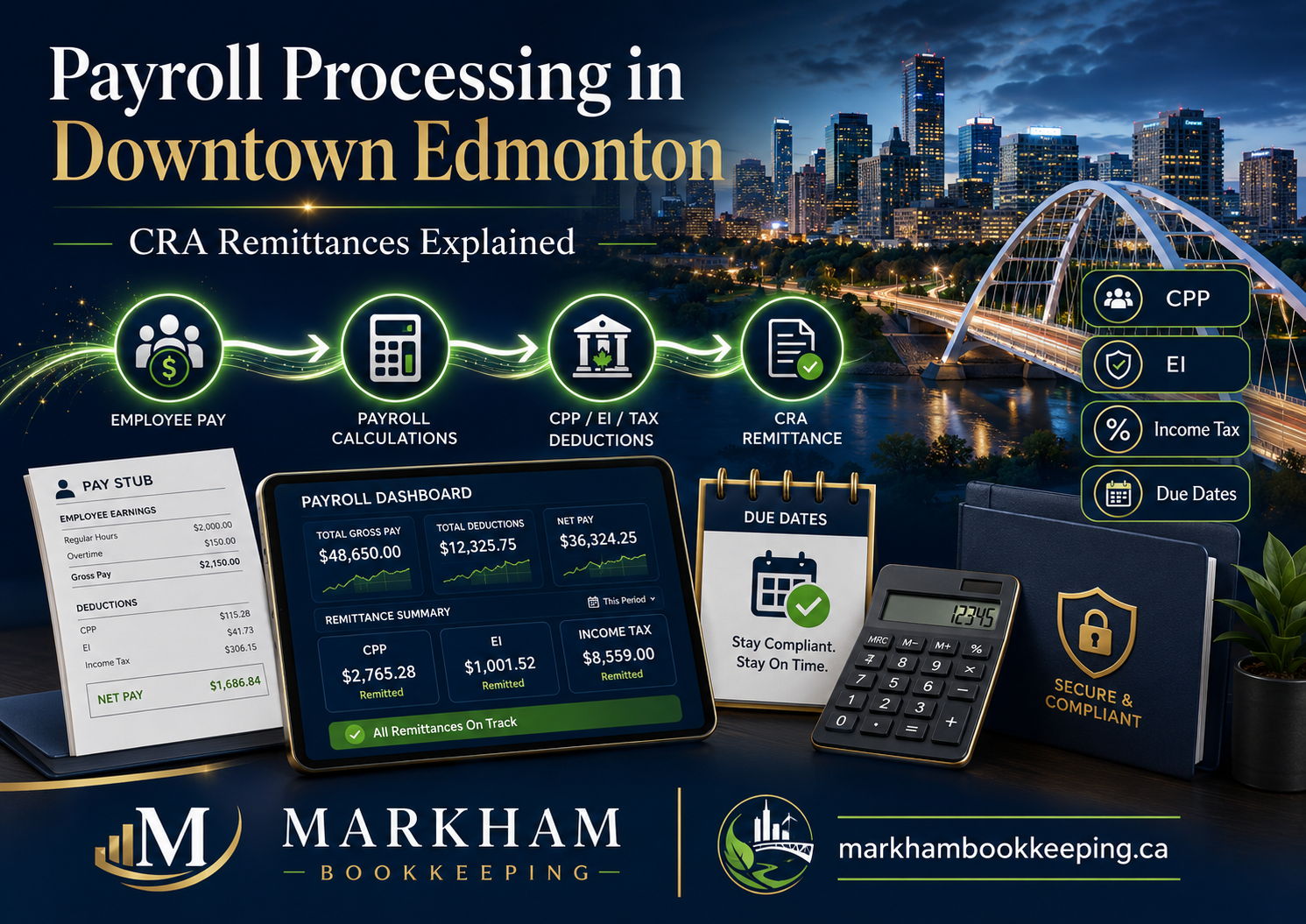
A proper payroll process usually includes collecting employee information, reviewing hours worked, calculating gross pay, deducting CPP, EI, and income tax, adding employer CPP and EI contributions, issuing net pay, recording payroll entries in the books, and remitting payroll source deductions to CRA.
The CRA states that employers are responsible for withholding amounts from pay, remitting those source deductions, and reporting them. Source deductions include CPP contributions, additional CPP contributions, EI premiums, and income tax from taxable, pensionable, and insurable income.
What Are CRA Payroll Remittances?
CRA payroll remittances are amounts that an employer sends to the Canada Revenue Agency after payroll is processed. These amounts usually include employee deductions and employer contributions.
When you pay an employee, you do not simply pay the full gross amount. You must calculate deductions from the employee’s pay, including income tax, CPP contributions, and EI premiums when applicable. On top of that, the employer must also contribute the employer portion of CPP and EI.
This means payroll has two sides. The employee has deductions withheld from their pay, and the employer has additional payroll costs. Both must be recorded properly in the accounting records.
For example, if an employee earns gross wages of $2,000, their net pay will be lower after CPP, EI, and income tax are deducted. The business then owes CRA the employee deductions plus the employer portion of CPP and EI. This amount is not optional. It is money that must be remitted by the required deadline.
Why Payroll Remittances Matter for Edmonton Businesses
Payroll remittances matter because they are a trust obligation. The amounts deducted from employees’ pay are not business revenue. They are amounts collected and held temporarily before being sent to CRA.
This is where many small business owners get into trouble. If payroll deductions are not tracked properly, the bank balance may look higher than it really is. A business owner may accidentally spend money that should have been set aside for CRA. Then, when the remittance deadline arrives, cash flow becomes tight.
For Downtown Edmonton businesses with rent, supplier payments, payroll costs, insurance, software subscriptions, vehicle expenses, and loan payments, this can create pressure quickly.
Clean payroll bookkeeping helps avoid this problem. When payroll is recorded correctly, the business can see wages expense, payroll liabilities, employer payroll costs, and amounts owing to CRA. This makes financial reports more accurate and helps the owner plan cash flow.
What Does an Employer Need to Deduct?
Employers generally need to calculate and deduct income tax, CPP contributions, and EI premiums from employee pay. The CRA explains that payroll responsibilities begin when an employer pays remuneration or provides a benefit to an employee. Employers must calculate total income, including salary, wages, taxable benefits, allowances, and other remuneration, and then determine required withholdings.
CPP applies to pensionable earnings, and EI applies to insurable earnings. These are not always exactly the same. Some taxable benefits may be pensionable but not insurable, while certain types of payments may need special handling.
This is why payroll processing should not be guessed. The correct treatment depends on the type of pay, the employee’s status, the province of employment, taxable benefits, deductions, and CRA rules.
For Alberta employers, payroll must also account for federal and Alberta income tax deductions. CRA’s Payroll Deductions Online Calculator can help calculate federal, provincial, and territorial payroll deductions, excluding Quebec.
Understanding Remitter Types
CRA does not give every employer the same remittance schedule. Your remittance frequency depends on your remitter type.
The CRA generally determines remitter type using the average monthly withholding amount, also called AMWA, from two calendar years ago. CRA calculates AMWA by taking the total required payroll deduction remittances in a calendar year and dividing by the number of months, up to 12, that required a payroll remittance. CRA reviews payroll accounts every November to determine remitter types.
The main remitter types are quarterly remitters, regular remitters, accelerated remitters threshold 1, and accelerated remitters threshold 2.
A small Downtown Edmonton business with only a few employees may be a regular or quarterly remitter, depending on CRA’s classification and compliance history. A larger employer with higher payroll deductions may become an accelerated remitter.
Your remitter type affects when CRA must receive your payroll remittance. It does not change how often you pay employees. For example, you may pay employees biweekly, but your CRA remittance frequency may be monthly.
CRA Payroll Remittance Due Dates
Due dates depend on the remitter type.
Quarterly remitters generally remit four times per year. The CRA lists quarterly remittance periods as January to March, April to June, July to September, and October to December, with due dates of April 15, July 15, October 15, and January 15.
Regular remitters remit monthly. For regular remitters, the remittance period is the calendar month, and the due date is the 15th day of the next month.
Accelerated remitters threshold 1 remit up to twice per month. The CRA lists the periods as the 1st to 15th of the month and the 16th to the end of the month, with due dates of the 25th day of the same month and the 10th day of the next month.
Accelerated remitters threshold 2 remit up to four times per month. The periods are the 1st to 7th, 8th to 14th, 15th to 21st, and 22nd to the last day of the month. The due dates are the third working day after the 7th, 14th, 21st, and last day of the month.
These deadlines are important because CRA may apply penalties and interest when payroll remittances are late.
What Happens If Payroll Remittances Are Late?
Late payroll remittances can create serious problems. CRA may charge penalties and interest if an employer remits late. CRA also states that interest may apply from the day an amount was due, the interest is compounded daily, and interest can apply to unpaid penalties.
This is why payroll should be treated as a priority. A missed remittance is not just a bookkeeping issue. It can become a compliance issue and a cash flow issue.
For Edmonton business owners, the best approach is to set aside payroll remittances immediately after each payroll run. Even if your remittance is not due until later, the liability should be clearly tracked in your accounting system.
How to Pay CRA Payroll Remittances
CRA allows different payment methods depending on remitter type. Quarterly, regular, and threshold 1 accelerated remitters can use approved methods, including electronic payment or payment through a Canadian financial institution. Threshold 2 accelerated remitters must remit electronically or at a Canadian financial institution.
If paying at a financial institution, CRA says an original paper remittance voucher is required because photocopies and faxes are not accepted. CRA also states that employers must remit by the due date even if they do not have a remittance voucher.
For most small businesses, online payment through a bank or CRA business account is usually the most convenient. However, the key is not just making the payment. The payment must be applied to the correct payroll account, correct period, and correct type of balance.
Payroll Processing and Bookkeeping Entries
Payroll must be recorded properly in the books. If payroll entries are wrong, the income statement and balance sheet will both be affected.
A typical payroll entry records gross wages as an expense, employer payroll costs as an expense, employee deductions as payroll liabilities, employer contributions as payroll liabilities, and net pay as the amount paid to employees.
When the CRA remittance is paid, the payroll liability account should decrease. If the remittance is posted directly to wages expense, the payroll reports may become inaccurate. If CPP, EI, and income tax are not separated properly, it may be harder to reconcile payroll at year-end.
For a Downtown Edmonton bookkeeper, one of the most important payroll cleanup tasks is matching the payroll register, bank withdrawals, CRA payments, and accounting records. This helps make sure payroll expenses and payroll liabilities are correct.
Common Payroll Mistakes Small Businesses Make
Many payroll problems happen because the business owner is busy and payroll gets handled quickly without review.
Common mistakes include paying employees without calculating deductions properly, missing taxable benefits, forgetting employer CPP and EI contributions, posting net pay as the full wage expense, recording CRA remittances to the wrong account, missing vacation pay accruals, failing to reconcile payroll liabilities, and not reviewing CRA balances.
Another common issue is confusion between employees and contractors. If a worker is treated as a contractor but should have been treated as an employee, payroll obligations may be affected. This can create problems later if CRA reviews the relationship.
Businesses in Downtown Edmonton that use payroll software should still review the reports. Software can calculate payroll, but the setup must be correct. Employee TD1 forms, pay frequency, province of employment, taxable benefits, vacation settings, and deduction settings all matter.
Why Payroll Reports Should Match the Books
Payroll reports should match the accounting records. If payroll software says wages were $80,000 for the year, but the general ledger shows $73,000, the difference needs to be investigated.
This matters at year-end when T4 slips are prepared. Payroll reports, CRA remittances, bank payments, and bookkeeping records should tell the same story. If they do not, there may be missing entries, duplicate entries, incorrect payroll mapping, or payments posted to the wrong accounts.
For Edmonton businesses, this is especially important before filing T4s, preparing year-end financial statements, or sending information to a tax preparer.
How a Downtown Edmonton Bookkeeper Can Help
Payroll processing can be stressful when the business owner is trying to manage everything alone. A bookkeeper can help by setting up payroll properly, recording payroll entries, reconciling payroll liabilities, reviewing CRA remittance balances, tracking due dates, and making sure payroll reports line up with the books.
For small businesses in Downtown Edmonton, Edmonton South, Sherwood Park, St. Albert, Fort Saskatchewan, and the greater Edmonton area, proper payroll support can reduce stress and improve financial accuracy.
A bookkeeper does not just help with data entry. They help create a process. That process may include payroll cut-off dates, employee timesheet review, vacation tracking, remittance reminders, monthly reconciliation, and year-end payroll review.
Final Thoughts
Payroll processing in Downtown Edmonton is about more than paying employees. It is about compliance, cash flow, bookkeeping accuracy, and trust. CRA remittances must be calculated correctly, recorded properly, and paid on time.
If your payroll records are messy, your CRA payroll account does not match your books, or you are unsure whether remittances were posted correctly, it may be time to review the process. Clean payroll bookkeeping helps protect your business from surprises and gives you better control over your numbers.
For Edmonton small business owners, the best payroll system is simple, accurate, and consistent. Pay employees correctly, record payroll properly, remit to CRA on time, and review the reports regularly. That is how payroll becomes manageable instead of stressful.