Published by Markham Bookkeeping | Edmonton, Alberta
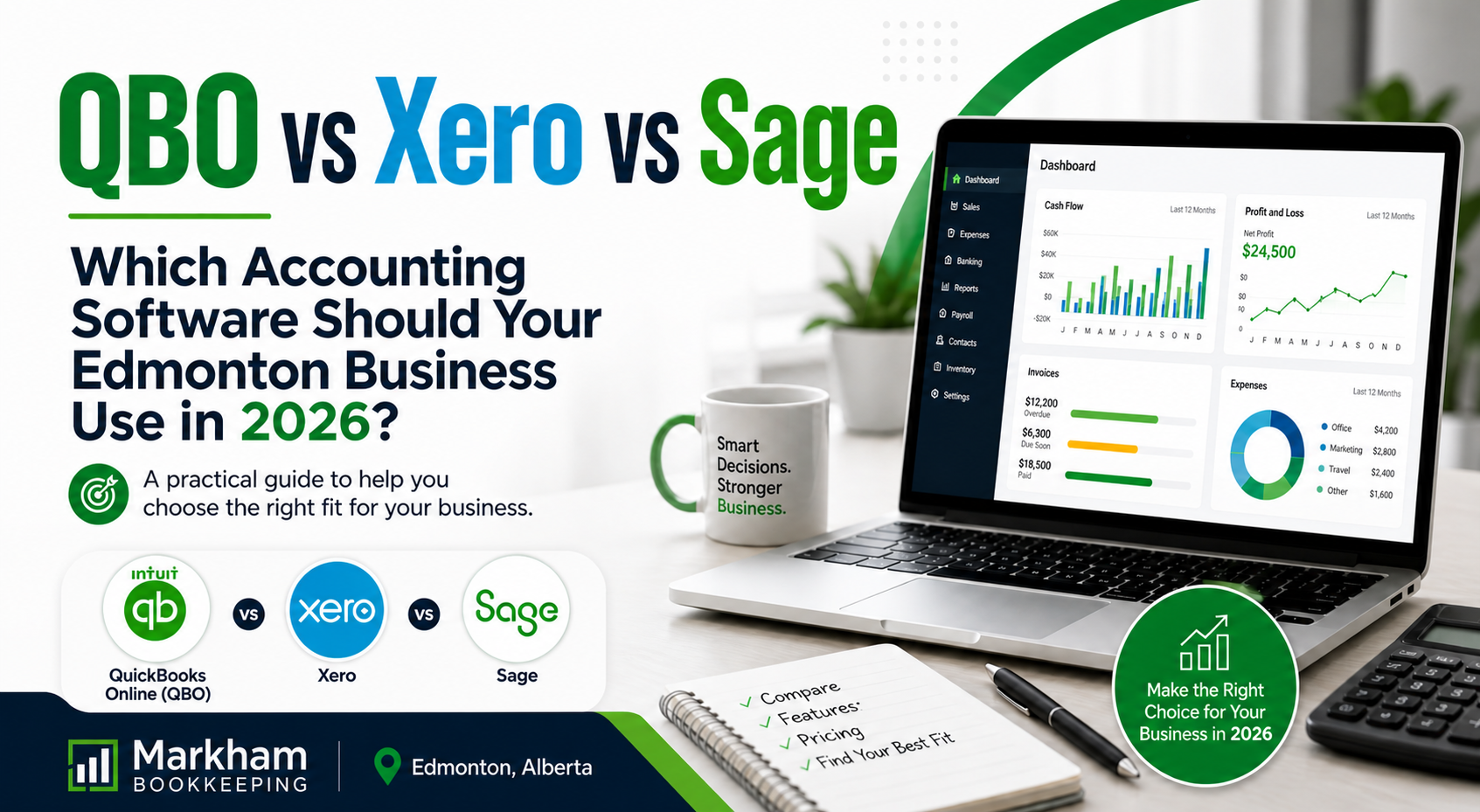
If you’re an Edmonton small business owner looking for accounting software, chances are you’ve already heard three names come up again and again: QuickBooks Online (QBO), Xero, and Sage. And there’s a good reason for that. These three platforms dominate the Canadian small business accounting landscape, and each one has earned its place at the top for legitimate reasons.
Before we dive into the comparison, it’s worth acknowledging something we see in practice at Markham Bookkeeping: there are other options out there. QuickBooks Desktop (QBD) and Sage 300, for example, are platforms we’ve encountered with clients — and they’re capable tools in the right hands. However, they’re far less common among small businesses today, and that’s not by accident. Both are desktop-heavy platforms that come with more complexity than most small business owners need or want to manage. They also tend to require more setup, more maintenance, and more technical know-how. Perhaps most telling is that even many service providers and accounting professionals are quietly steering clients away from these platforms as the industry moves decisively toward cloud-based accounting. The flexibility, remote access, and automatic updates that cloud solutions offer are simply hard to argue against in 2025.
That said, it would be unfair not to mention one genuine advantage desktop software still holds: speed. Sage 50’s desktop version, for instance, loads quickly and executes tasks with the kind of snappiness that cloud platforms sometimes struggle to match. If you’ve ever waited a few extra seconds for a cloud-based page to refresh or a report to generate, you know exactly what we mean. It’s a minor frustration for most users, but it’s real — and worth acknowledging honestly.
Now, with that context in place, let’s look at the three platforms that most Edmonton small businesses are actually choosing in 2025.
QuickBooks Online (QBO): The Industry Leader
There’s no getting around it — QuickBooks Online is the most widely adopted accounting software among Canadian small businesses and their bookkeepers. When clients come to us at Markham Bookkeeping, QBO is the platform we encounter most often, and for good reason. The ecosystem around it is enormous: integrations, third-party apps, payroll add-ons, and a massive community of accountants and bookkeepers who know it inside and out.
What QBO does well:
QBO offers a comprehensive feature set that covers invoicing, expense tracking, bank reconciliation, payroll, GST/HST filing, and reporting — essentially everything a small business needs under one roof. Its cloud-based nature means you and your bookkeeper can access your books from anywhere, collaborate in real time, and always be working on the most current version of your data. For Edmonton businesses with remote teams or owners who travel, this matters.
QBO also integrates with a wide range of Canadian banks for automatic transaction feeds, which cuts down on manual data entry significantly. And because it’s the industry standard, finding an accountant or bookkeeper who knows QBO is never a problem.
Where QBO falls short:
Here’s where we’ll be straight with you: QBO is, in our experience, one of the slower cloud-based platforms available. Pages can take a moment to load, reports sometimes lag, and if you’re doing high-volume data entry, those extra seconds add up over the course of a workday. For a business owner just reviewing their books occasionally, this is barely noticeable. For a bookkeeper processing dozens of transactions daily, it’s something you learn to live with.
There’s also a quirk in QBO that causes real workflow headaches: the platform does not allow the same name to be used for both a customer and a supplier. This sounds like a minor technical limitation, but in practice it creates a surprisingly frustrating problem. Businesses that both buy from and sell to the same company — which is more common than you’d think — end up creating workarounds like adding suffixes or slight name variations (think “ABC Supplies – Vendor” vs “ABC Supplies – Customer”) just to keep records straight. It’s an unnecessary complication that adds time and clutter to your books.
Best for: Edmonton businesses that want the most widely supported platform, plan to work closely with an accountant or bookkeeper, and value ecosystem depth over speed.
Pricing: Starts around $22–$35/month CAD for basic plans, scaling up with features and users. However, Intuit keeps changing the pricing and also offers promotional plans from time to time to increase signups.
Xero: The User-Friendly Challenger
If QuickBooks Online is the industry veteran, Xero is the platform that made everyone else rethink what accounting software could feel like. Originally developed in New Zealand and now widely used across Canada, Xero has built a strong following among small business owners and bookkeepers who value a clean, intuitive interface without sacrificing functionality.
What Xero does well:
Xero is, in our honest opinion, the most user-friendly of the three platforms. The interface is clean and well-organized, buttons are prominent and easy to find, and navigating between functions feels natural even for users who aren’t particularly tech-savvy. For a small business owner managing their own books for the first time, Xero has the gentlest learning curve.
What’s impressive is how much Xero packs into that simple interface. This is not a stripped-down platform. Xero offers robust invoicing, bank reconciliation, expense claims, payroll, inventory tracking, project tracking, and an extensive library of third-party integrations. Speaking of integrations — this is arguably where Xero truly shines. Its app marketplace is deep and well-curated, and for businesses that use tools like Shopify, Stripe, Hubdoc, or industry-specific software, Xero’s integrations can dramatically simplify workflows. If you know what you’re doing and build out the right integration stack, Xero can essentially automate large portions of your bookkeeping.
Xero also avoids the customer/supplier naming problem that plagues QBO. The same contact can be both a customer and a supplier in Xero without any workarounds — a small thing that saves real time in practice.
Where Xero falls short:
Like QBO, Xero is cloud-based, so it carries the same inherent limitation of occasional slowness compared to desktop software. It’s generally responsive, but you’re still dependent on your internet connection and server speeds. Xero is also less dominant in Canada compared to QBO, which means finding local bookkeepers and accountants with deep Xero experience can sometimes take a bit more effort — though that gap has closed considerably in recent years.
Best for: Edmonton small businesses that want an intuitive platform with strong integration capabilities, and owners who want to be actively involved in their own bookkeeping without a steep learning curve.
Pricing: Starts around $20–$33/month CAD, comparable to QBO at similar feature levels.
Sage 50: The Reliable Workhorse
Sage 50 occupies a unique position in this comparison because it still offers a desktop version — something QBO and Xero have moved away from entirely. For Edmonton business owners who have used accounting software for years and value the speed and reliability of a locally installed program, Sage 50 is worth serious consideration.
What Sage 50 does well:
Speed is the first thing you notice with Sage 50’s desktop version. It loads quickly, executes tasks without lag, and delivers a snappy, responsive experience that cloud platforms genuinely cannot match. If desktop speed is a priority — whether because of a slow internet connection, high transaction volumes, or simply personal preference — Sage 50 delivers.
Beyond speed, Sage 50 covers all the fundamentals well: invoicing, payroll, inventory, job costing, bank reconciliation, and Canadian tax compliance including GST/HST. It’s a mature, well-developed platform that has been serving Canadian businesses for decades. The Canadian-specific features are strong, and it handles multi-currency and more complex accounting scenarios with relative ease.
Sage 50 also now offers a cloud-connected version that syncs your desktop data to the cloud, giving you some of the remote access benefits of cloud software while retaining the speed of a desktop installation. It’s a middle-ground option that some businesses find ideal.
Where Sage 50 falls short:
Sage 50 is not as intuitive as Xero, and the interface feels more traditional — which some users appreciate and others find dated. It also carries a higher upfront cost in some configurations, and the desktop-first approach means you don’t get the same seamless real-time collaboration with your bookkeeper that QBO or Xero provide out of the box.
As more accounting professionals move toward cloud-first workflows, Sage 50 users may find that fewer bookkeepers are actively promoting or specializing in it — though experienced professionals like those at Markham Bookkeeping are comfortable working across all three platforms.
Best for: Edmonton businesses that prefer desktop speed and reliability, have complex inventory or job costing needs, or operate in areas with unreliable internet connections.
Pricing: Typically sold as an annual subscription; pricing varies by edition and number of users.
Side-by-Side Summary
| Feature | QBO | Xero | Sage 50 |
| Cloud-based | Yes | Yes | Desktop + optional cloud |
| Speed | Slower | Moderate | Fast (desktop) |
| Ease of use | Moderate | Excellent | Moderate |
| Canadian tax support | Strong | Strong | Strong |
| Integrations | Excellent | Excellent | Good |
| Industry adoption in Canada | Highest | Growing | Moderate |
| Customer/supplier flexibility | Limited | Flexible | Flexible |
| Best for | Most small businesses | User-friendly workflows | Desktop speed lovers |
So Which One Should Your Edmonton Business Choose?
Honestly? All three are good choices — and the best one depends on your specific situation.
If you want the most widely supported platform with the largest network of compatible accountants and bookkeepers, QBO is the safe, industry-standard choice. Just be prepared for occasional slowness and a few workflow quirks.
If you want the most user-friendly experience with strong integrations and a clean interface that won’t intimidate you, Xero is worth a serious look — especially if you plan to be hands-on with your own books.
If you value desktop speed, have more complex accounting needs, or simply prefer a locally installed program with optional cloud connectivity, Sage 50 remains a solid and underrated option.
Let Markham Bookkeeping Help You Decide
Choosing accounting software is one decision — setting it up correctly, keeping it clean, and making sure it works for your specific business is another. At Markham Bookkeeping, we work with Edmonton small business owners across all three platforms. Whether you need help choosing, setting up, or maintaining your books, we’re here to make it simple.
📍 Serving Edmonton and surrounding areas 📱 Available on WhatsApp 🗣️ Services available in English, Punjabi, and Urdu
Reach out today — your first conversation is always free.
Markham Bookkeeping | Edmonton’s trusted small business bookkeeping and tax service