Many business owners do not lose financial control all at once.
It usually happens gradually.
A few receipts are left unrecorded. Bank transactions remain uncategorized. Reconciliations are postponed because the business owner is busy serving customers, managing employees, handling suppliers, and trying to grow revenue.
Before long, the accounting software no longer reflects what is really happening in the business.
The bank balance may be visible, but profitability is unclear. Sales may be increasing, but cash continues to feel tight. Tax deadlines become stressful because the bookkeeping is not ready.
This is where the Financial Control Ladder can help.
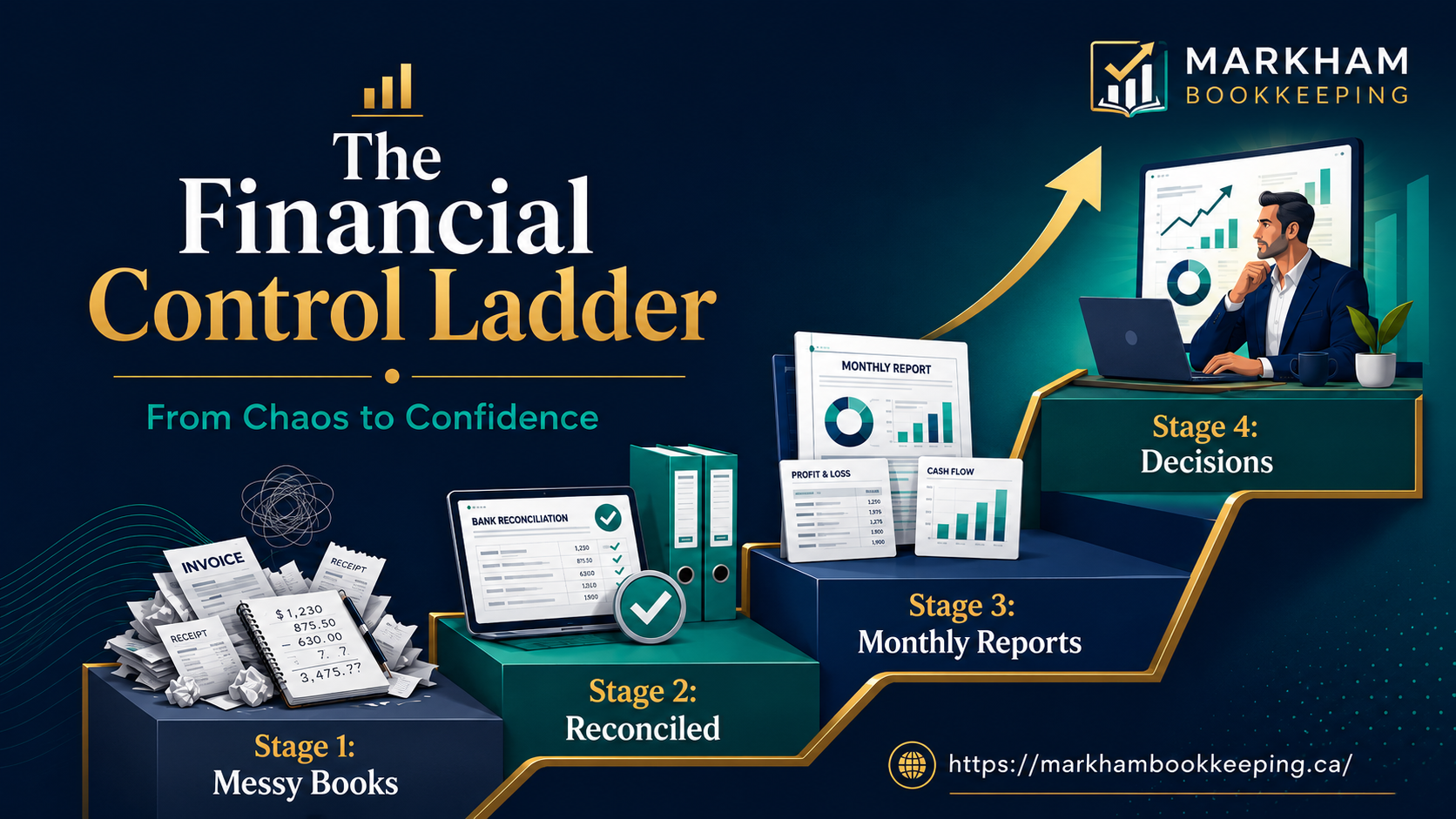
The Financial Control Ladder is a simple four-stage framework that shows how a business moves from disorganized financial records to confident, informed decision-making:
- Messy books
- Reconciled books
- Monthly financial reports
- Better business decisions
Each stage builds on the one before it. A business cannot rely on its financial reports until its accounts have been reconciled. It cannot make strong financial decisions when the reports are incomplete or inaccurate.
For small businesses in Edmonton, climbing this ladder can mean the difference between constantly reacting to financial problems and managing the business with confidence.
Stage 1: Messy Books
The first stage of the Financial Control Ladder is financial disorder.
Messy books do not necessarily mean the business is unsuccessful. In fact, bookkeeping problems often appear when a company is growing quickly and the owner no longer has enough time to manage every transaction personally.
Common signs of messy books include:
- Large numbers of uncategorized bank transactions
- Missing supplier invoices and receipts
- Duplicate expenses
- Personal purchases mixed with business expenses
- Customer payments that have not been matched to invoices
- Old unpaid invoices that may already have been collected
- Negative bank or credit card balances that do not make sense
- GST amounts recorded incorrectly
- Payroll liabilities that do not match CRA records
- Accounts that have not been reconciled for several months
At this stage, the business owner may still be able to see how much money is in the bank. However, the bank balance does not provide a complete picture of the company’s financial health.
For example, a business may have $70,000 in its bank account but also have $40,000 in upcoming supplier payments, $15,000 in payroll obligations, and a GST remittance approaching its deadline.
Without organized books, the available cash may appear stronger than it really is.
Messy bookkeeping can also create problems during tax preparation, financing applications, CRA reviews, audits, business sales, or investor discussions. The business may need to spend significant time reconstructing information that should already have been available.
An Edmonton bookkeeping cleanup often begins by identifying the last accurately completed month and working forward from that point. Bank statements, credit card statements, invoices, receipts, payroll reports, loan statements, and government account balances may all need to be reviewed.
The purpose of the cleanup is not simply to make the accounting software look tidy. It is to create a reliable financial foundation.
Stage 2: Reconciled Books
Once the missing information has been entered and obvious errors have been corrected, the business can move to the second stage: reconciliation.
A bank reconciliation compares the transactions recorded in the accounting system with the transactions appearing on the bank statement.
The same process should normally be completed for business credit cards, lines of credit, loans, payment processors, and other important financial accounts.
The goal is to confirm that:
- Transactions have not been missed
- Expenses have not been entered twice
- Deposits have been recorded properly
- Bank fees and interest charges are included
- Customer payments have been matched correctly
- Outstanding cheques or deposits are legitimate
- The accounting balance agrees with the financial institution’s records
Reconciliation is one of the most important controls in bookkeeping because it tests whether the accounting records are complete.
A profit and loss statement may look professional, but it cannot be trusted if the bank account has not been reconciled.
For example, suppose an Edmonton contractor records $25,000 in customer revenue but accidentally enters one deposit twice. The profit and loss statement would overstate revenue by $25,000.
Alternatively, a supplier payment may appear in the bank account but remain unrecorded in the bookkeeping system. In that situation, expenses would be understated and profit would appear higher than it really is.
Regular reconciliation helps identify these problems before they affect tax filings or business decisions.
For many Edmonton small businesses, monthly reconciliation is an appropriate minimum. Businesses with higher transaction volumes, multiple bank accounts, frequent payroll, inventory activity, or significant accounts receivable may need more frequent bookkeeping reviews.
Reconciled books provide something every business owner needs: a dependable starting point.
However, reconciliation alone is not the final goal. It confirms that the transactions are present, but the owner must still understand what those transactions mean.
That leads to the third stage.
Stage 3: Monthly Financial Reports
Once the books are accurate and reconciled, the business can begin producing meaningful monthly financial reports.
The three reports most small-business owners should understand are:
Profit and Loss Statement
The profit and loss statement, also called the income statement, shows revenue, cost of sales, operating expenses, and profit over a specific period.
It helps answer questions such as:
- Did the business make a profit this month?
- Is revenue increasing or declining?
- Which expenses are growing?
- Is gross profit strong enough?
- Are payroll costs sustainable?
- Is the business becoming more or less profitable?
The profit and loss statement should not be reviewed as an isolated document. Comparing the current month with prior months, the same month last year, or the company’s budget provides much more useful information.
Balance Sheet
The balance sheet shows what the business owns, what it owes, and the owner’s accumulated equity at a specific date.
It may include:
- Bank balances
- Accounts receivable
- Inventory
- Prepaid expenses
- Equipment and vehicles
- Credit card balances
- Accounts payable
- Payroll liabilities
- GST payable or receivable
- Business loans
- Shareholder or owner balances
A balance sheet can reveal risks that may not be obvious from the profit and loss statement.
For example, the business may be profitable while carrying a large amount of unpaid customer invoices. It may also have significant debt payments or tax obligations approaching in the next few months.
Cash Flow Reporting
Profit and cash flow are connected, but they are not the same.
A company can show an accounting profit while experiencing cash shortages. This may happen when customers have not paid their invoices, inventory purchases have increased, loan principal is being repaid, or large expenses were paid in advance.
Monthly cash flow reporting helps the owner understand where money came from, where it went, and whether current cash levels are sufficient for upcoming obligations.
When Edmonton businesses receive consistent monthly financial reports, they no longer need to depend solely on the bank balance or intuition.
They can see financial trends before those trends become emergencies.
Stage 4: Better Business Decisions
The final stage of the Financial Control Ladder is decision-making.
This is where bookkeeping becomes more than a compliance obligation.
Accurate financial information can help an Edmonton business owner decide:
- Whether the company can afford to hire another employee
- Whether prices need to be increased
- Which services or products are most profitable
- Whether certain expenses should be reduced
- Whether a major equipment purchase is affordable
- Whether a customer’s payment terms should be changed
- Whether expansion should happen now or later
- How much cash should be reserved for taxes
- Whether the business should seek financing
- Whether the owner can safely withdraw additional funds
Imagine a business owner considering the addition of a new full-time employee.
Without reliable reports, the decision might be based on one strong sales month or the current bank balance.
With accurate monthly financial statements, the owner can review revenue trends, gross margins, payroll costs, seasonal slowdowns, cash reserves, receivables, and upcoming tax obligations before making the commitment.
That does not eliminate all business risk. It makes the risk visible and manageable.
Financial confidence does not mean knowing exactly what will happen in the future. It means having enough accurate information to make a reasonable decision.
Why Businesses Get Stuck on the Financial Control Ladder
Many businesses remain at Stage 1 or Stage 2 because bookkeeping is treated as a year-end task.
Transactions are recorded only when a tax filing is approaching. Reports are prepared after the period is already over. By the time the owner discovers a problem, there may be limited opportunity to correct it.
Other businesses reach Stage 3 but fail to use the information.
They receive monthly reports but do not review them, ask questions, compare results, or use the numbers when making decisions.
A financial report creates value only when it leads to understanding and action.
The most effective bookkeeping process therefore includes three components:
- Accurate transaction recording
- Timely account reconciliation
- Regular financial review
Removing any one of these components weakens the entire system.
How to Move From Messy Books to Financial Confidence
The journey does not need to happen overnight.
A practical process may include:
Step 1: Complete a Bookkeeping Assessment
Determine which accounts are behind, whether prior periods were reconciled, which balances appear incorrect, and whether required documents are available.
Step 2: Clean Up Historical Transactions
Correct duplicates, record missing transactions, review uncategorized activity, separate personal expenses, and fix inaccurate opening balances.
Step 3: Reconcile Every Important Account
Reconcile bank accounts, credit cards, loans, lines of credit, payroll balances, payment processors, and other significant accounts.
Step 4: Establish a Monthly Closing Process
Set a consistent deadline for entering transactions, obtaining missing documents, reconciling accounts, reviewing receivables, checking payables, and preparing reports.
Step 5: Review the Numbers
Compare actual performance with prior periods, budgets, revenue targets, and expected cash requirements.
Step 6: Turn the Reports Into Decisions
Identify one or two actions that should be taken based on the latest financial information.
That action might involve following up on overdue invoices, adjusting prices, reducing an unnecessary expense, reserving money for GST, or delaying a purchase until cash flow improves.
The Role of an Edmonton Bookkeeper
A professional Edmonton bookkeeper can help a business climb the Financial Control Ladder by creating a repeatable monthly system.
This may include:
- Recording and categorizing transactions
- Reconciling bank and credit card accounts
- Managing accounts payable and receivable
- Reviewing payroll and GST balances
- Preparing monthly financial reports
- Identifying unusual transactions or changing trends
- Keeping the books organized for tax preparation
- Helping the owner understand the financial results
The purpose is not to overwhelm the owner with accounting terminology.
The purpose is to turn financial data into useful business information.
A business owner should be able to look at the monthly reports and understand whether the company is profitable, whether cash flow is stable, what obligations are approaching, and where attention is required.
From Chaos to Confidence
Financial control is not created by one report, one software subscription, or one bookkeeping cleanup.
It is built through a consistent process.
Messy books are cleaned up.
Clean books are reconciled.
Reconciled information becomes monthly financial reports.
Monthly reports support better business decisions.
That is the Financial Control Ladder.
For Edmonton small businesses, moving through these four stages can reduce financial uncertainty, improve CRA readiness, strengthen cash flow management, and provide the confidence needed to plan for growth.
The goal is not perfect bookkeeping for its own sake.
The goal is knowing where the business stands—and using that knowledge to decide where it should go next.
Need Help Organizing Your Business Finances?
Markham Bookkeeping provides bookkeeping, payroll, account reconciliation, financial reporting, and GST support for small businesses in Edmonton and across Canada.
Whether your books are several months behind or you need a reliable monthly bookkeeping process, professional support can help you move from financial chaos to control, clarity, and confidence.