
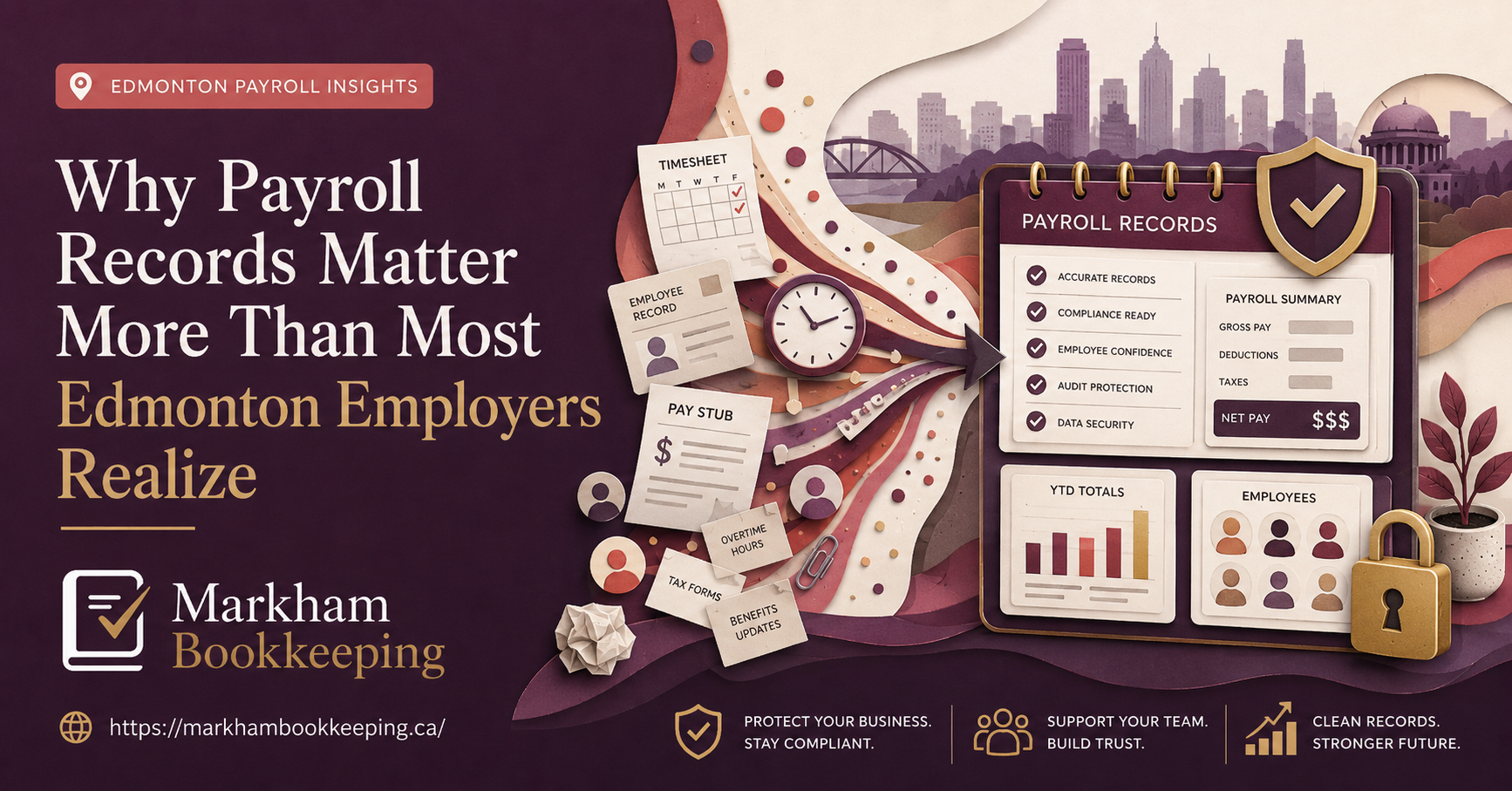
Payroll is often viewed as a simple payment process: calculate employee hours, deduct taxes, issue direct deposits, and provide pay statements.
However, payroll involves much more than paying employees.
Every payroll run creates financial, employment, and tax records that may be needed long after the payment has been processed. These records support source deductions, year-end reporting, vacation calculations, benefit deductions, employment standards compliance, Records of Employment, and responses to employee questions.
For Edmonton employers, maintaining accurate payroll records is an important part of bookkeeping, accounting, and business risk management.
A payroll deposit may take only a few minutes to process, but the records behind it can affect the business for years.
Payroll Records Explain How Every Payment Was Calculated
Employees need to know how their pay was determined.
A complete payroll record should clearly support items such as:
- Regular hours
- Overtime hours
- Hourly wages or salary
- Bonuses and commissions
- Vacation pay
- Statutory holiday pay
- Taxable benefits
- Expense reimbursements
- CPP contributions
- EI premiums
- Income tax deductions
- Benefit or pension deductions
- Net pay
Without detailed records, it may be difficult to explain why an employee received a particular amount.
For example, an employee may question why one paycheque was lower than the previous one. The difference could relate to fewer hours, unpaid leave, a benefit deduction, additional tax withholding, a payroll correction, or the timing of a bonus.
Timesheets Are Financial Documents
Timesheets are not merely internal scheduling tools. They provide support for payroll expenses recorded in the accounting system.
For hourly employees, timesheets may show:
- The days worked
- Start and finish times
- Breaks
- Regular hours
- Overtime
- Vacation time
- Sick time
- Approved adjustments
These details are particularly important for Edmonton businesses in construction, hospitality, retail, healthcare, transportation, security, and other industries with hourly or shift-based employees.
When timesheets are incomplete or not approved, payroll may be based on assumptions. That can lead to overpayments, underpayments, incorrect overtime, and disputes.
A strong payroll process should include a clear approval system. Supervisors should review employee hours before payroll is finalized, and changes should be documented.
This protects both the employee and the employer.
Payroll Records Support Source Deduction Remittances
Employers are responsible for deducting and remitting required amounts from employee pay.
Payroll records help support the calculation of:
- Employee CPP contributions
- Employer CPP contributions
- Employee EI premiums
- Employer EI premiums
- Income tax withheld
- Other payroll-related amounts
The payroll register should agree with the amounts recorded in the accounting system and the amounts remitted.
If these figures do not match, the business may need to determine whether an employee deduction was missed, an employer contribution was recorded incorrectly, a payment was applied to the wrong period, or a payroll entry was duplicated.
Regular payroll reconciliation is an important component of bookkeeping for Edmonton employers.
It is much easier to investigate a difference immediately after a payroll run than several months later when year-end slips are being prepared.
Accurate Records Make T4 Preparation Easier
At the end of the calendar year, employers generally rely on accumulated payroll records to prepare employee tax slips and summaries.
If payroll has been processed accurately throughout the year, year-end reporting becomes more manageable.
However, problems can arise when:
- Employees were paid outside the payroll system
- Taxable benefits were not recorded
- Manual cheques were omitted
- Payroll adjustments were not documented
- Vacation pay was calculated inconsistently
- Employee information was incomplete
- Payroll liabilities were not reconciled
- Payments were recorded in the wrong period
These issues may require corrections before T4 slips can be finalized.
Year-end payroll should not be the first time the business checks whether its payroll records agree with the general ledger. Monthly or quarterly reconciliation can identify differences much earlier.
An Edmonton payroll service or bookkeeper can compare payroll reports, accounting entries, and remittance records to help keep the information consistent.
Payroll Records Help Resolve Employee Disputes
Payroll disagreements can occur even in well-managed businesses.
An employee may believe that overtime was missed, vacation pay was calculated incorrectly, a deduction was unauthorized, or a bonus was not included.
The employer’s ability to respond depends on the quality of its records.
A complete payroll file may include:
- Employment agreements
- Wage-rate approvals
- Timesheets
- Payroll registers
- Pay statements
- Vacation records
- Bonus authorizations
- Deduction authorizations
- Direct deposit reports
- Records of payroll corrections
- Emails approving changes
These records provide a timeline showing what was approved, calculated, and paid.
Without supporting documents, the issue may become one person’s recollection against another’s.
Documented processes create accountability and reduce confusion.
Records Protect Against Unauthorized Payroll Changes
Not every payroll error is accidental.
Unauthorized rate increases, false overtime, duplicate payments, unapproved bonuses, and payments to inactive employees can occur when payroll controls are weak.
Small businesses may be especially vulnerable because one person may have access to employee information, time records, payroll processing, and bank payments.
Effective payroll controls can include:
- Written approval for wage-rate changes
- Supervisor approval of hours
- Restricted access to payroll software
- Review of new employees added to payroll
- Comparison of the payroll register with the employee list
- Separate authorization of payroll payments
- Review of unusual bonuses or overtime
- Removal of former employees from active payroll
Payroll records make these controls visible.
For example, if an employee’s hourly rate changes, the payroll file should include clear authorization. If overtime increases significantly, the employer should be able to compare the hours with schedules, timesheets, and project activity.
For Edmonton companies with growing payroll, these reviews become increasingly important.
Payroll Information Affects Job Costing and Profitability
Payroll records are not useful only for compliance. They also help management understand labour costs.
For a contractor, labour may need to be assigned to specific jobs. For a nonprofit, wages may need to be divided among programs. For a restaurant, the owner may compare labour costs with daily or weekly sales. For a professional firm, payroll may be analyzed by department or service line.
Accurate payroll allocation helps answer questions such as:
- Which projects are profitable?
- Is overtime reducing the margin?
- Are staffing levels appropriate?
- How much does each department cost?
- Are labour costs increasing faster than revenue?
- Is a contract priced high enough to cover wages and payroll costs?
If payroll is recorded as one large monthly expense without further analysis, business owners may miss valuable information.
Detailed payroll records allow Edmonton businesses to connect employee costs with operational performance.
Payroll Must Agree With the General Ledger
Payroll software and accounting software serve different purposes, but their totals should agree.
The payroll system may show gross wages, deductions, employer contributions, benefits, and net pay. The accounting system should reflect the same activity through payroll expense and liability accounts.
Differences can occur when:
- A payroll journal entry is not posted
- An entry is duplicated
- Net pay is recorded as gross pay
- Employer contributions are omitted
- A payroll remittance is posted entirely to expense
- Vacation payable is not recorded correctly
- Payroll liabilities are cleared against the wrong account
A monthly payroll reconciliation compares the payroll register with the general ledger and relevant bank transactions.
This helps ensure that wage expenses and payroll liabilities are presented accurately in the financial statements.
Good Records Make Records of Employment More Reliable
When an employee experiences an interruption of earnings or leaves the organization, payroll information may be needed to prepare a Record of Employment.
Accurate pay-period information helps ensure that insurable earnings and hours are properly reported.
If hours, earnings, or employment dates were not maintained correctly, preparing the record can become more difficult. The employer may need to reconstruct information from schedules, bank payments, pay statements, and emails.
A well-maintained payroll system reduces this risk because the necessary information is already organized by employee and pay period.
Employee Information Must Be Maintained Carefully
Payroll records contain sensitive information.
They may include Social Insurance Numbers, addresses, banking information, wage rates, tax forms, benefit information, and employment history.
Businesses should limit access to employees who genuinely require the information. Payroll files should be stored securely, and documents should not be left in shared folders or sent unnecessarily through unsecured channels.
Former employees should also be removed from active payroll access lists, while required records should remain properly retained.
Payroll confidentiality is not only an information-technology issue. It is part of responsible financial administration.
Build a Payroll Process, Not Just a Payday Routine
A reliable payroll process begins before employees are paid and continues after the deposits are issued.
Before payroll, the employer should collect and approve hours, employee changes, vacation requests, bonuses, and deductions.
During payroll, calculations should be reviewed for unusual amounts.
After payroll, reports should be saved, payments should be confirmed, and payroll liabilities should be reconciled with the accounting records.
This creates an audit trail showing what happened from the original timesheet to the final bank payment.
For a growing Edmonton business, this process can prevent payroll from becoming dependent on one person’s memory or private spreadsheet.
Payroll Records Create Long-Term Business Protection
Payroll records are more than evidence that employees were paid. They support tax reporting, remittances, employee communication, financial statements, job costing, employment records, and internal controls.
When records are incomplete, every payroll question becomes harder to answer.
When records are accurate and organized, the business can explain its calculations, identify mistakes, reconcile liabilities, prepare year-end reporting, and respond to employee concerns with confidence.
Markham Bookkeeping provides payroll support, payroll reconciliation, bookkeeping, and financial reporting services for Edmonton and Alberta businesses. A dependable payroll process can help employers move beyond simply issuing payments and build a stronger system for financial control.