
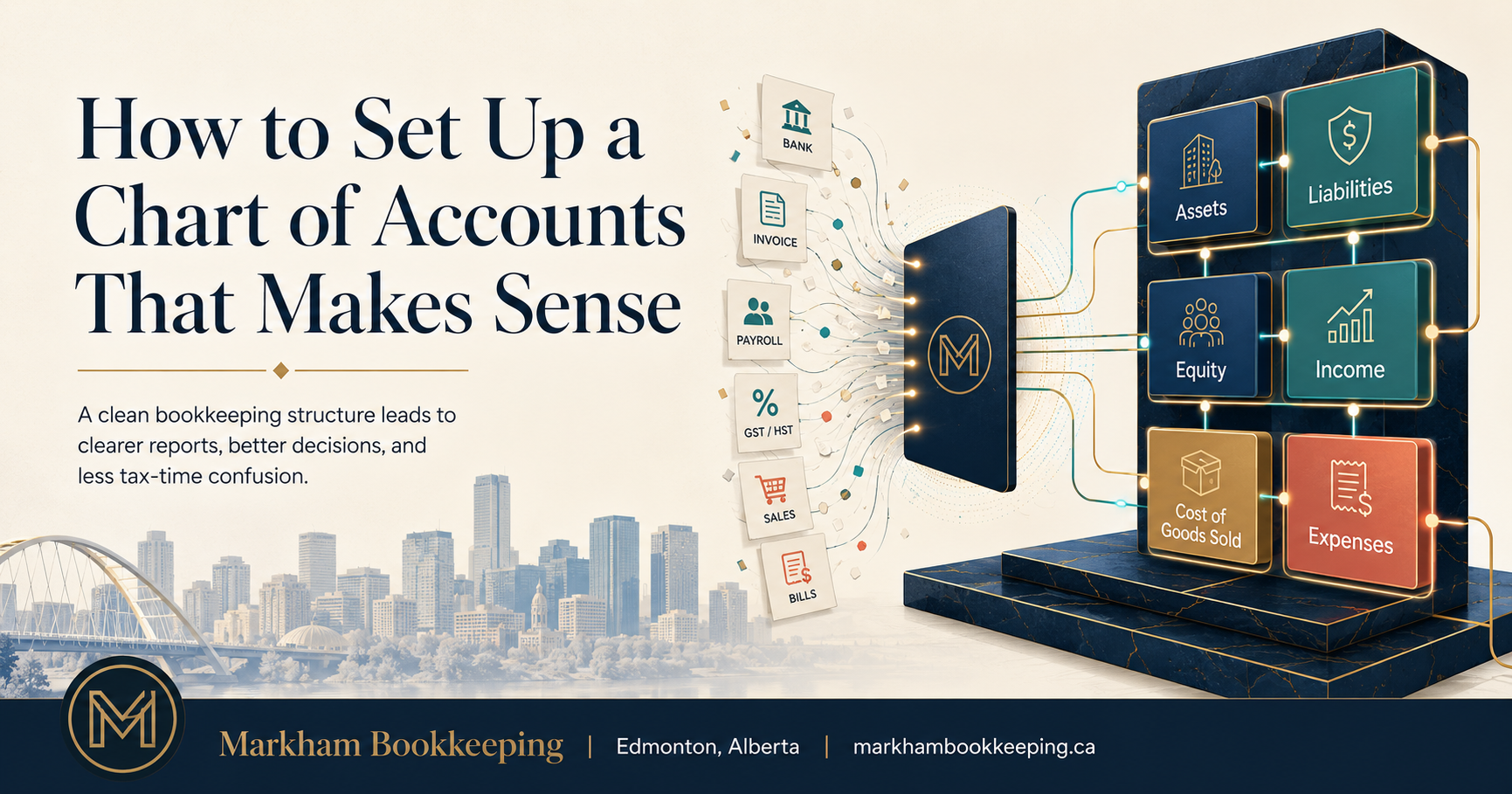
A chart of accounts is the foundation of your bookkeeping system.
If the chart of accounts is clean, your financial reports are easier to understand. If it is messy, your bookkeeping becomes confusing, your reports become harder to read, and tax time becomes more stressful.
Many small business owners think accounting software will automatically organize everything for them. But software like QuickBooks Online, Sage, Xero, or Wave can only work properly if the structure behind the books makes sense. That structure starts with the chart of accounts.
For Edmonton small businesses, a well-designed chart of accounts can help track income, expenses, assets, liabilities, GST/HST, payroll, loans, inventory, and owner transactions properly. It can also help business owners understand profit, cash flow, and business performance without getting lost in unnecessary details.
This guide explains how to set up a chart of accounts that makes sense for your business.
What Is a Chart of Accounts?
A chart of accounts is the list of categories used in your accounting system. Every transaction in the business is posted somewhere in the chart of accounts.
For example, when your business receives money from a customer, it may be recorded under sales income. When you pay rent, it may be recorded under rent expense. When you buy equipment, it may be recorded as an asset. When you collect GST/HST, it may be recorded as a tax liability.
The chart of accounts organizes your business activity into major sections, usually including:
Assets
Liabilities
Equity
Income
Cost of goods sold
Expenses
Other income
Other expenses
These categories help create financial reports like the balance sheet and income statement.
A good chart of accounts should help you answer simple but important questions:
How much money does the business have?
How much does the business owe?
How much revenue did the business earn?
What did the business spend money on?
Which costs are directly tied to sales?
How much profit did the business actually make?
Are owner draws, shareholder loans, payroll, GST/HST, and taxes recorded correctly?
If your chart of accounts cannot help answer these questions clearly, it may need to be cleaned up.
Why the Chart of Accounts Matters
The chart of accounts affects almost every part of bookkeeping.
If accounts are too broad, the reports do not give enough detail. If accounts are too detailed, the reports become overwhelming. The goal is to find the right balance.
For example, if every expense is posted to “general expenses,” the business owner cannot see what is really happening. Rent, software, meals, advertising, fuel, office supplies, and bank fees all get mixed together.
On the other hand, if a small business creates separate accounts for every tiny expense, the reports become too long and difficult to review. A small Edmonton business does not need a chart of accounts with hundreds of unnecessary categories unless there is a clear reporting reason.
The chart of accounts should be simple enough to maintain but detailed enough to support good decisions.
Start With the Main Account Types
Before creating individual accounts, it helps to understand the main account types.
Assets
Assets are things the business owns or controls. Common asset accounts include:
Bank accounts
Credit card clearing accounts
Accounts receivable
Inventory
Prepaid expenses
Equipment
Vehicles
Leasehold improvements
Computer equipment
Assets usually appear on the balance sheet.
For example, if an Edmonton retail store has unsold products on hand, those products may be recorded as inventory. If a contractor buys a vehicle for the business, that vehicle may be recorded as a fixed asset rather than a regular expense.
Liabilities
Liabilities are amounts the business owes. Common liability accounts include:
Credit cards payable
Accounts payable
GST/HST payable
Payroll deductions payable
Loans payable
Line of credit
Wages payable
Corporate tax payable
Liabilities are important because they show obligations that must be paid later. If GST/HST collected from customers is not separated properly, the business owner may accidentally treat that money like income. That can create problems when the GST/HST filing deadline arrives.
Equity
Equity shows the owner’s interest in the business. Common equity accounts include:
Owner contributions
Owner draws
Shareholder contributions
Shareholder loans
Retained earnings
Opening balance equity
This section is often messy in small business bookkeeping. Owner draws, personal expenses, shareholder loans, and business reimbursements can easily get mixed up if the chart of accounts is not set up properly.
For incorporated businesses, shareholder loan tracking is especially important. For sole proprietors, owner contributions and drawings should be recorded clearly.
Income
Income accounts show money earned from business activity. Examples include:
Sales revenue
Service income
Product sales
Consulting income
Online sales
Rental income
Commission income
Grant income
A business may need one income account or several, depending on how it operates.
For example, a Shopify seller may want to separate product sales, shipping income, discounts, and marketplace sales. A consultant may only need service revenue. A nonprofit may need to track grants, donations, program revenue, and fundraising income separately.
Cost of Goods Sold
Cost of goods sold, often called COGS, includes direct costs tied to products or services sold.
For product-based businesses, this may include:
Product purchases
Inventory costs
Packaging directly tied to products
Shipping-in or freight-in
Merchant fulfilment costs
Direct materials
For contractors, cost of goods sold may include:
Materials
Subcontractors
Job supplies
Direct labour
Equipment rental for jobs
Separating cost of goods sold from regular operating expenses is important because it helps calculate gross profit.
Gross profit shows how much money is left after direct costs. Without proper COGS tracking, the business owner may not know whether pricing is actually working.
Expenses
Expenses are regular operating costs needed to run the business. Common expense accounts include:
Rent
Utilities
Insurance
Advertising and marketing
Meals and entertainment
Office supplies
Software subscriptions
Professional fees
Bank charges
Vehicle expenses
Repairs and maintenance
Telephone and internet
Payroll expenses
Training and education
These accounts appear on the income statement and help show how much it costs to operate the business.
Keep the Chart of Accounts Simple
A good chart of accounts should be useful, not complicated.
One common mistake is creating too many accounts. For example, a business may create separate accounts for every software subscription: QuickBooks, Canva, Microsoft, Google, Adobe, Zoom, Shopify apps, and email software.
In most cases, these can simply be recorded under “Software and subscriptions.” If the owner wants more detail, the details can often be reviewed through vendor reports instead of creating too many accounts.
Another example is office expenses. A small business may not need separate accounts for paper, pens, printer ink, envelopes, binders, and desk supplies. One office supplies account may be enough.
Too many accounts create problems because transactions get categorized inconsistently. One month an expense may go to “office supplies,” the next month to “printing,” and the next month to “stationery.” The reports become harder to trust.
But Do Not Make It Too Broad
The opposite problem is making the chart of accounts too broad.
If everything goes to “miscellaneous expense,” the reports become useless. Business owners should avoid relying on vague accounts such as:
Miscellaneous
General expenses
Other expenses
Uncategorized expense
Ask my accountant
These accounts may be useful temporarily during cleanup, but they should not become permanent dumping grounds.
For Edmonton small business bookkeeping, the goal is to create categories that help the owner understand the business. A report should show meaningful information, not a long list of confusing or vague accounts.
Match the Chart of Accounts to the Business
There is no perfect chart of accounts for every business. The best setup depends on the industry and how the owner wants to review the numbers.
A retail business may need accounts for inventory, cost of goods sold, merchant fees, shipping, discounts, and returns.
A contractor may need accounts for materials, subcontractors, tools, vehicle expenses, job deposits, and equipment rentals.
An e-commerce business may need accounts for Shopify sales, Amazon sales, platform fees, shipping, inventory, advertising, refunds, chargebacks, and software.
A nonprofit may need accounts for grants, donations, program expenses, fundraising, restricted funds, departments, and administrative costs.
A professional service business may need accounts for service revenue, subcontractors, software, professional development, travel, meals, and office expenses.
The chart of accounts should reflect how the business actually works.
Use Classes, Locations, Projects, or Departments When Needed
Sometimes business owners create too many accounts because they are trying to track different parts of the business.
For example, a business with three locations may create separate rent accounts for each location. A nonprofit may create separate expense accounts for every program. A contractor may create separate accounts for every job.
This can make the chart of accounts too large.
In many accounting systems, it may be better to use classes, locations, projects, departments, or tracking categories instead of creating too many accounts.
For example:
Use accounts to track what the money was spent on.
Use classes or locations to track where it was spent.
Use projects or jobs to track which job it belongs to.
Use departments or programs to track internal reporting.
This keeps the chart of accounts cleaner while still allowing useful reporting.
For Edmonton nonprofits, contractors, and multi-location businesses, this structure can be very important. A clean chart of accounts combined with departments or projects can create better reports without overwhelming the bookkeeping system.
Separate Business and Personal Transactions
A chart of accounts cannot fix mixed business and personal spending by itself, but it can help identify and track it properly.
If personal expenses are paid from a business account, they should not be treated like business expenses. They may need to be recorded as owner draws, shareholder loan amounts, or reimbursements, depending on the business structure.
This is important because personal expenses can distort profit and create tax issues.
A clean chart of accounts should include proper accounts for owner draws, shareholder loans, or due to/from shareholder balances when needed.
Set Up GST/HST Accounts Properly
For Canadian businesses, GST/HST tracking is a major reason to set up the chart of accounts properly.
GST/HST collected from customers is not income. It is a liability until it is filed and paid to the CRA.
GST/HST paid on eligible business purchases may be tracked as an input tax credit.
Accounting software can help calculate GST/HST, but only if transactions are coded correctly. If tax codes are wrong or GST/HST is posted to regular income and expense accounts incorrectly, the return may be inaccurate.
For Edmonton businesses registered for GST, proper setup can help avoid confusion at filing time.
Avoid Duplicate and Similar Accounts
Duplicate accounts are a common issue in messy bookkeeping files.
For example, a business may have:
Meals
Meals and entertainment
Food
Restaurant expenses
Staff meals
Or:
Advertising
Marketing
Promotion
Online ads
Social media ads
Some detail is useful, but too many overlapping accounts create confusion.
A good cleanup step is to review the chart of accounts and merge or deactivate accounts that are not needed. The goal is consistency.
Review the Chart of Accounts Before Year-End
A chart of accounts should not be ignored after setup. It should be reviewed from time to time, especially before year-end.
Before tax season, business owners and bookkeepers should review:
Uncategorized transactions
Miscellaneous expenses
Negative balances
Duplicate accounts
Old inactive accounts
Personal expenses
GST/HST balances
Loan balances
Payroll liability accounts
Accounts receivable
Accounts payable
Inventory
Owner draws or shareholder loans
This review can catch problems before the accountant starts preparing year-end financial statements or tax returns.
A messy chart of accounts can delay tax filing and increase cleanup work.
Signs Your Chart of Accounts Needs Cleanup
Your chart of accounts may need cleanup if:
Reports are too long and hard to read.
You have several accounts that mean the same thing.
Many transactions sit in uncategorized expense.
You do not know where to post certain transactions.
GST/HST balances do not make sense.
Loan balances do not match statements.
Owner draws or shareholder loans are unclear.
Income categories do not match how the business earns money.
Expenses are posted inconsistently.
Your accountant keeps asking questions about account categories.
If these signs sound familiar, the issue may not just be bookkeeping entries. The structure itself may need improvement.
How Markham Bookkeeping Can Help
Markham Bookkeeping helps Edmonton small businesses clean up their books, organize their chart of accounts, and build bookkeeping systems that make sense.
A good chart of accounts should help the business owner understand the numbers. It should support clean GST/HST filing, proper tax preparation, meaningful financial reports, and better business decisions.
Whether your business uses QuickBooks Online, Sage, Xero, Wave, or another accounting system, the chart of accounts should match how your business operates.
If your reports are confusing, your expense categories are messy, or your books have too many unnecessary accounts, Markham Bookkeeping can help review and organize your system.
Clean structure leads to cleaner books.
Final Thoughts
A chart of accounts is more than a list of categories. It is the structure behind your bookkeeping.
When it is set up properly, financial reports become easier to understand. Business owners can see revenue, expenses, profit, cash flow, taxes, loans, and owner transactions more clearly.
When it is set up poorly, even good accounting software can produce confusing reports.
For Edmonton small businesses, the best chart of accounts is simple, consistent, and designed around the way the business actually operates. It should not be too broad, too detailed, or filled with duplicate accounts.
The goal is not to create a perfect-looking list. The goal is to create a system that helps you understand your business.
FAQ
What is a chart of accounts?
A chart of accounts is the list of categories used in accounting software to organize business transactions. It includes assets, liabilities, equity, income, cost of goods sold, and expenses.
Why is the chart of accounts important?
The chart of accounts is important because it controls how transactions appear on financial reports. A clean chart of accounts makes bookkeeping, tax preparation, GST/HST filing, and business reporting easier.
How many accounts should a small business have?
There is no exact number. A small business should have enough accounts to understand income and expenses clearly, but not so many that reports become confusing. Simplicity and consistency are more important than having too many categories.
Should every expense have its own account?
No. Creating a separate account for every small expense can make reports messy. Similar expenses can often be grouped together, such as software subscriptions, office supplies, or vehicle expenses.
What is the difference between expenses and cost of goods sold?
Cost of goods sold includes direct costs tied to products or services sold. Expenses are general operating costs such as rent, insurance, software, and office supplies. Separating them helps calculate gross profit.
Should GST/HST be included in income?
No. GST/HST collected from customers is not business income. It should be tracked separately as a liability until it is filed and paid to the CRA.
Can Markham Bookkeeping help clean up a chart of accounts?
Yes. Markham Bookkeeping helps Edmonton small businesses clean up messy bookkeeping files, organize chart of accounts, track GST/HST properly, and create more useful financial reports.