
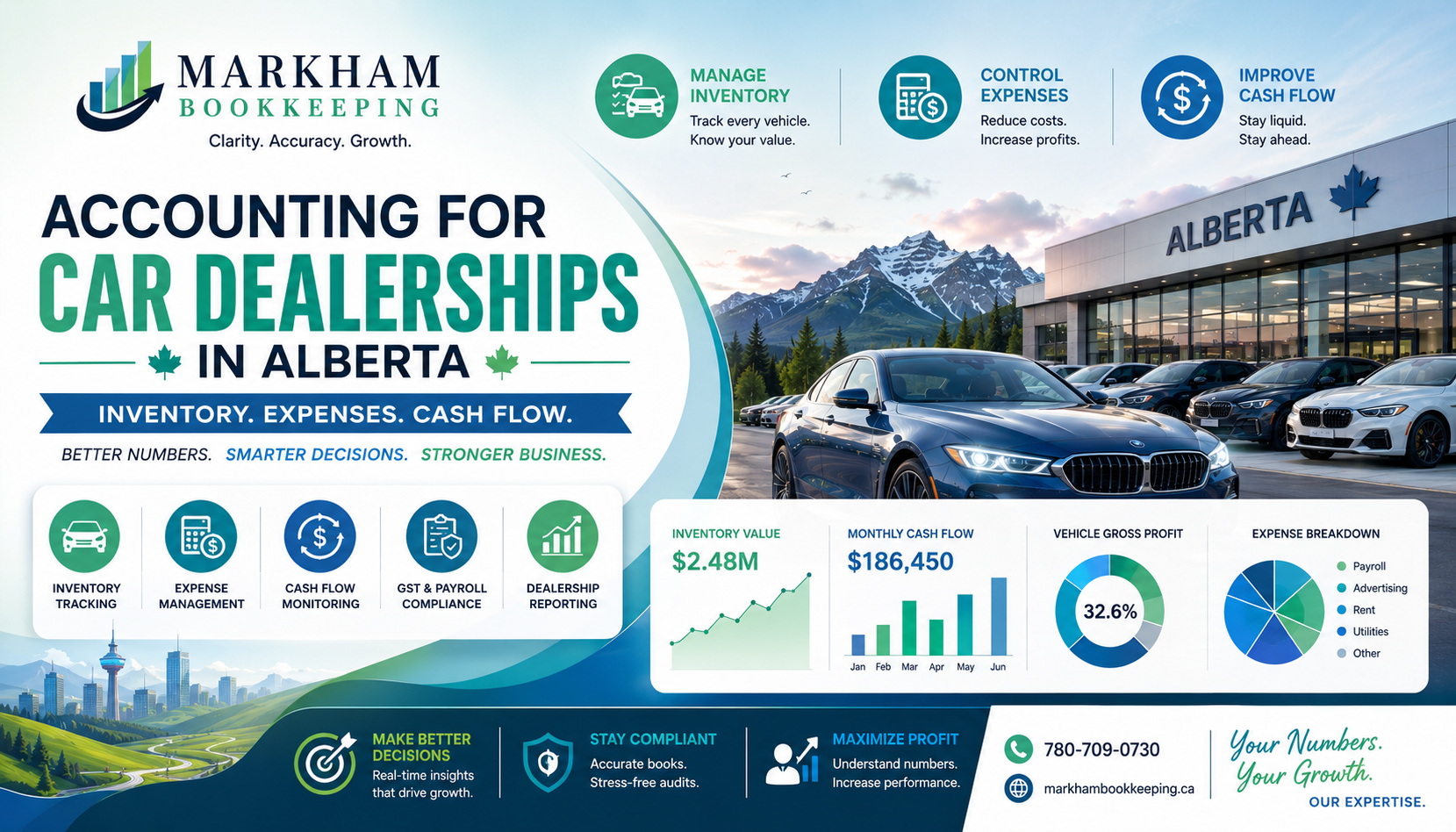
Car dealerships in Alberta deal with one of the most complex bookkeeping environments in small business accounting. Unlike many service-based businesses, an auto dealership does not simply record sales, expenses, and profit. A dealership must track vehicles, inventory costs, repairs, reconditioning, deposits, financing, trade-ins, GST, commissions, payroll, lender payments, cash flow, and customer receivables.
Whether the dealership is located in Edmonton, Calgary, Sherwood Park, Red Deer, St. Albert, Fort Saskatchewan, Leduc, Grande Prairie, Medicine Hat, or another Alberta community, accurate accounting is essential. A small mistake in dealership bookkeeping can affect profit, GST reporting, inventory value, cash flow, and year-end tax preparation.
For Alberta car dealers, accounting is not only about staying organized. It is about knowing whether each vehicle is actually profitable.
A dealership may sell many vehicles in a month but still struggle with cash flow. Another dealer may show a strong bank balance but have unpaid floor plan financing, recon costs, payroll, GST, and vendor bills coming due. That is why car dealership accounting in Alberta needs to be detailed, consistent, and reviewed regularly.
This guide explains the key accounting areas Alberta car dealerships should focus on: inventory, expenses, and cash flow.
Why Car Dealership Accounting Is Different
Car dealership accounting is different from regular retail or service bookkeeping because each vehicle is usually a major inventory item. Every unit has its own purchase cost, repair cost, detail cost, transport cost, inspection cost, advertising cost, and final sale price.
If costs are not tracked by vehicle, the dealership may not know which units made money and which units lost money.
For example, a vehicle may be purchased at auction for $18,000 and sold for $23,000. At first glance, that looks like a $5,000 gross profit. But after auction fees, transportation, mechanical inspection, detailing, tires, windshield repair, financing interest, advertising, commissions, and paperwork costs, the real profit may be much lower.
This is why bookkeeping for car dealerships in Alberta should not treat all expenses as general overhead. Some costs belong directly to specific vehicles, while others are general business expenses.
1. Inventory Tracking for Alberta Car Dealerships
Inventory is the heart of dealership accounting. For a car dealership, inventory usually includes vehicles held for resale. These vehicles should be tracked carefully from purchase to sale.
A proper inventory system should show:
Vehicle stock number
VIN
Year, make, and model
Purchase date
Purchase price
Auction or acquisition fees
Transportation costs
Inspection costs
Reconditioning costs
Detailing costs
Floor plan or financing information
Sale date
Sale price
Gross profit by unit
Vehicle status: available, pending sale, sold, wholesale, demo, or consignment
Without this level of tracking, the profit and loss report may not show the real picture. A dealership owner may think the business is profitable, but several vehicles could be sitting in inventory too long, costing money through interest, insurance, lot space, repairs, and price reductions.
Inventory Should Not Be Expensed Too Early
One common dealership bookkeeping mistake is expensing vehicle purchases immediately.
When a dealership buys vehicles for resale, those vehicles are usually inventory, not regular expenses. The cost generally becomes cost of goods sold when the vehicle is sold. If vehicle purchases are expensed right away, the monthly profit and loss report may look distorted.
For example, if a dealership buys five vehicles in January and sells them in March, expensing the full cost in January may make January look terrible and March look too profitable. Inventory accounting helps match the cost of the vehicle to the period when the related sale happens.
This gives dealership owners a clearer view of actual gross profit.
2. Reconditioning and Repair Costs
Reconditioning is a major part of car dealership accounting in Alberta. Used vehicles often need inspections, cleaning, repairs, windshield work, tires, brakes, detailing, paint correction, battery replacement, or mechanical work before resale.
The key question is whether these costs should be assigned to a specific vehicle or treated as general repairs.
In most dealership bookkeeping systems, costs that directly prepare a specific vehicle for sale should be tracked to that vehicle. This may include:
Auction fees
Transportation
Out-of-province inspection costs
Mechanical inspection
Parts and labour for resale preparation
Detailing
Tires
Windshield repair or replacement
Paint touch-ups
Key replacement
Safety-related repairs
Photography or vehicle listing costs, depending on the dealership’s tracking method
Tracking reconditioning by unit helps the owner know the true gross profit of each sale. If recon costs are simply posted to a general expense account, the dealership may not know whether certain vehicles are becoming too expensive to prepare for sale.
3. Cost of Goods Sold
Cost of goods sold, or COGS, is one of the most important sections in auto dealership accounting.
For a dealership, COGS may include the cost of vehicles sold plus direct costs needed to prepare those vehicles for resale. This is different from general overhead expenses such as rent, office supplies, software, telephone, insurance, and bookkeeping fees.
A clean dealership profit and loss report should separate:
Vehicle sales revenue
Cost of vehicles sold
Reconditioning costs assigned to sold vehicles
Gross profit
Operating expenses
Net profit
This structure helps Alberta dealership owners answer a very important question: are we making enough gross profit on vehicles before overhead?
If gross profit is strong but net profit is weak, the problem may be overhead. If gross profit is weak, the issue may be buying price, recon costs, pricing strategy, aging inventory, financing cost, or poor deal structure.
4. Trade-Ins
Trade-ins can complicate dealership bookkeeping.
When a customer trades in a vehicle, the dealership needs to record the transaction properly. The trade-in affects the sale deal, inventory, customer balance, lien payouts if applicable, and sometimes financing paperwork.
Important details to track include:
Trade-in allowance
Actual value assigned to the trade-in
Lien payout
Net equity or negative equity
GST treatment
Vehicle added to inventory
Repair or reconditioning costs after trade-in
Final sale or wholesale disposal of the trade-in
A trade-in should not be treated casually in the books. It is often both part of a customer transaction and a new inventory item.
5. GST Tracking for Alberta Car Dealerships
GST is a critical area for Alberta car dealerships. Alberta does not have provincial sales tax, but GST still applies to many taxable supplies.
Dealerships need clean GST tracking on:
Vehicle sales
Parts and service revenue
Admin fees
Documentation fees
Warranty products, depending on structure
Reconditioning expenses
Professional fees
Office expenses
Advertising
Rent and utilities
Subcontractors
Auction fees and purchases, depending on supplier and documentation
The dealership should also keep proper support for input tax credits. If GST is not coded correctly, the GST return may be wrong. That can create cash flow issues or problems during a CRA review.
A common mistake is relying only on bank deposits to record sales. Vehicle sales often include financing, deposits, trade-ins, lender payouts, warranties, fees, and taxes. The accounting entry should reflect the full deal, not just the net cash received.
6. Deposits and Customer Advances
Customer deposits are another area where dealerships need clean accounting.
When a customer pays a deposit on a vehicle, that money is usually not immediately sales revenue. It may be a liability until the deal is completed or the deposit becomes non-refundable under the agreement.
A dealership should track:
Deposit date
Customer name
Vehicle stock number
Amount received
Payment method
Refundable or non-refundable terms
Final sale application
Refunds, if any
If deposits are recorded directly as income too early, revenue can be overstated. If refunds are not recorded properly, customer balances may become messy.
A good dealership bookkeeping system should make it easy to see open deposits at any time.
7. Floor Plan Financing and Loans
Many Alberta car dealerships use floor plan financing or business loans to purchase inventory. This requires careful bookkeeping.
A floor plan payment may include principal, interest, fees, or curtailments. The principal portion reduces the loan balance. The interest and certain fees may be expenses. If the entire payment is posted as an expense, both the profit and loan balance may be wrong.
Dealership owners should regularly review:
Floor plan balance by lender
Floor plan balance by vehicle
Interest expense
Vehicles sold but not paid off
Curtailment schedules
Loan payments posted correctly
Inventory financed versus owned outright
This is especially important for cash flow. A dealership may sell a vehicle, receive funds, and still need to pay off the lender quickly. Poor tracking can create serious cash shortages.
8. Operating Expenses for Car Dealerships
Not every cost belongs to inventory. Some costs are general operating expenses.
Common dealership operating expenses include:
Rent or lease payments
Utilities
Business insurance
Lot insurance
Software subscriptions
Dealer management system fees
Website and hosting costs
Advertising
Google Ads and social media ads
Office supplies
Telephone and internet
Bookkeeping and accounting fees
Legal fees
Bank charges
Merchant fees
Payroll
Sales commissions
Cleaning and lot maintenance
Security system costs
Licensing and regulatory fees
These expenses should be categorized consistently. Too many transactions in “miscellaneous” makes the reports less useful.
A dealership owner should be able to review monthly expenses and quickly understand where the money went.
9. Payroll and Sales Commissions
Payroll can be another complex area for Alberta dealerships, especially when salespeople are paid commissions, bonuses, draws, or a mix of salary and commission.
Payroll reports should show:
Gross wages
Commissions
Bonuses
Vacation pay
CPP
EI
Income tax deductions
Employer payroll costs
Net pay
Payroll liabilities
Commission expense by salesperson, if needed
If commissions are tied to vehicle sales, the dealership may also want to track commission cost per deal. This helps calculate true gross profit after direct selling costs.
Payroll remittances should also be monitored closely. Late or incorrect payroll remittances can create penalties and interest.
10. Cash Flow Management for Alberta Dealerships
Cash flow is one of the biggest challenges for car dealerships.
A dealership may have strong sales but weak cash flow because money is tied up in inventory. Vehicles sitting on the lot are not just assets; they are cash waiting to be converted back into money.
Cash flow can be affected by:
Aging inventory
Floor plan interest
Slow lender funding
Vehicle repairs before sale
Customer deposits
Trade-in lien payouts
Warranty chargebacks
Payroll
Rent
Advertising
GST payments
Loan payments
Seasonal sales cycles
Dealership owners should review cash flow regularly, not only at year-end.
A simple cash flow review should ask:
How much cash is available today?
How much is owed to lenders?
How much GST is payable?
What bills are due in the next 30 days?
How many vehicles are aging over 60, 90, or 120 days?
How much cash is tied up in slow-moving inventory?
Are we collecting deposits properly?
Are customer refunds or chargebacks expected?
This helps the dealership avoid surprises and plan smarter.
11. Reports Car Dealership Owners Should Review
Clean dealership accounting should produce useful reports. The most important reports include:
Profit and loss report
Balance sheet
Inventory detail report
Vehicle gross profit report
Inventory aging report
Floor plan payable report
Accounts payable report
Accounts receivable report
GST report
Payroll summary
Cash flow report
Expense by category report
Sales by salesperson report
Advertising cost report
The vehicle gross profit report is especially important. It should show the sale price, vehicle cost, direct recon costs, direct selling costs, and gross profit by unit.
The inventory aging report is also powerful. Vehicles sitting too long can quietly reduce profit through interest, repairs, discounts, and opportunity cost.
12. Common Accounting Mistakes Car Dealerships Should Avoid
Many dealership bookkeeping problems come from a few common mistakes:
Recording vehicle purchases as immediate expenses
Not tracking recon costs by vehicle
Posting loan principal as an expense
Recording deposits as sales too early
Not reconciling floor plan balances
Not reviewing GST before filing
Mixing personal and business expenses
Using unclear categories like miscellaneous
Not tracking trade-ins properly
Ignoring inventory aging
Not reconciling bank and credit card accounts monthly
Not matching lender deposits to actual vehicle sales
These issues may not seem serious at first, but they can build up over time and make year-end accounting difficult.
13. Why Clean Bookkeeping Matters for Alberta Auto Dealers
Clean bookkeeping helps car dealership owners make better decisions. It also helps with tax preparation, GST filing, financing applications, lender reporting, and business planning.
With clean books, an Alberta dealership owner can see:
Which vehicles are profitable
Which inventory is aging
Which expenses are increasing
Whether cash flow is healthy
How much GST may be owing
How much is owed to lenders
Whether advertising is producing results
Whether payroll and commissions are sustainable
Whether the dealership is truly growing
Without clean books, the owner may be forced to guess.
And in a dealership, guessing can become expensive.
Final Thoughts
Accounting for car dealerships in Alberta requires more than basic bookkeeping. Dealerships must track inventory, vehicle costs, recon expenses, GST, trade-ins, deposits, floor plan financing, payroll, commissions, and cash flow.
The most important goal is clarity. Dealership owners need to know the real profit on each vehicle, the true value of inventory, the amount owed to lenders, and the cash available to run the business.
A dealership may look busy from the outside, but the books reveal whether the business is actually profitable.
If your dealership books are messy, delayed, or difficult to understand, Markham Bookkeeping can help with bookkeeping, cleanup, expense tracking, GST support, payroll entries, inventory reporting, and financial reports for Alberta small businesses.
Visit: https://markhambookkeeping.ca/
Clean books. Better inventory control. Stronger cash flow.