
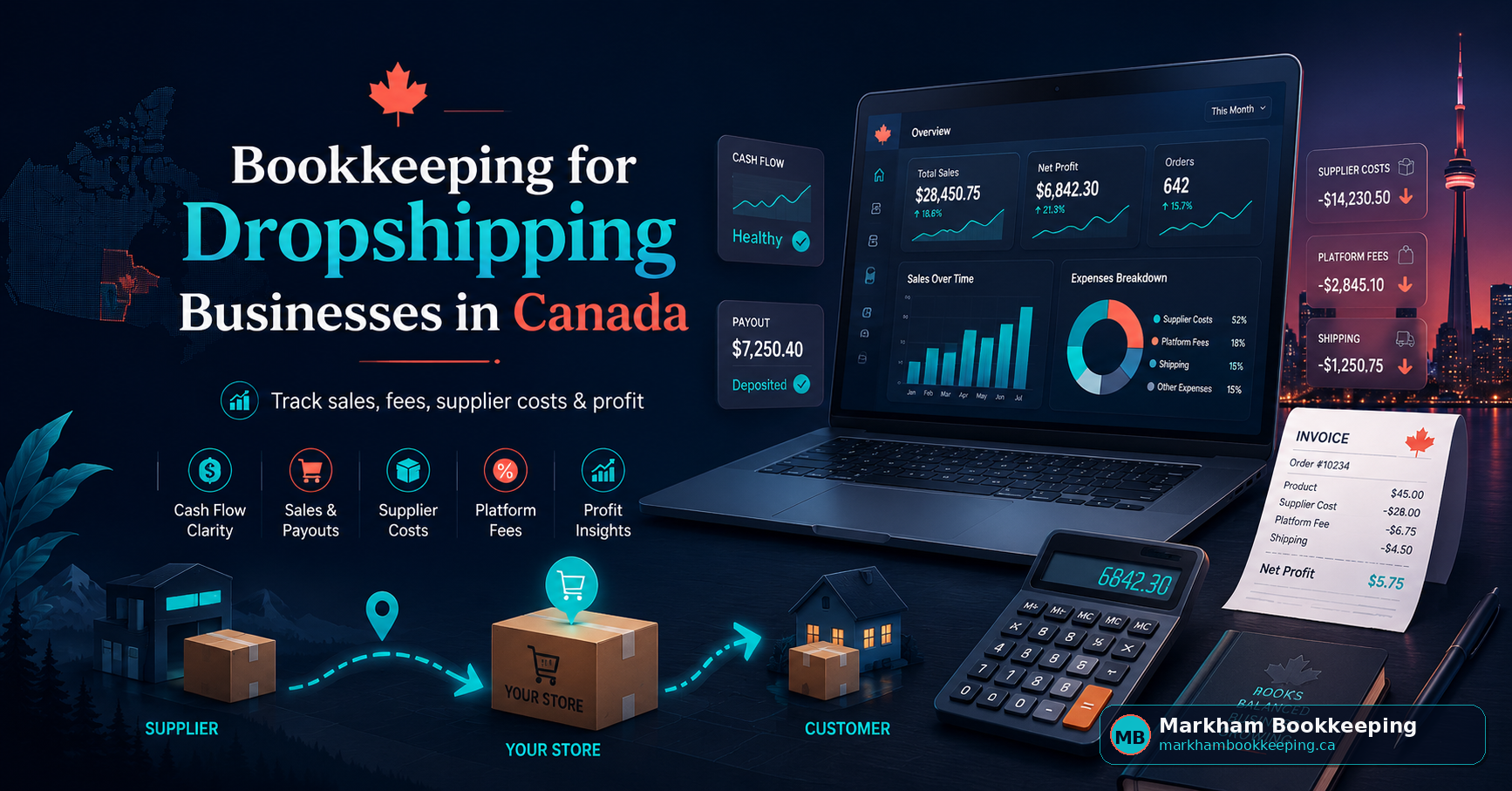
Dropshipping can look simple from the outside. You list products online, a customer places an order, your supplier ships the product, and you keep the difference between the selling price and the cost.
But from a bookkeeping point of view, dropshipping is not always simple.
Canadian dropshipping businesses deal with sales platforms, supplier invoices, payment processors, refunds, chargebacks, advertising costs, shipping charges, currency exchange, GST/HST, and sometimes international suppliers. If these numbers are not tracked properly, the business owner may think they are making money when the books show something completely different.
That is why proper bookkeeping for dropshipping businesses in Canada is so important. Clean books help you understand your real profit, prepare for tax season, stay organized for CRA, and make better business decisions.
Whether you sell through Shopify, Amazon, Walmart, Etsy, TikTok Shop, Facebook Marketplace, or your own website, your bookkeeping system should clearly show what came in, what went out, what fees were deducted, and what profit was actually left.
Why Dropshipping Bookkeeping Is Different
Dropshipping is different from a traditional retail business because the seller usually does not hold inventory in a warehouse. Instead, the seller accepts the order and the supplier ships the product directly to the customer.
That sounds easy, but it creates bookkeeping challenges.
A normal bank deposit does not always equal sales revenue. Payment processors may deduct fees before depositing money. Platforms may hold funds for several days. Refunds may happen after the original sale. Suppliers may charge in U.S. dollars. Advertising costs may be paid separately through Meta, Google, TikTok, or other platforms.
This means dropshipping bookkeeping must go deeper than simply recording bank deposits as income.
A proper bookkeeping system should track:
Customer sales
Platform fees
Payment processing fees
Supplier costs
Refunds and returns
Chargebacks
Advertising expenses
Shipping costs
Currency exchange differences
GST/HST collected and paid
Net profit by month
Without this level of tracking, the business owner may only see revenue, not profit.
Revenue Is Not the Same as Profit
One of the biggest mistakes dropshipping businesses make is confusing sales with profit.
For example, a store may generate $20,000 in monthly sales. That sounds impressive. But after supplier costs, payment processor fees, advertising, refunds, software subscriptions, and other expenses, the actual profit may be much smaller.
In some cases, the business may even be losing money while the sales dashboard looks strong.
This is why bookkeeping for dropshipping businesses should focus on net profit, not just revenue. Sales reports from Shopify, Amazon, or other platforms are helpful, but they do not tell the full story. The bookkeeping records should show what the business actually earned after all related costs.
A good monthly profit and loss report should answer:
How much revenue came in?
How much did products cost?
How much was spent on ads?
How much did payment processors take?
How much was refunded?
How much profit remained?
If your books cannot answer these questions, it becomes difficult to know whether the business is truly growing.
Key Accounts Dropshipping Businesses Should Track
A dropshipping business in Canada should have a clean chart of accounts. This helps organize income and expenses properly.
Common income accounts may include:
Online sales revenue
Shipping income charged to customers
Discounts and promotional adjustments
Refunds and returns
Common expense or cost accounts may include:
Cost of goods sold
Supplier payments
Platform fees
Payment processor fees
Advertising and marketing
Website and app subscriptions
Software costs
Bank fees
Professional fees
Office expenses
Foreign exchange gains or losses
The most important category is usually cost of goods sold. This represents the direct cost of buying the product from the supplier. If product costs are recorded as general expenses instead of cost of goods sold, your gross profit may not be accurate.
For dropshipping businesses, gross profit matters because it shows whether the product pricing actually works.
Tracking Supplier Costs Properly
Supplier costs are the heart of dropshipping bookkeeping.
If you sell a product for $80 and the supplier charges you $45, your gross margin starts at $35 before fees and advertising. But if the supplier also charges shipping, handling, or currency conversion costs, the actual margin may be lower.
Every supplier invoice should be recorded properly. If suppliers charge in foreign currency, the Canadian-dollar value should be reflected in the books. This is especially important for Canadian businesses buying from U.S. or international suppliers.
Supplier records should include:
Supplier name
Invoice date
Product cost
Shipping or handling charges
Currency used
Payment method
Order reference or product details
This makes it easier to match supplier payments with customer orders and understand which products are profitable.
Payment Processor Fees Matter
Dropshipping businesses often receive payments through Stripe, PayPal, Shopify Payments, Amazon, Square, or other processors. These platforms usually deduct fees before depositing money into the bank account.
For example, the customer may pay $100, but the bank deposit may only be $96.80 after fees. If the bookkeeper records only the $96.80 as revenue, sales will be understated and fees will be hidden.
The better method is to record:
Gross sale: $100
Payment processing fee: $3.20
Net deposit: $96.80
This gives a more accurate picture of both revenue and expenses.
Over time, payment processor fees can become a significant cost. Tracking them separately helps the business owner understand whether fees are eating into margins.
Refunds, Returns, and Chargebacks
Refunds are common in e-commerce and dropshipping. Customers may return products, request refunds, dispute transactions, or complain about shipping delays.
If refunds are not recorded properly, revenue may look higher than it really is.
Refunds should be tracked separately from regular expenses. They are not the same as advertising costs or office expenses. They reduce the sales value of the business.
Chargebacks should also be recorded carefully. A chargeback may include the refunded sale amount plus an additional dispute fee from the processor. If this is not separated, the business owner may not understand how much chargebacks are costing the company.
Good bookkeeping should show:
Total refunds
Refund rate
Chargeback fees
Products with high return issues
Net revenue after refunds
This information can help a dropshipping business improve product selection, supplier quality, and customer service.
Advertising Costs Can Make or Break Profit
Many dropshipping businesses rely heavily on paid ads. Meta ads, Google ads, TikTok ads, influencer campaigns, and other marketing costs can grow quickly.
A product may seem profitable before advertising but become unprofitable after ad spend.
For example:
Sale price: $70
Supplier cost: $35
Payment fee: $3
Ad cost per sale: $25
Profit before other costs: $7
That small profit can disappear once software, refunds, subscriptions, and other expenses are included.
This is why advertising should be tracked clearly and reviewed every month. Dropshipping businesses should not only look at revenue from campaigns. They should compare ad spend against gross profit and net profit.
Bookkeeping can help answer:
Which month had the highest ad spend?
Did higher ad spend create higher profit?
Which platform is most expensive?
Are ads creating sales but not profit?
GST/HST for Dropshipping Businesses in Canada
GST/HST is one of the most important tax areas for Canadian dropshipping businesses.
If your business crosses the small supplier threshold, GST/HST registration may be required. Once registered, you may need to charge GST/HST on taxable sales, file GST/HST returns, and remit the net amount to CRA.
This is where bookkeeping becomes very important.
Your books should track:
Taxable sales
GST/HST collected
GST/HST paid on eligible business expenses
Input tax credits
GST/HST owing or refundable
Filing periods and deadlines
A common mistake is spending the GST/HST collected from customers as if it belongs to the business. GST/HST collected is not regular income. It is an amount collected and later reported to CRA.
If your bookkeeping does not separate GST/HST properly, cash flow problems can happen when the filing deadline arrives.
Inventory and Dropshipping
Many dropshipping businesses do not hold inventory physically, but they still need to understand product costs.
If your business only purchases products after customer orders are placed, your cost tracking may be simpler than a warehouse-based business. However, if you prepay suppliers, buy sample products, hold limited stock, or use a fulfillment service, inventory tracking may become more important.
The key is consistency. Product costs should be recorded in a way that allows you to understand gross profit.
For businesses with physical stock, inventory records should be updated regularly. For pure dropshipping businesses, supplier costs should still be matched clearly against sales activity.
Currency Exchange Issues
Canadian dropshipping businesses often deal with U.S. dollars. Sales may be in Canadian dollars, supplier invoices may be in U.S. dollars, and advertising platforms may charge in another currency.
This creates foreign exchange differences.
For example, the supplier invoice may be $500 USD, but the Canadian-dollar cost depends on the exchange rate at the time of payment or recording. If the bookkeeping does not handle this properly, expenses and profit may be inaccurate.
Using accounting software that supports multi-currency can help. However, the setup must be done properly from the beginning.
Monthly Bookkeeping Checklist for Dropshipping Businesses
A dropshipping business should not wait until tax season to clean up the books. Monthly bookkeeping is much easier and more accurate.
A monthly checklist may include:
Download sales reports from each platform
Reconcile bank and credit card accounts
Record gross sales, not just deposits
Separate payment processor fees
Record supplier invoices and payments
Track refunds and chargebacks
Record advertising expenses
Review GST/HST collected and paid
Check software and subscription costs
Review profit and loss report
Review cash flow
Save receipts and invoices
Follow up on missing documents
This process helps keep the business organized and reduces year-end stress.
Best Accounting Software for Dropshipping Bookkeeping
Many Canadian dropshipping businesses use QuickBooks Online, Xero, or other cloud accounting software. The best option depends on the sales platforms, number of transactions, currency needs, reporting requirements, and budget.
For a small dropshipping business, the software should be able to:
Connect to bank accounts
Import transactions
Handle sales tax
Track expenses by category
Create profit and loss reports
Support app integrations
Store receipts and invoices
Reconcile accounts monthly
However, software alone does not fix messy bookkeeping. The setup matters. If sales, fees, refunds, and supplier costs are not mapped correctly, the reports may still be wrong.
Common Bookkeeping Mistakes Dropshipping Businesses Make
Dropshipping businesses often make the same mistakes:
Recording deposits as total sales
Ignoring payment processor fees
Mixing personal and business expenses
Not tracking supplier costs properly
Forgetting refunds and chargebacks
Not saving receipts and invoices
Ignoring GST/HST registration requirements
Not reconciling accounts monthly
Relying only on Shopify or Amazon dashboards
Using profit estimates instead of bookkeeping reports
These mistakes can lead to inaccurate profit, missed deductions, tax problems, and poor business decisions.
Why Clean Books Help Dropshipping Businesses Grow
Clean bookkeeping is not just about taxes. It helps the business owner make better decisions.
With accurate books, you can see:
Which products are profitable
Which expenses are increasing
Whether advertising is working
How much cash is available
Whether pricing needs to change
How much tax to set aside
When to stop selling low-margin products
Dropshipping is a numbers business. Small changes in supplier cost, ad cost, refund rate, or shipping charges can change the entire profit picture.
Clean books give you control.
Final Thoughts
Bookkeeping for dropshipping businesses in Canada requires more than basic income and expense tracking. A dropshipping business must understand gross sales, supplier costs, processor fees, refunds, chargebacks, advertising costs, GST/HST, foreign exchange, and net profit.
The sales dashboard may show growth, but the bookkeeping tells the truth.
If you run a dropshipping business in Canada, do not wait until tax season to organize your records. Monthly bookkeeping can help you stay compliant, understand your real profit, and make smarter business decisions.
Markham Bookkeeping helps Canadian small businesses, e-commerce sellers, and online entrepreneurs keep their books clean, accurate, and ready for tax time.
Need help cleaning up your dropshipping books or setting up monthly bookkeeping?
Contact Markham Bookkeeping today.
FAQ: Bookkeeping for Dropshipping Businesses in Canada
Do dropshipping businesses need bookkeeping?
Yes. Dropshipping businesses need bookkeeping to track sales, supplier costs, platform fees, refunds, advertising expenses, GST/HST, and profit. Without bookkeeping, it is difficult to know whether the business is actually profitable.
Is dropshipping income taxable in Canada?
Yes. Income earned from a dropshipping business is generally taxable in Canada. Business owners should track income and expenses properly and report business income when filing taxes.
Do Canadian dropshipping businesses need to register for GST/HST?
A Canadian dropshipping business may need to register for GST/HST once it exceeds the small supplier threshold. Once registered, the business may need to charge, collect, file, and remit GST/HST.
Can dropshipping businesses deduct advertising costs?
Advertising costs used to earn business income are generally a business expense. This may include costs for Meta ads, Google ads, TikTok ads, influencer campaigns, and other marketing platforms, as long as they relate to the business.
Should supplier costs be recorded as expenses or cost of goods sold?
Supplier product costs are usually recorded as cost of goods sold because they are directly connected to the products sold. This helps calculate gross profit more accurately.
What is the biggest bookkeeping mistake dropshippers make?
One of the biggest mistakes is recording bank deposits as total revenue. Payment processors often deduct fees before depositing funds, so the books should show gross sales, fees, refunds, and net deposits separately.



One thing that stands out is how easy it is for dropshippers to overestimate profitability when platform fees, chargebacks, refunds, and currency conversion costs aren’t tracked separately. Having clean records for each sales channel also makes it much easier to spot which products or campaigns are actually generating profit rather than just revenue.