
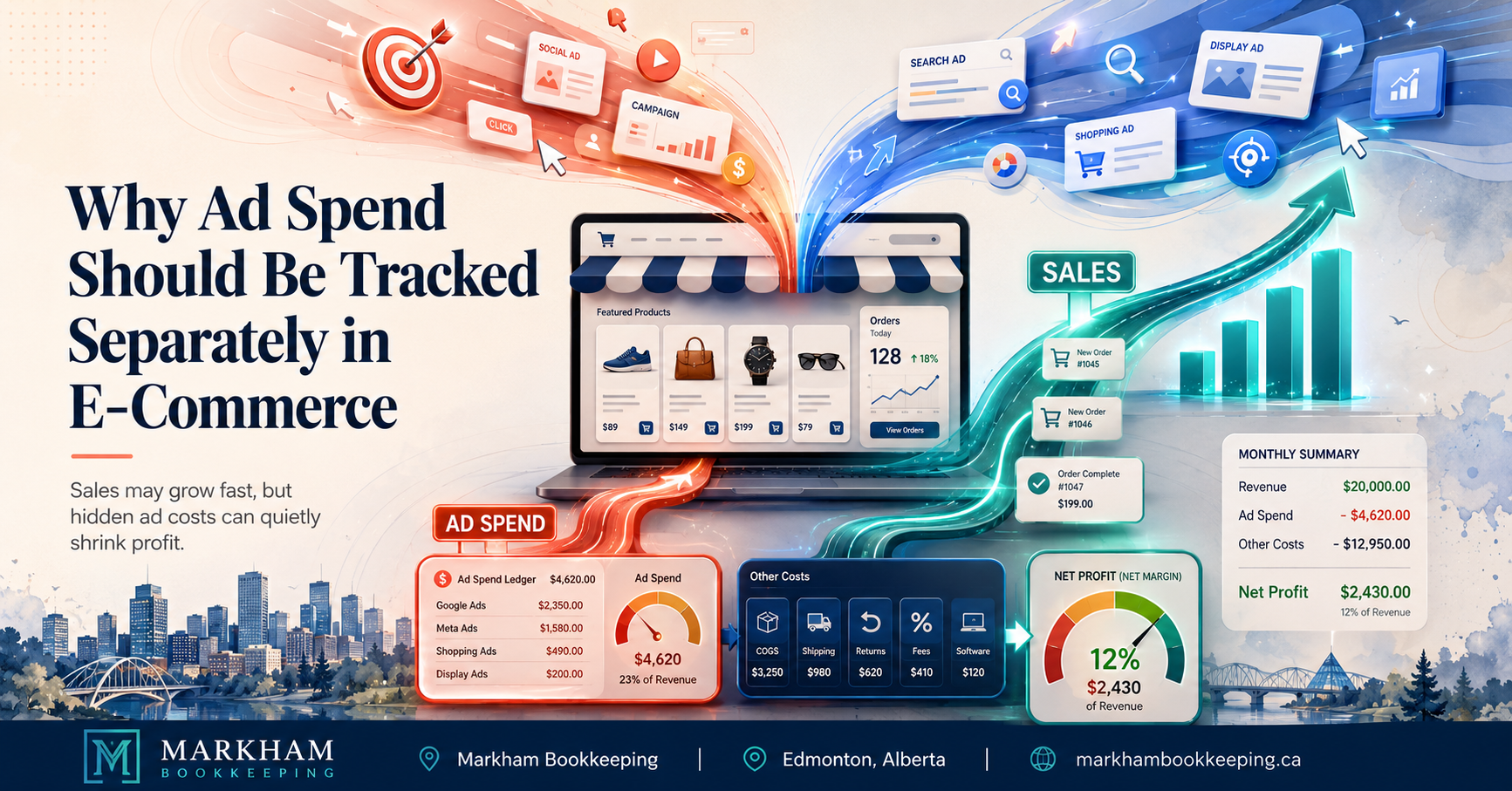
For e-commerce businesses, advertising can be one of the biggest expenses in the business.
A Shopify store may spend money on Facebook ads, Instagram ads, Google Ads, TikTok ads, influencer campaigns, Pinterest ads, email marketing, affiliate commissions, and sponsored posts. These expenses can help generate sales, but they can also make profit very confusing if they are not tracked properly.
Many online sellers look at sales and assume the business is doing well. But revenue alone does not show the full picture. If ad spend is not separated and reviewed properly, an e-commerce business may think it is profitable when ads are actually eating up most of the margin.
For Edmonton e-commerce businesses and Canadian online sellers, tracking ad spend separately is not just good bookkeeping. It helps with cash flow, pricing, profitability, tax preparation, and better business decisions.
This guide explains why ad spend should be tracked separately in e-commerce bookkeeping and how clean records can help online business owners understand their real profit.
Ad Spend Is Not Just Another Expense
A common mistake in e-commerce bookkeeping is putting all marketing costs into one general “advertising” or “marketing” account without any detail.
At first, that may seem fine. But as the business grows, this becomes a problem.
E-commerce advertising is different from many other business expenses because it is directly tied to customer acquisition. If you spend $1,000 on ads, the real question is not only, “How much did we spend?”
The better questions are:
How much revenue did that ad spend generate?
Which platform produced the best return?
Which product was promoted?
Was the campaign profitable after product cost, shipping, transaction fees, and refunds?
Did the ad spend help generate repeat customers?
Was the business scaling profitably or just buying sales?
If ad spend is mixed with other expenses, those answers become harder to find.
For e-commerce businesses, advertising should be tracked clearly so the owner can understand whether marketing is helping the business grow or quietly reducing profit.
Sales Alone Do Not Show Profit
One of the biggest reasons to track ad spend separately is that sales can be misleading.
An online store may generate $50,000 in monthly sales and still have weak profit. Why? Because revenue is only the top line.
Before the owner can understand real profit, they need to consider:
Cost of goods sold
Product packaging
Shipping and fulfillment
Platform fees
Payment processor fees
Returns and refunds
Chargebacks
Discounts
Ad spend
Software subscriptions
Contractors or freelancers
GST/HST obligations
Bookkeeping and admin costs
Ad spend can be especially dangerous because it can increase quickly. A campaign may perform well for a few days, then become less profitable. A store may keep spending money because sales are coming in, but if the ads are too expensive, the business may not be making much money.
This is why e-commerce bookkeeping should not only track total sales. It should help show the cost of getting those sales.
Ad Spend Affects Gross Margin and Net Profit
E-commerce sellers often focus on product margin.
For example, if a product sells for $100 and costs $40 to purchase, the owner may think there is a $60 margin.
But that is not the full story.
There may also be:
$10 shipping cost
$3 payment processing fee
$5 platform fee
$8 packaging and handling
$20 advertising cost
Suddenly, the profit is much smaller.
This is why tracking ad spend separately matters. It helps show the difference between product margin and real profit.
A product may look profitable before advertising but become barely profitable after customer acquisition cost is included.
For Edmonton e-commerce businesses trying to grow online, this is a major point. Growth is good, but growth without profit can create cash flow problems. Clean bookkeeping helps business owners see whether the business is scaling in a healthy way.
Track Ad Spend by Platform
One of the best ways to organize e-commerce ad spend is to track it by platform.
Instead of recording everything under one broad advertising account, businesses can use separate categories or tracking methods for each major platform.
For example:
Facebook and Instagram Ads
Google Ads
TikTok Ads
Pinterest Ads
YouTube Ads
Influencer Marketing
Affiliate Commissions
Email Marketing Promotions
Sponsored Content
Creative Production Costs
This gives the business owner a clearer view of where money is being spent.
If Facebook ads cost $4,000 per month and Google Ads cost $1,500 per month, the owner should be able to see that clearly. If TikTok ads are being tested, those costs should not disappear inside a general marketing account with everything else.
This does not mean the chart of accounts needs to become messy. The goal is to create enough detail to make decisions without creating unnecessary bookkeeping work.
Separate Ad Spend From Software and Creative Costs
Another common bookkeeping issue is mixing ad spend with marketing software, design work, and content creation.
For example, an e-commerce business may pay for:
Facebook ads
Google Ads
Canva
Klaviyo or email marketing software
A freelance video editor
A photographer
Influencer content
Landing page software
SEO tools
Graphic design
Copywriting
These are all related to marketing, but they are not the same thing.
Actual ad spend is the money paid to platforms to show ads.
Creative costs are the costs of producing the ads.
Software costs are tools used to manage marketing.
Influencer payments may be promotional expenses, content expenses, or affiliate-type costs depending on how they are structured.
If everything is grouped together, the owner may not know how much was spent on actual paid media versus tools and production.
For better e-commerce bookkeeping, these costs should be separated in a way that makes sense for the business.
Track Ad Spend Against Sales Channels
E-commerce businesses often sell through multiple channels.
A business may sell on:
Shopify
Amazon
Walmart Marketplace
Etsy
TikTok Shop
eBay
Wholesale
In-person markets
Social media checkout
If possible, ad spend should be reviewed against the sales channel or campaign it supports.
For example, Google Shopping ads may drive Shopify sales. Amazon ads may support Amazon marketplace sales. Influencer campaigns may promote a specific product launch.
When ad spend is connected to sales channels, the business can better understand which channels are actually profitable.
This is especially helpful for Canadian e-commerce sellers because payout reports can already be complicated. Shopify payouts, Amazon settlements, merchant fees, refunds, and taxes can make revenue difficult to read. Adding mixed-up ad spend makes it even harder.
Ad Spend Can Create Cash Flow Pressure
Advertising is usually paid before the business sees the full benefit.
An e-commerce store may spend thousands of dollars on ads this month, but the related sales may not turn into cash immediately. There may be payout delays, shipping costs, supplier payments, refunds, or inventory restocking needs.
This can create cash flow pressure.
For example, a business may spend heavily on ads to drive sales, but then need to buy more inventory, pay shipping vendors, cover platform fees, and handle returns. If the owner only looks at sales, the business may appear healthy. But if cash is leaving faster than it is coming in, the business can run into problems.
Tracking ad spend separately helps business owners see how much cash is being invested into growth and whether the return is worth it.
A simple monthly ad spend review can help answer:
Are we spending too much too quickly?
Are ads creating profitable sales?
Are we buying customers at a sustainable cost?
Do we have enough cash to support the next inventory order?
Are refunds or low margins making campaigns less profitable?
This is why ad spend belongs in the financial discussion, not just the marketing discussion.
Ad Spend and Return on Ad Spend
Many e-commerce owners look at ROAS, or return on ad spend.
ROAS compares revenue generated from advertising to the amount spent on advertising.
For example, if a business spends $1,000 on ads and generates $4,000 in sales, the ROAS is 4x.
That sounds good, but ROAS does not automatically mean profit.
A 4x ROAS may be profitable for a high-margin product but not enough for a low-margin product. If product cost, shipping, platform fees, discounts, and refunds are high, the business may need a stronger ROAS to make money.
This is where bookkeeping becomes powerful. Marketing platforms show ad results, but bookkeeping shows business reality.
Ad dashboards may show sales, clicks, conversions, and ROAS. The books show product costs, fees, refunds, shipping, and net profit.
Both are needed.
GST/HST and Advertising Expenses
For Canadian e-commerce businesses, GST/HST should also be considered when tracking ad spend.
Some advertising platforms may charge tax depending on the supplier, billing setup, and location. Some invoices may be from foreign companies and may not show GST/HST the same way a Canadian supplier invoice would.
Business owners should not guess the GST/HST treatment from the bank feed alone. They should keep the actual ad invoices and billing statements so the bookkeeper can review them properly.
This is one reason why receipt and invoice management is important. Advertising expenses often come from online dashboards, not paper receipts. The invoices may need to be downloaded from Meta, Google, TikTok, Pinterest, Shopify apps, or other platforms.
If invoices are missing, GST/HST tracking may be incomplete.
For Edmonton e-commerce businesses, keeping proper ad spend records helps support bookkeeping, GST/HST filing, and year-end tax preparation.
Ad Spend Should Be Reviewed Monthly
Ad spend should not be reviewed only at tax time.
A monthly review gives the business owner a better chance to catch problems early.
Each month, e-commerce businesses should review:
Total ad spend
Ad spend by platform
Sales by channel
Cost of goods sold
Gross profit margin
Refunds and chargebacks
Shipping costs
Merchant fees
Customer acquisition cost
Net profit after advertising
Cash available for inventory purchases
This monthly process helps the owner understand whether marketing is helping or hurting the business.
If ad spend is rising but profit is not improving, the business may need to review pricing, campaigns, product margins, or customer retention.
If one platform is producing strong results while another is wasting money, the owner can adjust faster.
Good bookkeeping gives the owner better information before the damage becomes serious.
How to Set Up Ad Spend in the Books
The setup does not need to be complicated, but it should be intentional.
A simple e-commerce bookkeeping setup may include accounts such as:
Advertising and Promotion
Facebook and Instagram Ads
Google Ads
TikTok Ads
Pinterest Ads
Influencer Marketing
Email Marketing
Creative Production
Marketing Software
Affiliate Commissions
For smaller businesses, fewer categories may be enough. For larger businesses, more detail may be helpful.
Another option is to use classes, tracking categories, projects, or tags inside accounting software. This can help separate advertising by product line, sales channel, or campaign type without making the chart of accounts too large.
The best setup depends on the size and complexity of the business.
The key is consistency. If Facebook ad payments are posted to one category this month and another category next month, reports become unreliable.
Common Ad Spend Bookkeeping Mistakes
E-commerce businesses often make the same ad spend mistakes.
They record ad spend only from bank withdrawals.
They do not download invoices from ad platforms.
They mix ad spend with software subscriptions.
They do not separate ad spend by platform.
They ignore refunds and chargebacks when reviewing ad performance.
They use sales numbers from ad dashboards without comparing them to accounting reports.
They forget that ad spend affects cash flow.
They do not review net profit after advertising.
They wait until year-end to clean everything up.
These mistakes can make the business look better than it really is. They can also make bookkeeping cleanup more expensive later.
How Markham Bookkeeping Can Help
Markham Bookkeeping helps Edmonton small businesses and Canadian e-commerce sellers organize their books, track expenses properly, and understand their real profit.
For e-commerce businesses, clean bookkeeping means more than recording sales. It means tracking platform payouts, merchant fees, inventory, shipping, refunds, GST/HST, software costs, and ad spend in a way that makes sense.
If your Shopify store, Amazon business, or online shop has strong sales but unclear profit, the issue may not be sales. The issue may be tracking.
Markham Bookkeeping can help set up a better bookkeeping system so your ad spend, product costs, fees, and profit are easier to understand.
Better tracking leads to better decisions.
Final Thoughts
Ad spend should be tracked separately in e-commerce because it directly affects profitability, cash flow, pricing, and growth decisions.
Online sellers should not treat advertising as just another expense. It is one of the biggest drivers of customer acquisition, and it needs to be reviewed carefully.
When ad spend is separated by platform, matched with sales channels, reviewed against gross margin, and supported with proper invoices, business owners get a clearer picture of what is actually working.
For Edmonton e-commerce businesses, clean ad spend tracking can help answer one of the most important questions in business:
Are your ads helping you grow profitably, or are they just making your sales look bigger?
FAQ
Why should e-commerce businesses track ad spend separately?
E-commerce businesses should track ad spend separately because advertising directly affects profit, cash flow, and customer acquisition cost. If ad spend is mixed with other expenses, it becomes harder to know whether sales are actually profitable.
Should Facebook Ads and Google Ads be separate accounts?
In many cases, yes. Tracking Facebook Ads, Google Ads, TikTok Ads, and other platforms separately can help business owners see where marketing money is going and which platforms are worth reviewing more closely.
Is ad spend tax deductible in Canada?
Advertising costs related to earning business income are generally business expenses, but records should be kept properly. Business owners should keep invoices and ask their accountant or tax professional for advice specific to their situation.
Does ROAS mean profit?
No. ROAS shows revenue compared to ad spend, but it does not include product cost, shipping, platform fees, refunds, merchant fees, or other expenses. A strong ROAS does not always mean the business is profitable.
How often should e-commerce ad spend be reviewed?
Ad spend should be reviewed monthly at minimum. Businesses spending heavily on ads may need to review it weekly to avoid wasting cash on campaigns that are not producing profitable sales.
What records should online sellers keep for ad spend?
Online sellers should keep invoices, billing statements, platform reports, payment records, and notes about campaigns or business purpose. This helps support bookkeeping, GST/HST tracking, and tax preparation.
How can bookkeeping help with ad spend?
Bookkeeping helps organize ad spend by platform, track invoices, compare advertising costs to sales, review profit after product costs, and support better cash flow decisions.