
For many small business owners, receipts are one of the easiest things to ignore and one of the hardest things to fix later.
A receipt gets left in the vehicle. An invoice sits in an email inbox. A supplier bill gets downloaded but never attached to the accounting transaction. A credit card charge appears in QuickBooks or Xero, but nobody remembers what it was for. By tax time, the business owner is trying to match bank transactions to missing paperwork, and the bookkeeper is left cleaning up the mess.
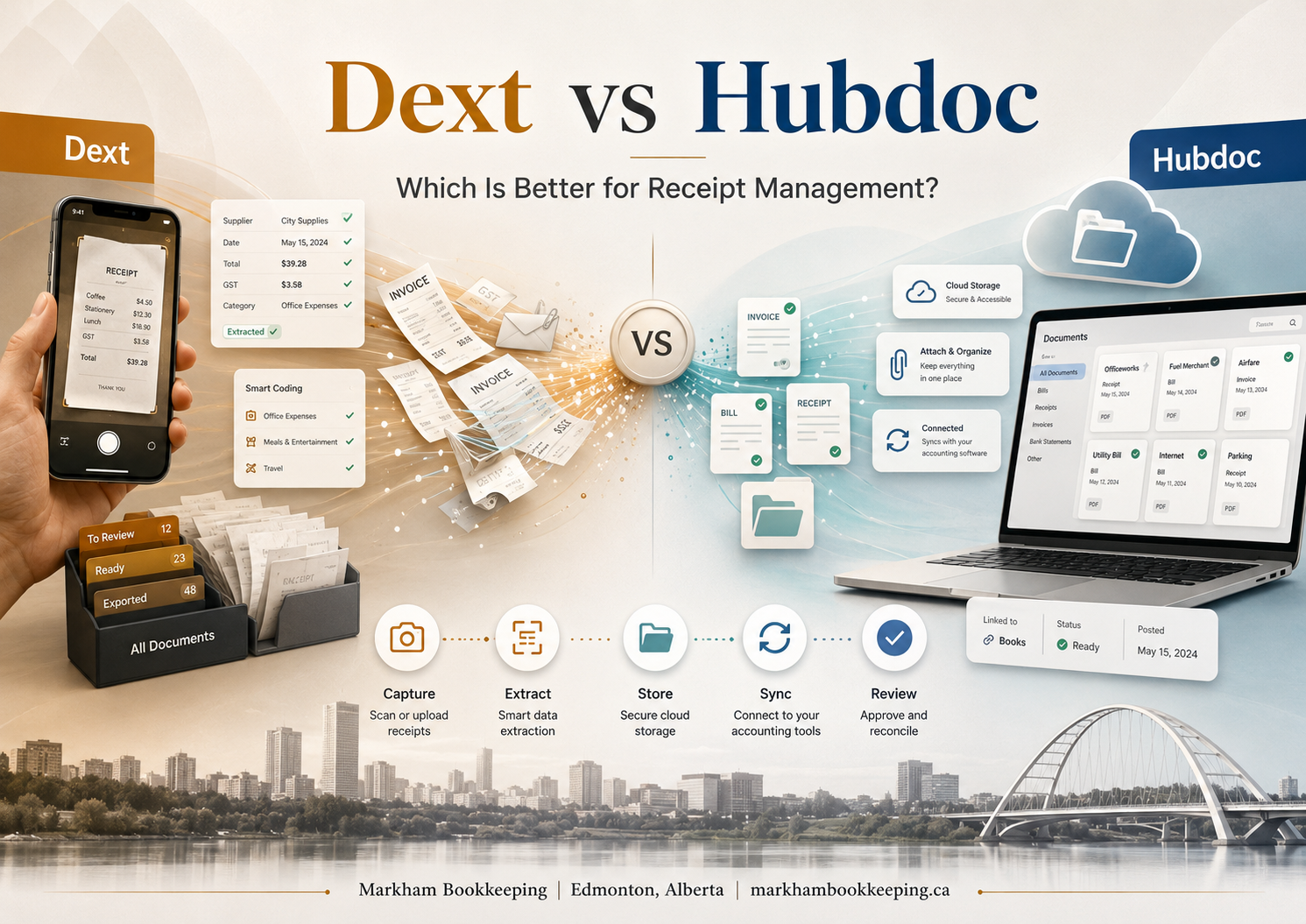
This is where receipt management apps like Dext and Hubdoc can help.
Both tools are designed to reduce manual data entry, organize receipts and invoices, and help businesses keep better records. But they are not exactly the same. For Edmonton small businesses, choosing between Dext and Hubdoc depends on the accounting software being used, the volume of receipts, the type of business, and how much automation is needed.
This guide explains Dext vs Hubdoc in simple terms so business owners can understand which one may be better for receipt management, bookkeeping, GST/HST records, and year-end tax preparation.
Why Receipt Management Matters for Small Businesses
Receipt management is not just about staying organized. It directly affects bookkeeping accuracy.
When receipts and invoices are missing, several problems can happen:
Expenses may be categorized incorrectly.
GST/HST input tax credits may be missed.
Business and personal expenses may get mixed.
Supplier bills may be entered twice.
The bookkeeper may waste time asking for documents.
Tax preparation may become stressful.
CRA support may be harder to provide if records are incomplete.
For Edmonton business owners, receipt management is especially important because many small businesses operate with a mix of credit cards, debit cards, e-transfers, supplier accounts, online purchases, vehicle expenses, meals, fuel, subcontractors, and home office costs. Without a proper system, paperwork can pile up quickly.
Good receipt management helps connect the transaction, the receipt, and the bookkeeping entry together. That makes the books easier to review, easier to reconcile, and easier to support if questions come up later.
What Is Dext?
Dext, formerly known as Receipt Bank, is a receipt and document capture tool used by many bookkeepers, accountants, and business owners. It allows users to upload receipts, bills, invoices, and other documents through a mobile app, email, or file upload. Dext then extracts key information from the document and can help push that information into accounting software such as QuickBooks Online, Xero, Sage, and other platforms.
The main purpose of Dext is to reduce manual data entry and keep source documents attached to the bookkeeping records.
For example, a business owner can take a photo of a fuel receipt from their phone. Dext can read the supplier name, date, amount, tax, and other details. The bookkeeper can then review it, code it to the correct expense category, and publish it to the accounting software.
Dext is commonly used when businesses have a lot of receipts, supplier invoices, contractor bills, or recurring expenses that need to be captured quickly.
What Is Hubdoc?
Hubdoc is another document collection and receipt management tool. It is owned by Xero and is commonly used with Xero accounting software, although it can also connect with other platforms such as QuickBooks Online.
Hubdoc allows users to upload or email bills, receipts, and invoices. It extracts important information and stores the documents online. Once processed, the document can be connected to transactions in the accounting software.
Hubdoc is often attractive to Xero users because it is included with many Xero subscriptions. For small businesses already using Xero, Hubdoc can be a simple way to start organizing receipts without paying for a separate receipt management app.
Dext vs Hubdoc: The Main Difference
The simplest way to look at the difference is this:
Dext is often better for businesses that need stronger receipt processing, more automation, and a smoother bookkeeping workflow.
Hubdoc is often better for businesses already using Xero that want a simple, included receipt storage and document capture tool.
Both can help with receipt management. Both can reduce manual data entry. Both can help store documents online. But Dext often feels more powerful for bookkeeping firms and businesses with higher document volume, while Hubdoc is often more basic and practical for smaller Xero-based businesses.
The best choice depends on how the business actually works.
When Dext May Be the Better Choice
Dext may be a better option for businesses with frequent receipts, multiple users, more complex bookkeeping, or a bookkeeper who wants a more efficient document workflow.
For example, Dext may work well for:
Construction contractors with fuel, materials, tools, and subcontractor receipts.
Restaurants with supplier invoices, food purchases, delivery platform fees, and operating expenses.
Retail businesses with supplier bills, inventory purchases, shipping costs, and merchant fee records.
E-commerce sellers with platform fees, advertising expenses, shipping receipts, and product costs.
Consultants and professionals who need to track meals, travel, software, and office expenses.
Nonprofits that need organized backup for grants, programs, departments, and board reporting.
For Edmonton small businesses that are behind on bookkeeping or constantly losing receipts, Dext can help create a better habit. Instead of waiting until month-end or year-end, the business owner can upload receipts as they happen. This gives the bookkeeper faster access to the paperwork and reduces the need for repeated follow-ups.
Dext may also be a strong choice when the business uses QuickBooks Online and wants a dedicated tool that works well with bookkeeping workflows.
When Hubdoc May Be the Better Choice
Hubdoc may be the better option for a small business that already uses Xero and wants a simple document capture system without adding another paid tool.
For example, Hubdoc may work well for:
A small consulting business using Xero.
A freelancer with limited monthly receipts.
A service business with simple expenses.
A small nonprofit already using Xero.
A business owner who mainly needs to upload receipts and bills for storage.
A company that wants to attach documents to transactions without a complicated setup.
For businesses with fewer documents, Hubdoc can be enough. If the main goal is to stop losing receipts and keep everything attached to the accounting records, Hubdoc may do the job well.
The key is to be realistic. Hubdoc can help organize documents, but if the business has a high volume of supplier invoices, multiple users, complex expense coding, or heavy bookkeeping cleanup needs, Dext may provide a smoother workflow.
Receipt Capture and Uploading
Both Dext and Hubdoc allow users to capture receipts through a mobile app or upload documents electronically.
This is important because business owners do not always receive receipts in one format. Some receipts are paper. Some invoices are PDFs. Some bills arrive by email. Some online purchases are stored in supplier portals.
A good receipt management process should allow documents to be captured quickly from different places.
For example:
A fuel receipt can be photographed on the phone.
A supplier invoice can be forwarded by email.
A PDF bill can be uploaded from a computer.
A restaurant receipt can be captured before it fades or gets lost.
For busy Edmonton business owners, the best system is the one that gets used consistently. The tool matters, but the habit matters more.
Data Extraction and Bookkeeping Accuracy
Dext and Hubdoc both extract information from documents, but business owners should understand one important point: automation does not replace review.
Receipt apps can read the supplier, date, amount, tax, and invoice number, but the bookkeeping still needs judgment. The software may not always know whether something should be meals, office supplies, repairs, advertising, cost of goods sold, or shareholder loan.
This is where a bookkeeper still matters.
For example, a receipt from Costco could be groceries, office supplies, staff kitchen expenses, resale inventory, or personal spending. The software can read the total, but it may not know the business purpose.
That is why receipt management should be combined with proper bookkeeping review. The app captures the document. The bookkeeper makes sure it is recorded correctly.
GST/HST Tracking
For Canadian businesses, GST/HST tracking is one of the biggest reasons to keep receipts organized.
If a business is registered for GST/HST, it may be able to claim input tax credits on eligible business purchases. But the business needs proper support. A bank transaction alone does not always show the GST/HST breakdown.
Receipts and invoices help show:
The supplier name.
The date of purchase.
The business purpose.
The amount paid.
The GST/HST charged.
The invoice number when applicable.
The description of goods or services.
If receipts are missing, GST/HST claims can become messy. This is especially common when business owners rely only on bank feeds. Bank feeds show money leaving the account, but they do not always show tax details or business purpose.
Dext and Hubdoc can both help by storing the source document with the transaction. This makes GST/HST review easier and helps reduce tax-time stress.
Integration With Accounting Software
A receipt management app is most useful when it connects properly with the accounting software.
Dext works with several accounting platforms, including QuickBooks Online, Xero, Sage, and others. This makes it flexible for different bookkeeping setups.
Hubdoc is closely connected with Xero and is commonly used by Xero users. It can also work with QuickBooks Online, but many businesses think of Hubdoc primarily as part of the Xero ecosystem.
For Edmonton businesses using QuickBooks Online, Dext may often feel like the stronger option. For businesses using Xero, Hubdoc may be a simple place to start, especially if it is already included with the subscription.
However, the best choice should depend on the full bookkeeping process, not only the software name.
Cost Considerations
Pricing can change, so business owners should always check current pricing before making a decision.
In general, Hubdoc may be more cost-effective for businesses already using Xero because it is often included with Xero plans. Dext is usually a separate paid tool, but it may save time for businesses with more receipts, more supplier invoices, or more bookkeeping complexity.
The real question is not only, “Which app is cheaper?”
The better question is:
Which app saves more time?
Which app reduces missing receipts?
Which app makes bookkeeping easier?
Which app helps avoid cleanup costs later?
A cheaper tool that does not get used properly may not save money. A paid tool that reduces admin time, improves records, and helps the bookkeeper work faster may be worth the cost.
Dext vs Hubdoc for Different Businesses
Here is a simple way to think about it.
Dext may be better for:
Businesses using QuickBooks Online.
Businesses with lots of receipts.
Businesses with multiple employees submitting expenses.
Businesses with frequent supplier invoices.
Businesses needing stronger bookkeeping workflow.
Businesses doing bookkeeping cleanup.
Businesses that want more automation.
Hubdoc may be better for:
Businesses already using Xero.
Businesses with simple receipt needs.
Freelancers or consultants with fewer expenses.
Small businesses wanting basic document capture.
Businesses wanting an included tool before paying for another app.
Business owners who mainly need digital receipt storage.
There is no one-size-fits-all answer. A small consultant and a busy retail store do not need the same receipt system. A nonprofit with grant reporting may need more structure than a solo contractor with a few monthly expenses.
Common Receipt Management Mistakes
No matter which app you choose, the biggest mistakes are usually the same.
Uploading receipts late.
Forgetting to include the business purpose.
Mixing personal and business receipts.
Not attaching invoices to supplier bills.
Relying only on bank feeds.
Not reviewing GST/HST properly.
Using too many expense categories.
Not reconciling accounts monthly.
Thinking the app replaces bookkeeping.
Dext and Hubdoc are tools. They help collect and organize the paperwork, but they do not automatically fix poor bookkeeping habits.
A good receipt management system should be simple enough that the business owner actually follows it every week.
Which One Is Better?
For many Edmonton small businesses, Dext is the better choice if the business has a higher volume of receipts, uses QuickBooks Online, needs stronger automation, or works closely with a bookkeeper who manages the monthly process.
Hubdoc is a good option if the business uses Xero, has simpler document needs, and wants an included tool for receipt storage and basic data capture.
So the practical answer is:
Choose Dext if receipt management is a major pain point and you need a stronger workflow.
Choose Hubdoc if you already use Xero and need a simple system to stop losing receipts.
The best tool is the one that fits your bookkeeping process and gets used consistently.
How Markham Bookkeeping Can Help
Choosing between Dext and Hubdoc is only one part of the bigger bookkeeping system.
Markham Bookkeeping helps Edmonton small businesses organize receipts, clean up old records, track GST/HST, reconcile accounts, and build monthly bookkeeping workflows that make sense.
Whether your business uses QuickBooks Online, Xero, Sage, Dext, Hubdoc, or another system, the goal is the same: clean records, fewer missing documents, better tax preparation, and financial reports you can trust.
If your receipts are scattered across emails, glove boxes, folders, text messages, and supplier portals, it may be time to build a better system.
Clean receipt management leads to cleaner books.
Final Thoughts
Dext and Hubdoc can both help small businesses manage receipts and reduce paperwork. The right choice depends on the business size, accounting software, receipt volume, and bookkeeping needs.
For simple Xero-based businesses, Hubdoc may be enough. For businesses with more documents, more complexity, or stronger bookkeeping needs, Dext may be the better long-term option.
But the tool alone is not the solution.
The real solution is having a consistent process: capture the receipt, attach it to the transaction, review the category, track GST/HST properly, and reconcile the books every month.
For Edmonton business owners, better receipt management means less stress, cleaner books, and fewer surprises at tax time.
FAQ
Is Dext better than Hubdoc?
Dext may be better for businesses with higher receipt volume, more complex bookkeeping, or QuickBooks Online workflows. Hubdoc may be better for Xero users who need simple document capture and storage.
Is Hubdoc included with Xero?
Hubdoc is commonly included with Xero subscriptions when connected to Xero. Business owners should check their current Xero plan details to confirm what is included.
Can Dext and Hubdoc help with GST/HST?
Yes. Both tools can help store receipts and invoices, which makes GST/HST review easier. However, the bookkeeper still needs to make sure GST/HST is recorded correctly.
Do receipt apps replace a bookkeeper?
No. Receipt apps help capture and organize documents, but they do not replace bookkeeping judgment. A bookkeeper still needs to review categories, GST/HST, reconciliations, and financial reports.
Which receipt app is best for QuickBooks Online?
Many QuickBooks Online users prefer Dext because it is widely used in bookkeeping workflows and integrates with QuickBooks Online. However, the best choice depends on the business needs.
Which receipt app is best for Xero?
Hubdoc is often a good starting point for Xero users because it is closely connected with Xero and may already be included with the subscription. Dext can also work well with Xero for businesses needing more automation.
Why should Edmonton businesses use receipt management software?
Receipt management software helps Edmonton businesses avoid missing documents, improve GST/HST tracking, reduce bookkeeping cleanup, and make tax preparation easier.