
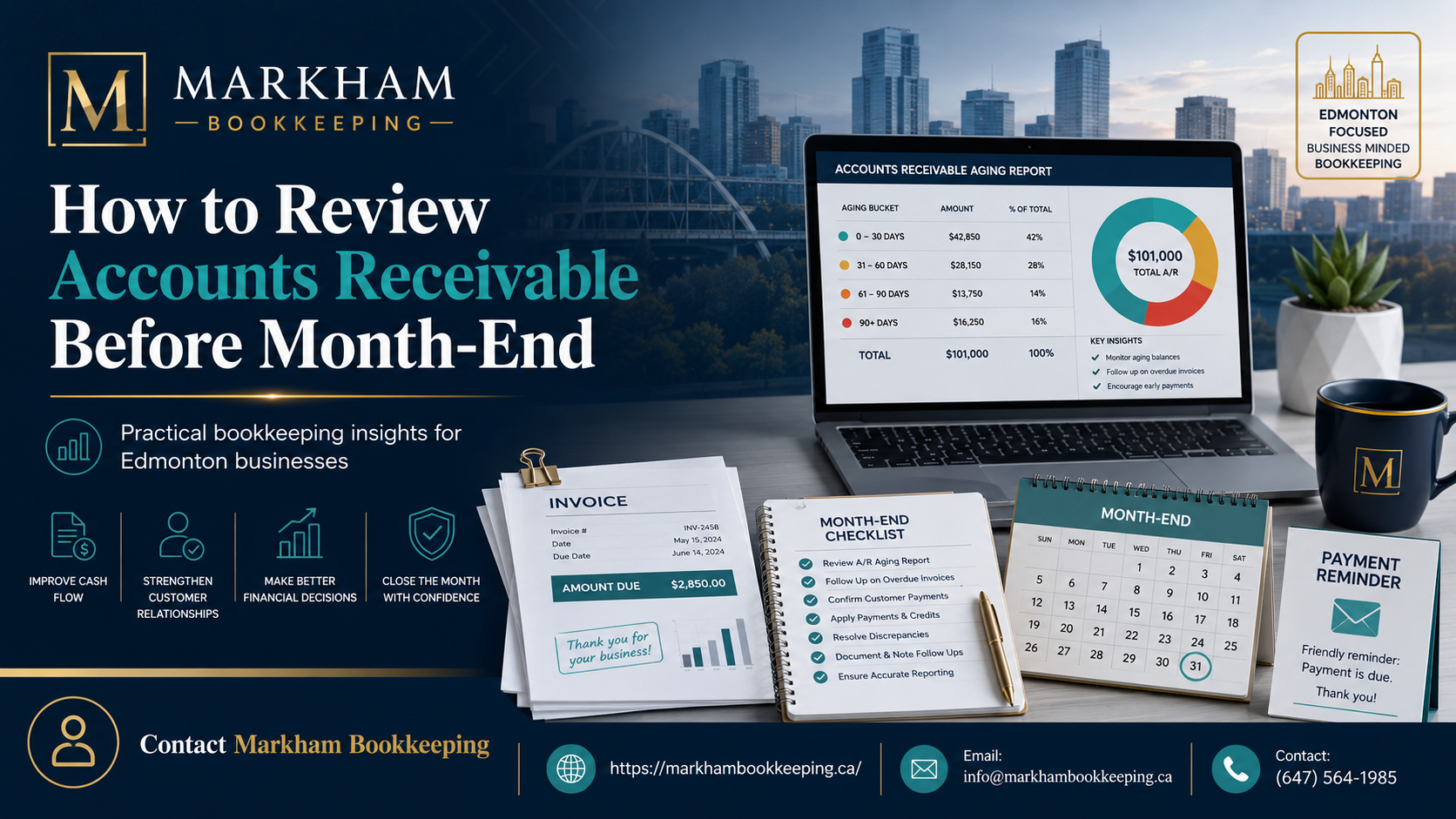
For many Edmonton small businesses, month-end bookkeeping becomes stressful because accounts receivable are not reviewed early enough. Sales may look strong on the profit and loss statement, but if customers have not paid, the business may still struggle with cash flow. That is why reviewing accounts receivable before month-end is one of the most important bookkeeping habits for business owners, contractors, consultants, retailers, service providers, and professional firms in Edmonton.
Accounts receivable, often called A/R, represents money owed to your business by customers. These are invoices you have issued but have not collected yet. If your accounts receivable are not accurate, your financial reports may show revenue that does not match your real cash position. For Edmonton businesses that deal with payroll, GST, supplier bills, rent, vehicle expenses, loan payments, and operating costs, this can create serious pressure.
A proper accounts receivable review before month-end helps you confirm what is collectible, what is overdue, what needs follow-up, and what may need to be adjusted. It also helps your Edmonton bookkeeper or accountant prepare cleaner month-end reports, better cash flow summaries, and more reliable financial statements.
Why Accounts Receivable Review Matters Before Month-End
Month-end is not just about closing the books. It is about making sure the numbers tell the truth. If your accounts receivable balance is overstated, your business may appear more profitable than it really is. If your invoices are missing, duplicated, or recorded to the wrong customer, your reporting can become misleading.
For example, an Edmonton contractor may complete a job in June and issue an invoice at month-end. If that invoice is not entered properly, revenue may be understated. On the other hand, if an invoice was created but later cancelled, and the cancellation was not recorded, revenue and accounts receivable may be overstated.
This is why accounts receivable review should happen before month-end closing, not after. Once reports are sent to owners, lenders, managers, or accountants, incorrect receivable balances can lead to poor decisions.
For Edmonton small businesses, reviewing accounts receivable helps answer important questions:
Are customers paying on time?
Which invoices are overdue?
Is cash flow tight because sales are slow, or because collections are delayed?
Are old balances still collectible?
Are customer deposits or advances recorded correctly?
Are GST amounts on invoices accurate?
Are credit notes, discounts, and write-offs properly recorded?
These questions matter because a business can be profitable on paper but still short on cash.
Step 1: Run the Accounts Receivable Aging Report
The first step is to run an accounts receivable aging report from your accounting software. This report usually groups unpaid invoices into categories such as current, 1–30 days overdue, 31–60 days overdue, 61–90 days overdue, and over 90 days overdue.
For Edmonton businesses using QuickBooks Online, Xero, Sage, or another accounting system, this report is one of the most useful month-end tools. It shows how much money customers owe and how long the balances have been outstanding.
When reviewing the A/R aging report, look for large overdue balances first. A small invoice that is one week overdue may not be urgent, but a large invoice that is 60 or 90 days overdue can create cash flow issues quickly.
Pay attention to invoices over 90 days old. These balances may need stronger collection efforts, a payment plan, or possible write-off consideration. If your business has many old receivables, your reports may be showing income that may never turn into cash.
Step 2: Compare A/R Aging to the General Ledger
Your accounts receivable aging report should match the accounts receivable balance on your balance sheet. If the two reports do not agree, there may be posting errors, journal entries, deleted transactions, unapplied payments, or software setup issues.
This step is important for Edmonton bookkeeping because many business owners only check customer invoices but do not compare them to the balance sheet. A/R is not just a customer list. It is also an accounting control account. The customer subledger and the general ledger should agree.
If your balance sheet shows $75,000 in accounts receivable but your aging report only shows $68,000, you need to investigate the difference before closing the month. The issue could be caused by manual journal entries posted directly to accounts receivable, customer payments not applied properly, or invoices dated in the wrong period.
A clean month-end process should include checking that the A/R aging total matches the balance sheet total as of the same date.
Step 3: Review Unapplied Customer Payments
Unapplied payments are common in small business bookkeeping. This happens when a customer payment is recorded, but it is not matched to the correct invoice. The customer may have paid, but the invoice still appears open on the aging report.
This can make your accounts receivable look worse than it really is. It can also create confusion when following up with customers. You do not want to ask an Edmonton customer to pay an invoice they already paid.
Before month-end, review customer payments that have not been applied. Match payments to invoices wherever possible. If the payment relates to multiple invoices, allocate it correctly. If the payment is a deposit or advance, make sure it is recorded in the right account and not incorrectly applied as revenue.
Unapplied payments can also affect customer statements. If your business sends statements at month-end, errors in payment application can damage trust and create unnecessary back-and-forth.
Step 4: Check for Duplicate or Missing Invoices
Duplicate invoices can overstate revenue and accounts receivable. Missing invoices can understate revenue and make your month-end results look weaker than reality.
For Edmonton service businesses, this often happens when work is completed but the invoice is delayed. For contractors, trades, and project-based businesses, invoices may depend on progress billing, change orders, holdbacks, or approvals. For professional service providers, invoices may be based on time, retainers, or monthly service agreements.
Before month-end, compare completed work, sales records, contracts, job reports, or delivery records to invoices issued. Ask yourself whether every completed job has been invoiced. Also check whether any invoice was accidentally entered twice.
A simple invoice review can prevent major reporting problems.
Step 5: Confirm Customer Deposits and Advances
Customer deposits and advances should not always be recorded as revenue immediately. In many cases, if the work has not been completed or the service has not been provided, the amount may need to be recorded as a liability until earned.
This is especially important for Edmonton businesses that collect retainers, deposits, booking fees, or upfront payments. Examples include contractors, consultants, event service providers, repair shops, and professional firms.
Before month-end, review whether customer deposits are recorded correctly. If the service has now been completed, the deposit may need to be applied against the invoice. If the work is still pending, the amount may need to remain as a liability.
This matters because recording deposits incorrectly can distort both revenue and accounts receivable. It can also create GST reporting issues if tax is charged or payable at a specific point.
Step 6: Review Credit Notes, Discounts, and Adjustments
Not every invoice will be collected in full. Sometimes businesses issue discounts, credit notes, refunds, or corrections. If these are not recorded properly, your accounts receivable may remain overstated.
Before month-end, review any customer disputes, returns, service issues, pricing corrections, or approved discounts. Make sure credit notes are entered and applied to the right invoices.
For example, if an Edmonton customer was invoiced $5,000 but later received a $500 discount due to a billing correction, the receivable should not still show the full $5,000. The adjustment should be recorded before month-end so reports are accurate.
This also helps with collection. Your team should follow up based on the correct outstanding balance, not an old or disputed amount.
Step 7: Identify Bad Debts or Doubtful Accounts
Some accounts receivable may not be collectible. Customers may stop responding, dispute the invoice, close their business, or delay payment for months. Before month-end, review old balances and decide whether any need to be flagged as doubtful.
This does not always mean writing them off immediately. Sometimes the first step is to create a list of high-risk receivables and follow up more aggressively. In other cases, your accountant may recommend recording a bad debt expense or allowance for doubtful accounts.
For Edmonton businesses, this is especially important when preparing year-end financial statements or tax filings. Carrying old receivables that are unlikely to be collected can make the business look stronger than it really is.
A practical approach is to separate receivables into categories:
Current and likely collectible.
Overdue but actively being followed up.
Disputed or requiring adjustment.
Very old and possibly uncollectible.
This helps owners make better cash flow decisions.
Step 8: Send Customer Statements Before Month-End
Customer statements can be useful before month-end, especially if your business has recurring customers or multiple invoices per customer. A statement summarizes unpaid invoices, payments, credits, and outstanding balances.
Sending statements before month-end gives customers a chance to identify missing payments, disputed invoices, or errors before your books are closed. It also encourages faster collection.
For Edmonton businesses that rely on steady cash flow, this can make a real difference. A polite reminder sent before month-end may help collect invoices before payroll, rent, GST remittance, or supplier payments are due.
The statement should be clear and professional. Include invoice numbers, dates, amounts, payments received, and total balance owing.
Step 9: Follow Up on Overdue Invoices
Accounts receivable review is not only an accounting task. It is also a cash flow task. Once you identify overdue invoices, follow up with customers quickly.
A good follow-up process should be consistent. Do not wait until invoices are 90 days overdue. Start early with a friendly reminder. Then continue with stronger follow-ups if payment is not received.
For example:
Before due date: friendly reminder.
1–7 days overdue: payment follow-up.
15–30 days overdue: direct request for update.
30+ days overdue: payment plan or escalation.
60+ days overdue: owner or manager review.
Clear communication helps prevent receivables from becoming old and difficult to collect.
Step 10: Review Payment Terms
If many customers are paying late, the issue may not only be collection. It may be your payment terms. Some Edmonton businesses offer 30-day terms automatically, even when their own expenses are due much sooner.
Before month-end, review whether your payment terms still make sense. Are customers being given too much time? Are due dates clear on invoices? Are payment methods easy? Are late fees mentioned in your agreement? Are deposits required for larger jobs?
Improving payment terms can reduce accounts receivable problems before they happen.
For small businesses, faster payment terms such as due on receipt, 7 days, or 15 days may be more practical than 30 days. The right answer depends on the industry, customer relationship, and cash flow needs.
Step 11: Reconcile A/R with Bank Deposits
Customer payments should agree with bank deposits. If payments are entered in the accounting system but not deposited into the bank, there may be an issue with undeposited funds, payment processor timing, or bank reconciliation.
For Edmonton businesses using Stripe, Square, Moneris, Clover, PayPal, or e-transfer, deposits may not match invoices exactly because of processing fees, timing differences, chargebacks, or batch deposits.
Before month-end, review whether customer payments have been deposited and reconciled. Make sure payment processor fees are recorded separately and not simply netted against sales unless your accounting method is designed that way.
This step helps ensure both accounts receivable and bank balances are accurate.
Step 12: Check GST on Customer Invoices
GST errors on customer invoices can create problems at filing time. If GST is charged incorrectly, not charged when required, or posted to the wrong tax code, your GST return may be wrong.
Before month-end, review invoices for correct GST treatment. This is especially important for Edmonton and Alberta businesses because the standard GST rate is commonly part of day-to-day invoicing.
Check whether taxable sales were coded correctly. Review exempt or zero-rated items carefully. Make sure credit notes also reverse GST correctly where applicable.
GST mistakes can affect revenue, accounts receivable, and tax payable. A monthly review makes GST filing easier and reduces the chance of cleanup work later.
Step 13: Prepare a Month-End A/R Summary
After reviewing accounts receivable, prepare a short summary for the business owner or management team. This does not need to be complicated. A simple month-end A/R summary can include:
Total accounts receivable.
Total overdue amount.
Largest overdue customers.
Invoices over 60 or 90 days.
Unapplied payments fixed.
Adjustments or credit notes posted.
Expected collections next month.
Potential bad debts.
This summary gives Edmonton business owners a clearer view of cash flow. It also helps them understand whether the business has a sales problem, a collection problem, or a reporting problem.
Common Accounts Receivable Mistakes Edmonton Businesses Should Avoid
Many small businesses make the same A/R mistakes every month. These include issuing invoices late, not applying payments properly, ignoring old balances, failing to send statements, not reviewing customer deposits, and relying only on bank balance instead of proper receivable reports.
Another common mistake is assuming revenue equals cash. It does not. Revenue can be recorded when an invoice is issued, but cash is only available when payment is received. This is why accounts receivable review is so important for cash flow planning.
Edmonton businesses also need to be careful with project billing, progress invoices, holdbacks, partial payments, and customer credits. These situations can quickly create messy receivable reports if not reviewed regularly.
How an Edmonton Bookkeeper Can Help with Accounts Receivable
A professional Edmonton bookkeeper can help keep accounts receivable clean throughout the month, not just at month-end. This includes entering invoices, applying payments, reconciling deposits, reviewing aging reports, following up on old balances, preparing customer statements, and supporting GST accuracy.
For businesses with high transaction volume, multiple customers, or project-based billing, monthly A/R review can save hours of cleanup later. It also gives business owners better information for decision-making.
Clean accounts receivable help answer key questions:
How much cash should come in soon?
Which customers need follow-up?
Are sales being collected properly?
Are invoices being issued on time?
Is the business carrying too much old receivable balance?
These answers help Edmonton business owners manage cash flow with more confidence.
Final Thoughts
Reviewing accounts receivable before month-end is one of the best habits an Edmonton business can build. It keeps reports accurate, improves cash flow, reduces collection problems, and helps owners understand the real financial position of the business.
A/R review should not be left until year-end or tax season. By then, old balances may be harder to collect, missing invoices may be harder to trace, and customer payment issues may be harder to fix.
For Edmonton small businesses, contractors, consultants, retailers, trades, and service providers, a monthly accounts receivable review can make bookkeeping cleaner and cash flow stronger.
If your business has overdue invoices, unapplied payments, customer deposits, or unclear receivable balances, month-end is the right time to clean it up before the reports are finalized.
Need help reviewing accounts receivable or cleaning up your monthly bookkeeping? Contact Markham Bookkeeping for bookkeeping, payroll, GST, and month-end support.