For many small business owners in Edmonton, bookkeeping can feel like something that only matters at tax time. Receipts get uploaded, bank transactions get categorized, invoices get sent, and payroll gets processed. But the real value of bookkeeping is not just in recording transactions. The real value comes from reviewing the books every month and understanding what the numbers are saying.
A monthly bookkeeping review helps Edmonton business owners catch errors early, understand cash flow, prepare for GST filings, monitor expenses, and make better decisions. Whether you run a construction company, car dealership, consulting business, retail store, restaurant, or professional service business, your books should not sit untouched until year-end.
When accountants review monthly bookkeeping, they are looking for accuracy, consistency, missing information, unusual transactions, tax risks, and business trends. A good monthly review can prevent messy books, surprise tax bills, incorrect reports, and costly cleanup work later.
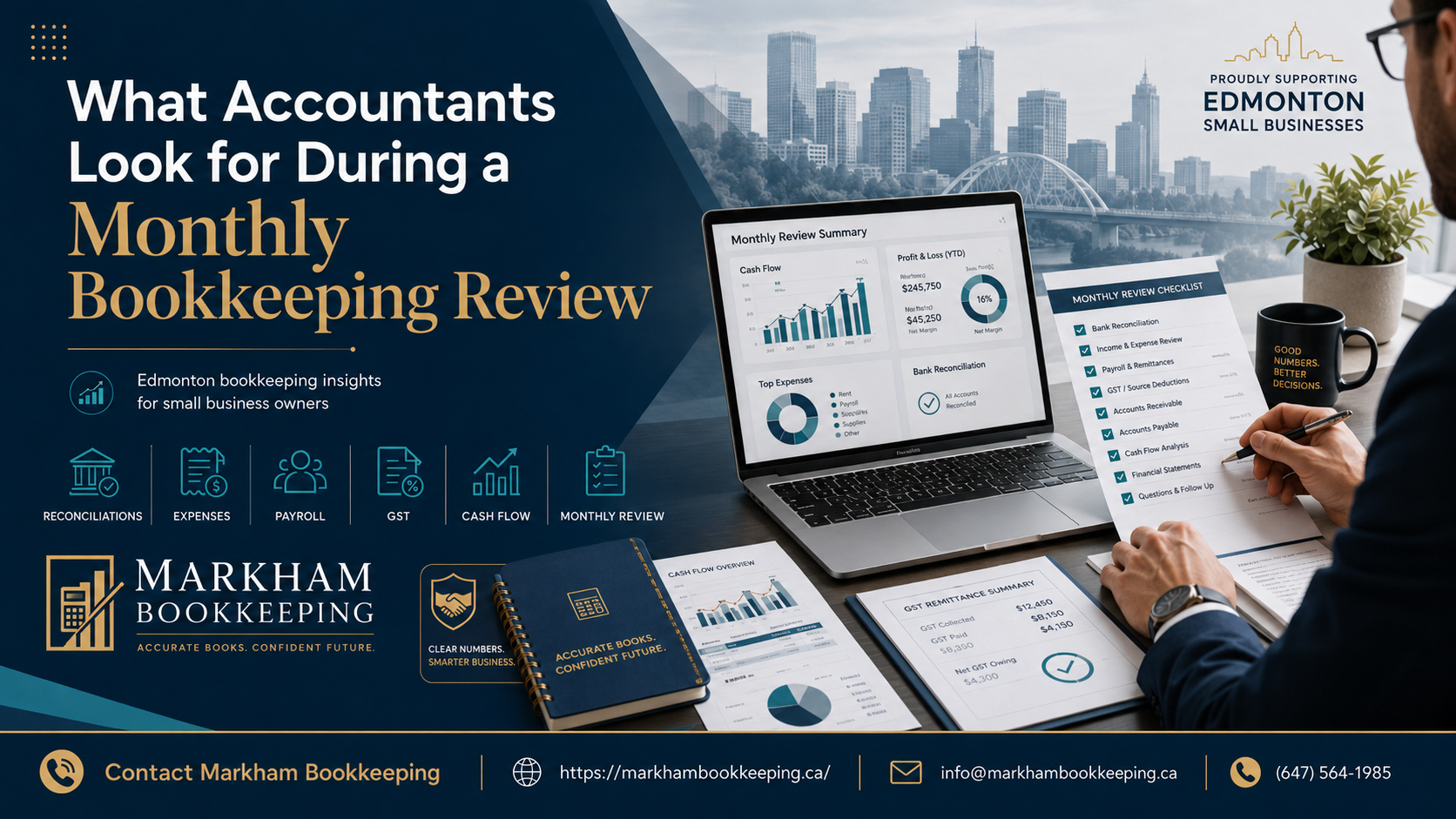
Below is what accountants usually look for during a monthly bookkeeping review.
1. Bank and Credit Card Reconciliations
The first thing accountants look for is whether all bank and credit card accounts have been reconciled properly.
Bank reconciliation means comparing the transactions in your accounting software with your actual bank statement. This helps confirm that every deposit, payment, bank fee, loan payment, transfer, and credit card charge has been recorded correctly.
For Edmonton small businesses, this step is critical because many bookkeeping problems start with unreconciled bank accounts. If the bank balance in QuickBooks Online, Xero, Sage, or another accounting system does not match the actual bank statement, the financial reports may not be reliable.
Accountants usually check:
- Are all bank accounts reconciled to the month-end statement?
- Are credit cards reconciled?
- Are there duplicate transactions?
- Are transfers recorded properly?
- Are deposits matched to invoices or sales?
- Are old outstanding items still sitting uncleared?
- Are bank fees, merchant fees, and loan payments posted correctly?
A clean bank reconciliation is the foundation of accurate bookkeeping. Without it, the profit and loss statement, balance sheet, GST report, and cash flow reports can all be wrong.
2. Uncategorised and Misclassified Transactions
Another major area accountants review is uncategorised transactions. Many business owners rely on bank feeds, rules, or automatic suggestions in accounting software. While these tools are helpful, they are not perfect.
For example, a payment to a vendor may be posted to office supplies when it should be repairs and maintenance. A vehicle loan payment may be posted fully to an expense account when part of it should reduce the loan balance. A credit card payment may be recorded as an expense instead of a transfer.
During a monthly bookkeeping review, accountants check whether transactions are posted to the right accounts. This includes revenue, cost of goods sold, expenses, assets, liabilities, owner draws, shareholder loans, and loan accounts.
For Edmonton businesses, proper classification matters because your reports should show the real picture of your business. If expenses are not categorized correctly, you may think one area of the business is more profitable than it really is.
3. Revenue and Sales Accuracy
Accountants also review revenue to make sure sales are recorded properly. This is especially important for businesses with multiple payment methods, such as cash, debit, credit card, e-transfer, online payments, POS systems, and third-party processors.
A monthly bookkeeping review looks at whether all sales have been recorded, whether deposits make sense, and whether sales reports match the amounts received in the bank.
For example, a restaurant in Edmonton may have sales from its POS system, SkipTheDishes, Uber Eats, debit deposits, and cash. A car dealership may have vehicle sales, deposits, finance proceeds, trade-ins, and refunds. A contractor may have progress billings, customer deposits, holdbacks, and final invoices.
Accountants look for:
- Missing sales invoices
- Duplicate sales
- Customer deposits recorded incorrectly as revenue
- Merchant fees deducted from deposits
- Sales tax recorded correctly
- Refunds and discounts posted properly
- Accounts receivable balances that appear too old
Accurate revenue matters because it affects profit, GST, corporate tax, and cash flow.
4. Expense Review and Reasonableness
A monthly bookkeeping review also includes checking business expenses. Accountants look at whether expenses are reasonable, properly supported, and posted to the right month.
Some expenses are straightforward, such as rent, utilities, insurance, phone bills, software subscriptions, and office supplies. Other expenses need more attention, such as meals, vehicle expenses, shareholder payments, subcontractor payments, repairs, and equipment purchases.
For Edmonton small businesses, this step helps avoid tax-time confusion. If receipts are missing or expenses are mixed with personal spending, it becomes harder to support deductions later.
Accountants usually ask:
- Are expenses business-related?
- Are receipts or invoices attached?
- Are large purchases posted as assets instead of expenses?
- Are meals and entertainment separated properly?
- Are vehicle expenses reasonable and supported?
- Are personal expenses coded to shareholder loan or owner draws?
- Are recurring expenses consistent with prior months?
This review helps keep the profit and loss statement clean and reliable.
5. GST and Sales Tax Review
For many Edmonton businesses, GST is one of the most important areas of bookkeeping. A monthly review helps ensure GST collected and GST paid are tracked properly before filing deadlines.
Accountants check whether sales tax is being charged correctly, whether input tax credits are recorded properly, and whether the GST/HST payable account makes sense.
Common GST issues include:
- GST not charged when it should be
- GST charged on exempt or zero-rated items
- Expenses recorded without claiming eligible GST
- GST claimed on personal expenses
- GST claimed on non-eligible items
- Sales tax reports not matching the balance sheet
- Old GST balances sitting unpaid
For businesses registered for GST in Canada, monthly bookkeeping reviews make GST filing much smoother. Instead of rushing through months of transactions at the deadline, the business can stay organized throughout the year.
6. Payroll and Source Deduction Review
If your Edmonton business has employees, payroll should be reviewed monthly. Payroll errors can create issues with CRA remittances, employee records, T4 slips, vacation pay, and year-end reporting.
Accountants look at whether wages, employer CPP, employer EI, vacation pay, benefits, payroll liabilities, and source deductions are recorded correctly.
They may check:
- Do payroll expenses match payroll reports?
- Are CPP, EI, and income tax deductions posted correctly?
- Are employer payroll costs recorded?
- Are payroll remittances paid on time?
- Is vacation pay tracked properly?
- Are taxable benefits recorded correctly?
- Are employee advances or reimbursements handled properly?
Payroll mistakes can become expensive if not caught early. A monthly review helps ensure payroll liabilities are accurate and CRA remittances are not missed.
7. Accounts Receivable Review
Accounts receivable shows money customers owe your business. During a monthly bookkeeping review, accountants check whether receivables are collectible, accurate, and up to date.
For service businesses, contractors, consultants, and trades businesses in Edmonton, accounts receivable can have a major impact on cash flow. A business may show profit on paper but still struggle if customers are not paying on time.
Accountants look for:
- Old unpaid invoices
- Duplicate invoices
- Customer payments not matched correctly
- Credit balances
- Bad debts
- Deposits recorded incorrectly
- Invoices that should be followed up
A monthly review of accounts receivable helps business owners see which customers need attention and whether collection processes need improvement.
8. Accounts Payable Review
Accounts payable shows what the business owes to suppliers, contractors, credit cards, lenders, and other vendors. Accountants review payable balances to make sure bills are entered correctly and not duplicated.
This is important because overstated payables can make expenses look higher than they are, while missing bills can make profit look better than reality.
Accountants usually check:
- Are supplier bills entered in the correct month?
- Are duplicate bills posted?
- Are vendor credits applied?
- Are old unpaid bills still valid?
- Are credit card bills and loan payments recorded properly?
- Are subcontractor or supplier balances accurate?
For Edmonton businesses managing multiple vendors, suppliers, or subcontractors, this step keeps financial reporting more accurate.
9. Balance Sheet Review
A strong monthly bookkeeping review does not only look at the profit and loss statement. Accountants also review the balance sheet.
The balance sheet shows what the business owns, what it owes, and what belongs to the owner or shareholders. Many bookkeeping mistakes hide on the balance sheet.
Accountants review accounts such as:
- Bank accounts
- Credit cards
- Loans
- GST payable
- Payroll liabilities
- Accounts receivable
- Accounts payable
- Inventory
- Prepaid expenses
- Equipment and vehicles
- Shareholder loans
- Owner draws
- Customer deposits
A balance sheet review helps catch problems that may not be obvious from the income statement alone. For example, a business may show profit, but the shareholder loan account may reveal personal expenses mixed into the company books.
10. Profit and Loss Review
The profit and loss statement shows revenue, expenses, and net income. Accountants review this report monthly to see whether the numbers make sense.
They compare current-month activity to previous months, budget, expectations, or industry patterns. If rent doubled, sales dropped suddenly, subcontractor costs increased, or software expenses are unusually high, accountants investigate.
For Edmonton small businesses, monthly profit and loss review helps answer important questions:
- Is the business actually profitable?
- Are expenses increasing faster than revenue?
- Are margins improving or getting worse?
- Which expense categories need attention?
- Are there seasonal changes?
- Are there unusual transactions?
This report helps owners move from guessing to decision-making.
11. Cash Flow and Owner Withdrawals
Profit and cash flow are not the same thing. A business can show profit but still be short on cash because of unpaid invoices, loan payments, inventory purchases, taxes, or owner withdrawals.
During a monthly bookkeeping review, accountants look at cash flow patterns and whether the business has enough money for upcoming obligations.
They may review:
- Cash in bank
- Upcoming bills
- Payroll obligations
- GST payable
- Loan payments
- Owner draws or shareholder withdrawals
- Customer collections
- Large upcoming expenses
For Edmonton business owners, cash flow review is one of the most valuable parts of monthly bookkeeping because it helps avoid surprises.
12. Missing Documents and Audit Readiness
Accountants also check whether important documents are missing. This includes receipts, supplier invoices, bank statements, credit card statements, payroll reports, loan statements, lease documents, and sales reports.
Clean documentation matters if CRA asks for support. It also matters at year-end when preparing tax returns or financial statements.
A monthly review helps keep records organized while the information is still fresh. Waiting until year-end makes it harder to remember what a transaction was for.
13. Month-End Adjustments
Some transactions need monthly adjusting entries. Depending on the business, accountants may review or record adjustments for:
- Depreciation
- Prepaid insurance
- Accrued expenses
- Deferred revenue
- Inventory adjustments
- Loan interest
- Payroll accruals
- Merchant fees
- Bad debts
- Work in progress
These entries help make the monthly reports more accurate. Without them, profit may be overstated or understated.
Why Monthly Bookkeeping Reviews Matter for Edmonton Businesses
A monthly bookkeeping review is not just about fixing mistakes. It gives Edmonton business owners better control over their numbers.
With a proper monthly review, you can:
- Catch errors before they grow
- Prepare for GST and payroll deadlines
- Understand profit and cash flow
- Keep records organized
- Reduce year-end bookkeeping cleanup
- Make better business decisions
- Avoid relying on inaccurate reports
- Improve communication with your accountant
For many small businesses, monthly bookkeeping is the difference between reacting late and managing proactively.
Final Thoughts
Accountants look for more than just whether transactions were entered. They look at the full financial picture: bank reconciliations, revenue, expenses, GST, payroll, receivables, payables, the balance sheet, cash flow, and supporting documents.
For Edmonton small businesses, a monthly bookkeeping review can prevent year-end stress and help owners understand what is really happening in the business. Clean books are not just useful for tax filing. They are useful for pricing, hiring, budgeting, financing, growth, and daily decision-making.
If your books are only reviewed once a year, small mistakes can turn into major cleanup projects. But when your bookkeeping is reviewed monthly, your numbers become clearer, your tax filings become easier, and your business decisions become stronger.
Need monthly bookkeeping support in Edmonton? Markham Bookkeeping helps small business owners stay organized with bookkeeping, GST, payroll, reconciliations, and financial reporting.
Website: https://markhambookkeeping.ca/For many small business owners in Edmonton, bookkeeping can feel like something that only matters at tax time. Receipts get uploaded, bank transactions get categorized, invoices get sent, and payroll gets processed. But the real value of bookkeeping is not just in recording transactions. The real value comes from reviewing the books every month and understanding what the numbers are saying.
A monthly bookkeeping review helps Edmonton business owners catch errors early, understand cash flow, prepare for GST filings, monitor expenses, and make better decisions. Whether you run a construction company, car dealership, consulting business, retail store, restaurant, or professional service business, your books should not sit untouched until year-end.
When accountants review monthly bookkeeping, they are looking for accuracy, consistency, missing information, unusual transactions, tax risks, and business trends. A good monthly review can prevent messy books, surprise tax bills, incorrect reports, and costly cleanup work later.
Below is what accountants usually look for during a monthly bookkeeping review.
1. Bank and Credit Card Reconciliations
The first thing accountants look for is whether all bank and credit card accounts have been reconciled properly.
Bank reconciliation means comparing the transactions in your accounting software with your actual bank statement. This helps confirm that every deposit, payment, bank fee, loan payment, transfer, and credit card charge has been recorded correctly.
For Edmonton small businesses, this step is critical because many bookkeeping problems start with unreconciled bank accounts. If the bank balance in QuickBooks Online, Xero, Sage, or another accounting system does not match the actual bank statement, the financial reports may not be reliable.
Accountants usually check:
- Are all bank accounts reconciled to the month-end statement?
- Are credit cards reconciled?
- Are there duplicate transactions?
- Are transfers recorded properly?
- Are deposits matched to invoices or sales?
- Are old outstanding items still sitting uncleared?
- Are bank fees, merchant fees, and loan payments posted correctly?
A clean bank reconciliation is the foundation of accurate bookkeeping. Without it, the profit and loss statement, balance sheet, GST report, and cash flow reports can all be wrong.
2. Uncategorised and Misclassified Transactions
Another major area accountants review is uncategorised transactions. Many business owners rely on bank feeds, rules, or automatic suggestions in accounting software. While these tools are helpful, they are not perfect.
For example, a payment to a vendor may be posted to office supplies when it should be repairs and maintenance. A vehicle loan payment may be posted fully to an expense account when part of it should reduce the loan balance. A credit card payment may be recorded as an expense instead of a transfer.
During a monthly bookkeeping review, accountants check whether transactions are posted to the right accounts. This includes revenue, cost of goods sold, expenses, assets, liabilities, owner draws, shareholder loans, and loan accounts.
For Edmonton businesses, proper classification matters because your reports should show the real picture of your business. If expenses are not categorized correctly, you may think one area of the business is more profitable than it really is.
3. Revenue and Sales Accuracy
Accountants also review revenue to make sure sales are recorded properly. This is especially important for businesses with multiple payment methods, such as cash, debit, credit card, e-transfer, online payments, POS systems, and third-party processors.
A monthly bookkeeping review looks at whether all sales have been recorded, whether deposits make sense, and whether sales reports match the amounts received in the bank.
For example, a restaurant in Edmonton may have sales from its POS system, SkipTheDishes, Uber Eats, debit deposits, and cash. A car dealership may have vehicle sales, deposits, finance proceeds, trade-ins, and refunds. A contractor may have progress billings, customer deposits, holdbacks, and final invoices.
Accountants look for:
- Missing sales invoices
- Duplicate sales
- Customer deposits recorded incorrectly as revenue
- Merchant fees deducted from deposits
- Sales tax recorded correctly
- Refunds and discounts posted properly
- Accounts receivable balances that appear too old
Accurate revenue matters because it affects profit, GST, corporate tax, and cash flow.
4. Expense Review and Reasonableness
A monthly bookkeeping review also includes checking business expenses. Accountants look at whether expenses are reasonable, properly supported, and posted to the right month.
Some expenses are straightforward, such as rent, utilities, insurance, phone bills, software subscriptions, and office supplies. Other expenses need more attention, such as meals, vehicle expenses, shareholder payments, subcontractor payments, repairs, and equipment purchases.
For Edmonton small businesses, this step helps avoid tax-time confusion. If receipts are missing or expenses are mixed with personal spending, it becomes harder to support deductions later.
Accountants usually ask:
- Are expenses business-related?
- Are receipts or invoices attached?
- Are large purchases posted as assets instead of expenses?
- Are meals and entertainment separated properly?
- Are vehicle expenses reasonable and supported?
- Are personal expenses coded to shareholder loan or owner draws?
- Are recurring expenses consistent with prior months?
This review helps keep the profit and loss statement clean and reliable.
5. GST and Sales Tax Review
For many Edmonton businesses, GST is one of the most important areas of bookkeeping. A monthly review helps ensure GST collected and GST paid are tracked properly before filing deadlines.
Accountants check whether sales tax is being charged correctly, whether input tax credits are recorded properly, and whether the GST/HST payable account makes sense.
Common GST issues include:
- GST not charged when it should be
- GST charged on exempt or zero-rated items
- Expenses recorded without claiming eligible GST
- GST claimed on personal expenses
- GST claimed on non-eligible items
- Sales tax reports not matching the balance sheet
- Old GST balances sitting unpaid
For businesses registered for GST in Canada, monthly bookkeeping reviews make GST filing much smoother. Instead of rushing through months of transactions at the deadline, the business can stay organized throughout the year.
6. Payroll and Source Deduction Review
If your Edmonton business has employees, payroll should be reviewed monthly. Payroll errors can create issues with CRA remittances, employee records, T4 slips, vacation pay, and year-end reporting.
Accountants look at whether wages, employer CPP, employer EI, vacation pay, benefits, payroll liabilities, and source deductions are recorded correctly.
They may check:
- Do payroll expenses match payroll reports?
- Are CPP, EI, and income tax deductions posted correctly?
- Are employer payroll costs recorded?
- Are payroll remittances paid on time?
- Is vacation pay tracked properly?
- Are taxable benefits recorded correctly?
- Are employee advances or reimbursements handled properly?
Payroll mistakes can become expensive if not caught early. A monthly review helps ensure payroll liabilities are accurate and CRA remittances are not missed.
7. Accounts Receivable Review
Accounts receivable shows money customers owe your business. During a monthly bookkeeping review, accountants check whether receivables are collectible, accurate, and up to date.
For service businesses, contractors, consultants, and trades businesses in Edmonton, accounts receivable can have a major impact on cash flow. A business may show profit on paper but still struggle if customers are not paying on time.
Accountants look for:
- Old unpaid invoices
- Duplicate invoices
- Customer payments not matched correctly
- Credit balances
- Bad debts
- Deposits recorded incorrectly
- Invoices that should be followed up
A monthly review of accounts receivable helps business owners see which customers need attention and whether collection processes need improvement.
8. Accounts Payable Review
Accounts payable shows what the business owes to suppliers, contractors, credit cards, lenders, and other vendors. Accountants review payable balances to make sure bills are entered correctly and not duplicated.
This is important because overstated payables can make expenses look higher than they are, while missing bills can make profit look better than reality.
Accountants usually check:
- Are supplier bills entered in the correct month?
- Are duplicate bills posted?
- Are vendor credits applied?
- Are old unpaid bills still valid?
- Are credit card bills and loan payments recorded properly?
- Are subcontractor or supplier balances accurate?
For Edmonton businesses managing multiple vendors, suppliers, or subcontractors, this step keeps financial reporting more accurate.
9. Balance Sheet Review
A strong monthly bookkeeping review does not only look at the profit and loss statement. Accountants also review the balance sheet.
The balance sheet shows what the business owns, what it owes, and what belongs to the owner or shareholders. Many bookkeeping mistakes hide on the balance sheet.
Accountants review accounts such as:
- Bank accounts
- Credit cards
- Loans
- GST payable
- Payroll liabilities
- Accounts receivable
- Accounts payable
- Inventory
- Prepaid expenses
- Equipment and vehicles
- Shareholder loans
- Owner draws
- Customer deposits
A balance sheet review helps catch problems that may not be obvious from the income statement alone. For example, a business may show profit, but the shareholder loan account may reveal personal expenses mixed into the company books.
10. Profit and Loss Review
The profit and loss statement shows revenue, expenses, and net income. Accountants review this report monthly to see whether the numbers make sense.
They compare current-month activity to previous months, budget, expectations, or industry patterns. If rent doubled, sales dropped suddenly, subcontractor costs increased, or software expenses are unusually high, accountants investigate.
For Edmonton small businesses, monthly profit and loss review helps answer important questions:
- Is the business actually profitable?
- Are expenses increasing faster than revenue?
- Are margins improving or getting worse?
- Which expense categories need attention?
- Are there seasonal changes?
- Are there unusual transactions?
This report helps owners move from guessing to decision-making.
11. Cash Flow and Owner Withdrawals
Profit and cash flow are not the same thing. A business can show profit but still be short on cash because of unpaid invoices, loan payments, inventory purchases, taxes, or owner withdrawals.
During a monthly bookkeeping review, accountants look at cash flow patterns and whether the business has enough money for upcoming obligations.
They may review:
- Cash in bank
- Upcoming bills
- Payroll obligations
- GST payable
- Loan payments
- Owner draws or shareholder withdrawals
- Customer collections
- Large upcoming expenses
For Edmonton business owners, cash flow review is one of the most valuable parts of monthly bookkeeping because it helps avoid surprises.
12. Missing Documents and Audit Readiness
Accountants also check whether important documents are missing. This includes receipts, supplier invoices, bank statements, credit card statements, payroll reports, loan statements, lease documents, and sales reports.
Clean documentation matters if CRA asks for support. It also matters at year-end when preparing tax returns or financial statements.
A monthly review helps keep records organized while the information is still fresh. Waiting until year-end makes it harder to remember what a transaction was for.
13. Month-End Adjustments
Some transactions need monthly adjusting entries. Depending on the business, accountants may review or record adjustments for:
- Depreciation
- Prepaid insurance
- Accrued expenses
- Deferred revenue
- Inventory adjustments
- Loan interest
- Payroll accruals
- Merchant fees
- Bad debts
- Work in progress
These entries help make the monthly reports more accurate. Without them, profit may be overstated or understated.
Why Monthly Bookkeeping Reviews Matter for Edmonton Businesses
A monthly bookkeeping review is not just about fixing mistakes. It gives Edmonton business owners better control over their numbers.
With a proper monthly review, you can:
- Catch errors before they grow
- Prepare for GST and payroll deadlines
- Understand profit and cash flow
- Keep records organized
- Reduce year-end bookkeeping cleanup
- Make better business decisions
- Avoid relying on inaccurate reports
- Improve communication with your accountant
For many small businesses, monthly bookkeeping is the difference between reacting late and managing proactively.
Final Thoughts
Accountants look for more than just whether transactions were entered. They look at the full financial picture: bank reconciliations, revenue, expenses, GST, payroll, receivables, payables, the balance sheet, cash flow, and supporting documents.
For Edmonton small businesses, a monthly bookkeeping review can prevent year-end stress and help owners understand what is really happening in the business. Clean books are not just useful for tax filing. They are useful for pricing, hiring, budgeting, financing, growth, and daily decision-making.
If your books are only reviewed once a year, small mistakes can turn into major cleanup projects. But when your bookkeeping is reviewed monthly, your numbers become clearer, your tax filings become easier, and your business decisions become stronger.
Need monthly bookkeeping support in Edmonton? Markham Bookkeeping helps small business owners stay organized with bookkeeping, GST, payroll, reconciliations, and financial reporting.
Website: https://markhambookkeeping.ca/