
Introduction
Clean books do not start with fancy reports, complicated software, or a long chart of accounts. Clean books start with one basic habit: bank reconciliation.
For many Edmonton small business owners, bookkeeping feels simple at first. Money comes in. Bills get paid. Receipts are saved somewhere. QuickBooks, Xero, or another accounting software pulls in the bank transactions automatically. Everything looks like it is “in the system.”
But here is the problem: bank feeds are not the same as clean books.
Just because transactions appear in your accounting software does not mean they are recorded correctly. A payment may be duplicated. A deposit may be matched to the wrong invoice. A transfer may be counted as income. A loan payment may be posted fully to expense. A cheque may be outstanding. A merchant payout may not match the actual sales. Payroll withdrawals may be split incorrectly. GST/HST may be reported wrong.
That is why bank reconciliation is so important.
Bank reconciliation is the process of comparing your business bank statement to your bookkeeping records and making sure both sides agree. It confirms that every dollar going in and out of the bank has been properly recorded.
For Edmonton businesses, whether you operate a retail store, trades business, consulting company, restaurant, clinic, ecommerce business, or professional service company, bank reconciliation is one of the most important bookkeeping tasks you can do every month.
Without it, your financial statements are only a guess.
What Is Bank Reconciliation?
Bank reconciliation means comparing your accounting records to your bank statement for a specific period, usually monthly.
The goal is simple: your bookkeeping balance should match your actual bank balance after accounting for timing differences such as outstanding cheques or deposits in transit.
In plain language, reconciliation answers this question:
Does the money shown in my bookkeeping system match what actually happened in the bank?
For example, your accounting software may show that your business bank account has $18,500. But your bank statement may show $17,950. That difference could be caused by a cheque that has not cleared, a missing bank fee, a duplicate transaction, an incorrect deposit, or a transaction posted to the wrong account.
Until the account is reconciled, you do not really know which number is correct.
A proper bank reconciliation checks:
- Deposits and customer payments
- Debit card and credit card transactions
- Bank fees and service charges
- Loan payments
- Payroll withdrawals
- Transfers between accounts
- Supplier payments
- GST/HST payments or refunds
- Merchant processor deposits
- Outstanding cheques
- Duplicate or missing transactions
This is why professional bookkeeping services in Edmonton usually treat reconciliation as a monthly non-negotiable task.
Why Bank Reconciliation Is the Foundation of Clean Books
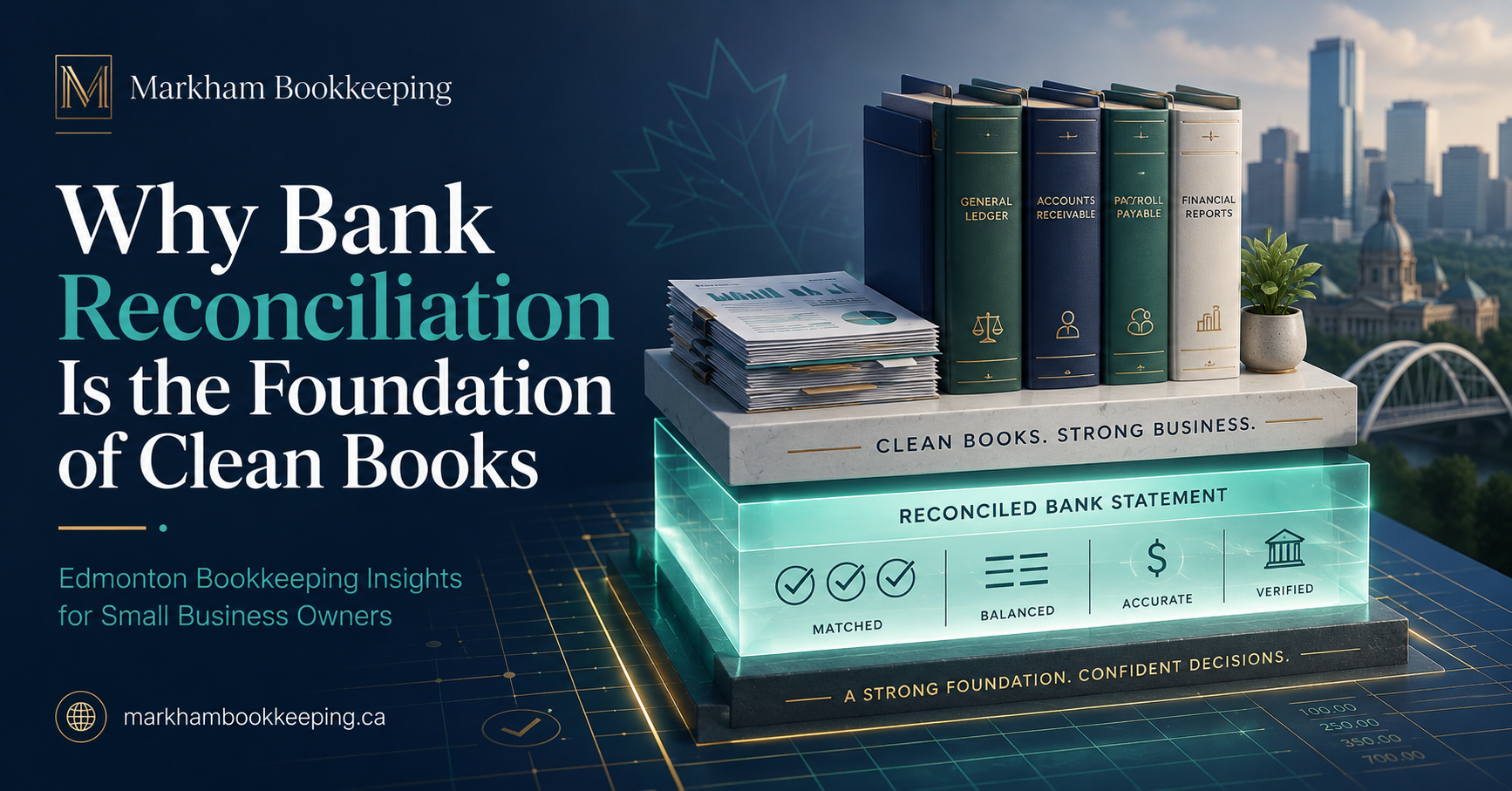
Think of your books like a house. The financial reports are the walls, roof, and windows. Your profit and loss statement, balance sheet, cash flow reports, accounts payable, accounts receivable, payroll records, and tax filings all depend on the same base.
That base is reconciliation.
If the bank accounts are not reconciled, everything built on top of them becomes unreliable.
Your profit may be wrong. Your expenses may be overstated. Your income may be missing. Your GST/HST return may be inaccurate. Your tax bill may be higher or lower than it should be. Your accountant may spend extra time cleaning up errors at year-end.
For a small business owner, this can create real problems. You may think the business is profitable when it is not. You may think you have more cash available than you do. You may make decisions based on reports that are not accurate.
Clean books are not just about being organized. They help you understand your business.
And reconciliation is what gives your numbers credibility.
Bank Feeds Do Not Replace Reconciliation
Many Edmonton business owners use cloud accounting software such as QuickBooks Online, Xero, Sage, or Wave. These tools can connect directly to your bank and import transactions automatically.
That is helpful, but it can also create a false sense of security.
Bank feeds bring transactions into the software, but they do not always know what the transaction means.
For example:
A transfer from your savings account may be recorded as income.
A credit card payment may be recorded as an expense instead of a liability payment.
A supplier payment may be categorized to the wrong expense account.
A loan deposit may be recorded as sales.
A duplicate bank feed transaction may create double income or double expenses.
A merchant payout from Stripe, Square, Shopify, or PayPal may be recorded as one lump deposit without separating sales, fees, refunds, and taxes.
Automation can speed up bookkeeping, but it cannot replace review.
Bank reconciliation is the step that confirms whether the software is correct.
How Reconciliation Helps Catch Missing Income
One of the biggest risks in bookkeeping is missing income.
This can happen easily when a business receives money from multiple sources. An Edmonton small business may receive payments through e-transfer, credit card, cheque, cash, direct deposit, Shopify, PayPal, Stripe, Square, or third-party platforms.
If those deposits are not properly matched to sales invoices or sales records, income may be understated or overstated.
For example, a customer pays an invoice by e-transfer. The payment appears in the bank feed. If it is not matched to the invoice, the invoice may still show as unpaid. Later, the bookkeeper may record the deposit again as sales. Now income is counted twice.
Or the opposite can happen. A deposit may be posted as a shareholder loan, transfer, or other income account by mistake, causing sales to be understated.
Monthly reconciliation helps catch these problems before they grow.
For businesses with high transaction volume, such as ecommerce stores, restaurants, retail shops, or service businesses, this is especially important.
How Reconciliation Helps Prevent Duplicate Expenses
Duplicate expenses are another common bookkeeping issue.
This often happens when bills, receipts, and bank feed transactions are entered separately.
For example, a business owner uploads a receipt for office supplies. The bookkeeper records the expense. Later, the bank feed imports the debit card payment and it gets categorized again. Now the same expense appears twice.
At first, this may seem harmless because it lowers profit. But duplicate expenses create inaccurate reports and can cause problems at tax time.
They can also hide the true performance of your business.
If your books show $8,000 in office expenses but the real number is $4,000, you may think your overhead is much higher than it actually is. That can affect pricing, budgeting, and cash flow decisions.
Bank reconciliation helps identify duplicate entries because the bookkeeper checks what actually cleared the bank and compares it to what has been recorded.
Reconciliation Protects Your Cash Flow
Cash flow is one of the biggest challenges for small businesses in Edmonton.
A business can be profitable on paper and still struggle to pay bills if cash is not managed properly.
Bank reconciliation helps you understand your real cash position. It shows what has cleared, what is still outstanding, and whether your bookkeeping balance is reliable.
This matters when making decisions such as:
Can I pay myself this month?
Can I afford to hire someone?
Can I buy new equipment?
Can I pay suppliers on time?
Do I have enough set aside for GST/HST, payroll remittances, or corporate tax?
Can I take on a new project without cash pressure?
Without reconciled books, you may rely only on your bank balance. But your bank balance does not tell the full story. It does not show upcoming payments, uncleared cheques, payroll obligations, tax liabilities, credit card balances, or customer invoices still unpaid.
Good bookkeeping gives you context. Bank reconciliation makes that context reliable.
Reconciliation Makes Tax Time Easier
Tax time becomes much more stressful when bank accounts have not been reconciled during the year.
If you wait until year-end, the cleanup becomes harder. You may need to review twelve months of transactions at once. Receipts may be missing. Customer payments may be unclear. Transfers may be confusing. Credit card payments may not match. Old transactions may need to be investigated.
This creates extra work for your bookkeeper or accountant.
For Edmonton businesses, clean monthly reconciliation can help with:
- Corporate tax preparation
- GST/HST filing
- Payroll remittance review
- Year-end adjustments
- Financial statement preparation
- Expense classification
- Owner draw or shareholder loan tracking
- Audit or review support
When accounts are reconciled monthly, year-end is not a panic project. It becomes a review process.
That is one reason monthly bookkeeping services in Edmonton are often better than once-a-year cleanup. The longer errors sit, the harder they are to fix.
Reconciliation Helps With GST/HST Accuracy
GST/HST reporting depends on accurate sales and expense records.
If income is duplicated, GST/HST collected may be overstated. If expenses are duplicated, input tax credits may be overstated. If transactions are posted to the wrong accounts, the GST/HST return may not reflect the real numbers.
This is especially important for businesses that collect GST/HST, file quarterly, or have mixed taxable and exempt activities.
Bank reconciliation does not calculate GST/HST by itself, but it helps make sure the transactions behind the GST/HST return are complete and accurate.
For example, if a GST/HST payment to CRA clears the bank but is posted to an expense account instead of the GST/HST payable account, your reports may look wrong. If a refund from CRA is recorded as income, your profit may be overstated.
A clean reconciliation process helps catch these issues.
Reconciliation Helps Identify Fraud, Errors, and Unusual Activity
Bank reconciliation is not only about accounting accuracy. It is also a control.
When transactions are reviewed every month, unusual activity becomes easier to spot.
This may include:
Unauthorized withdrawals
Unexpected bank fees
Duplicate supplier payments
Payments to unfamiliar vendors
Incorrect loan withdrawals
Missing customer deposits
Refunds that were not recorded
Old outstanding cheques
Internal posting errors
For small businesses, this matters because owners are often busy and may not review every bank transaction closely. A monthly reconciliation process creates a second layer of review.
Even if there is no fraud, errors happen. Banks, payment processors, employees, vendors, and accounting software can all create confusion. Reconciliation helps you catch problems early.
Reconciliation Improves Financial Reports
Your profit and loss statement and balance sheet are only useful if the underlying accounts are accurate.
If the bank account is not reconciled, your reports may show numbers that are misleading.
For example:
Your sales may look higher because transfers were recorded as income.
Your expenses may look higher because credit card payments were recorded as expenses instead of payments against the card balance.
Your cash balance may be wrong because old uncleared transactions are still sitting in the books.
Your accounts receivable may be wrong because payments were not matched to invoices.
Your accounts payable may be wrong because supplier bills were entered but payments were not applied properly.
Your shareholder loan may be wrong because owner contributions and withdrawals were not classified properly.
Clean financial reports start with clean transaction records. Clean transaction records start with reconciliation.
This is why an Edmonton bookkeeper will often review bank reconciliation before trusting the financial statements.
Monthly Reconciliation Is Better Than Year-End Cleanup
Many business owners delay bookkeeping because they are busy. They plan to “clean it up later.”
But later usually means more work.
Monthly reconciliation is faster because the transactions are still fresh. You remember what happened. Receipts are easier to find. Customer payments are easier to match. Mistakes are easier to correct.
Year-end cleanup is harder because you may be looking at transactions from 8, 10, or 12 months ago. You may not remember what a payment was for. Vendors may have changed. Receipts may be lost. Employees may have left. Bank feed rules may have created months of repeated errors.
This is why bookkeeping cleanup often costs more than monthly bookkeeping.
The issue is not only the number of transactions. It is the investigation required.
A good monthly reconciliation process saves time, reduces stress, and helps business owners stay in control.
What Happens When Bank Reconciliation Is Ignored?
When bank reconciliation is ignored, the books slowly become unreliable.
At first, the difference may be small. One missing bank fee. One unmatched payment. One duplicate deposit. One transfer posted incorrectly.
But over time, those small issues build up.
Eventually, the business owner may face problems such as:
Reports that do not match the bank
Old transactions sitting unreconciled
Wrong profit numbers
Incorrect GST/HST filings
Unpaid invoices that were actually paid
Vendor bills that appear unpaid
Duplicate expenses
Overstated or understated income
Incorrect shareholder loan balances
Difficult year-end accounting
Higher bookkeeping cleanup costs
The longer reconciliation is ignored, the less confidence you can have in your books.
That is why bank reconciliation is not just an admin task. It is a core financial control.
Best Practice: Reconcile Every Month
For most small businesses, bank reconciliation should be done monthly.
This includes:
Business chequing accounts
Business savings accounts
Credit cards
Lines of credit
Loan accounts
Payment processor clearing accounts
Payroll accounts, if applicable
For businesses with high transaction volume, weekly review may be even better.
A monthly bookkeeping routine should include collecting bank statements, reviewing bank feeds, matching deposits, categorizing expenses, checking transfers, reviewing uncleared transactions, and confirming that the ending balance matches the statement.
Once the accounts are reconciled, the financial reports become much more useful.
Why Edmonton Businesses Should Take Reconciliation Seriously
Edmonton small businesses operate in a competitive environment. Costs are rising, margins can be tight, and cash flow matters.
Whether you are running a construction company, clinic, trucking business, restaurant, retail store, ecommerce business, consulting company, or professional service firm, you need reliable numbers.
You cannot make strong business decisions with messy books.
Bank reconciliation helps Edmonton business owners understand:
How much cash is actually available
Whether customers are paying on time
Whether expenses are being recorded correctly
Whether tax obligations are being tracked
Whether profit is accurate
Whether bookkeeping errors are building up
A reliable Edmonton bookkeeper does more than enter transactions. They help make sure the numbers make sense.
That starts with reconciliation.
Final Thoughts
Bank reconciliation may not sound exciting, but it is one of the most important parts of bookkeeping.
It protects your business from errors, duplicate entries, missing income, incorrect tax filings, and unreliable reports. It gives you confidence that your books reflect what actually happened in the bank.
For Edmonton small business owners, clean books are not just about staying organized. Clean books help with cash flow, tax planning, payroll, pricing, financing, and better decision-making.
If your bank accounts have not been reconciled for months, your reports may not be telling the full story.
The best time to fix that is before year-end, before tax season, and before small mistakes become expensive cleanup work.
At Markham Bookkeeping, we help small business owners keep their books clean, organized, and ready for better decisions.
Need help with bank reconciliation or monthly bookkeeping in Edmonton? Contact Markham Bookkeeping today and get your books back on track.
FAQ
1. What is bank reconciliation in bookkeeping?
Bank reconciliation is the process of comparing your business bank statement to your bookkeeping records to make sure all deposits, payments, fees, and transfers are recorded correctly.
2. How often should a small business reconcile bank accounts?
Most small businesses should reconcile bank accounts monthly. Businesses with high transaction volume may benefit from weekly review.
3. Can bank feeds replace bank reconciliation?
No. Bank feeds import transactions, but they do not guarantee accuracy. Transactions still need to be reviewed, matched, categorized, and reconciled.
4. Why is bank reconciliation important for Edmonton small businesses?
It helps Edmonton business owners maintain accurate financial reports, avoid duplicate transactions, catch missing income, track cash flow, and reduce tax-time stress.
5. What happens if my bank account is not reconciled?
Your financial reports may be inaccurate. You may have missing income, duplicate expenses, incorrect GST/HST numbers, wrong cash balances, and more expensive cleanup work later.
6. Can a bookkeeper help with old unreconciled accounts?
Yes. A bookkeeper can review old transactions, compare them to bank statements, correct errors, and bring the accounts up to date. This is often called bookkeeping cleanup or catch-up bookkeeping.