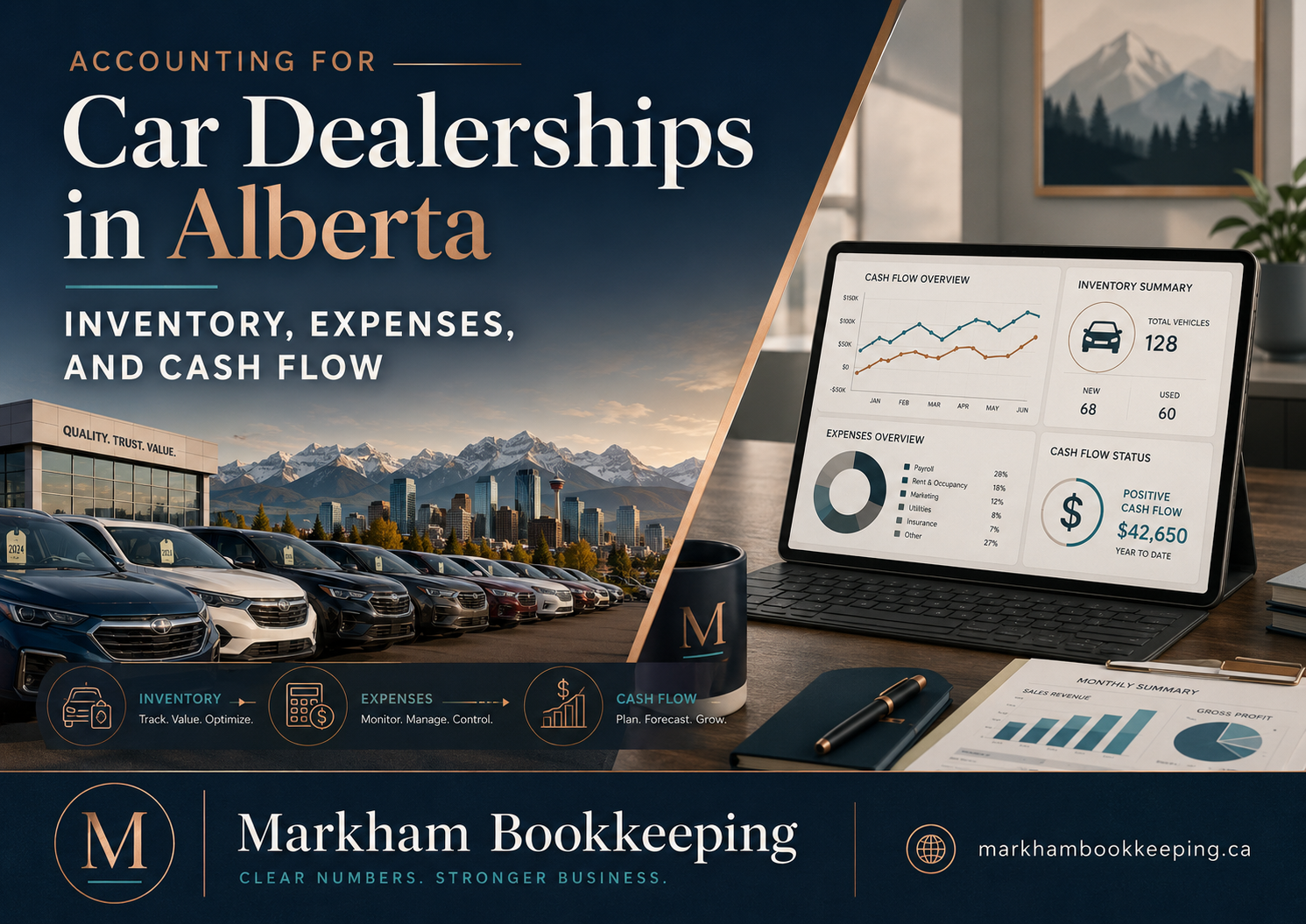
Accounting for car dealerships in Alberta is different from regular small business bookkeeping. A dealership does not simply buy products and sell them like a basic retail store. Vehicle inventory is expensive, financing can be complex, deposits and trade-ins must be tracked carefully, and cash flow can change quickly from month to month.
For Alberta auto dealers, clean books are not just about filing taxes. Proper accounting helps the dealership understand real profit per vehicle, manage cash flow, track inventory accurately, monitor expenses, prepare for GST, and make better decisions about buying and selling vehicles.
A dealership may look busy on the outside, but the numbers can tell a different story. A lot of vehicles on the lot does not always mean strong cash flow. High sales do not always mean high profit. A dealership can sell multiple vehicles and still struggle if flooring interest, repairs, advertising, commissions, warranty costs, and chargebacks are not being tracked properly.
That is why accounting for car dealerships in Alberta should be set up with inventory, expenses, and cash flow in mind from day one.
Vehicle Inventory Is the Core of Dealership Accounting
For most car dealerships, inventory is the biggest asset on the books. Every vehicle purchased for resale should be recorded properly. The dealership needs to know what it paid for the vehicle, what extra costs were added, how much was spent on reconditioning, and what profit was made when the vehicle was sold.
A common mistake is treating vehicle purchases as normal expenses right away. In dealership accounting, vehicles purchased for resale are usually recorded as inventory until they are sold. When the vehicle is sold, the cost moves from inventory to cost of goods sold.
This matters because if inventory is recorded incorrectly, the profit and loss statement becomes misleading. The dealership may appear to have very high expenses in one month and high profit in another month, even though the real business activity is different.
A clean inventory process helps answer questions like:
Which vehicles are currently in stock?
What is the cost of each vehicle?
How much was spent on repairs or reconditioning?
How long has each vehicle been sitting on the lot?
What is the gross profit per vehicle sold?
Which vehicles are tying up too much cash?
For Alberta car dealerships, inventory should be reviewed monthly, not only at year-end.
Track the Full Cost of Each Vehicle
The purchase price is only one part of the vehicle cost. Dealerships often spend money before a vehicle is ready for sale. These costs may include inspection, repairs, detailing, transport, auction fees, mechanical work, parts, tires, windshield replacement, cleaning, and other reconditioning costs.
If these costs are not attached to the right vehicle, the dealership may not know the true profit on each sale.
For example, a vehicle purchased for $18,000 and sold for $21,000 may look like it made a $3,000 gross profit. But if the dealership spent $1,200 on repairs, $300 on detailing, $250 on transport, and $150 on auction fees, the real gross profit is much lower.
This is why dealership bookkeeping should include vehicle-level tracking. Each unit should have a clear file showing purchase cost, added costs, selling price, and gross profit.
Clean vehicle costing helps owners avoid pricing mistakes. It also helps identify which vehicle types are profitable and which ones create too much repair cost or sit too long.
Flooring Loans and Vehicle Financing Must Be Reconciled
Many dealerships use floor plan financing, also called flooring, to purchase inventory. This means a lender finances the vehicles and the dealership pays interest or fees until the vehicles are sold.
Flooring can help dealerships carry more inventory, but it also creates bookkeeping complexity. Each vehicle may have a related loan balance. When the vehicle is sold, the dealership may need to pay off that specific unit.
If flooring loans are not reconciled properly, the dealership may not know the true liability balance. The books may show inventory that has already been sold, or loans that should have been cleared. This can cause confusion in both the balance sheet and cash flow.
A dealership should reconcile flooring statements monthly. The accounting should match each vehicle, the loan balance, interest charges, curtailment payments, and payoff amounts.
This is especially important because cash flow can look better than reality if vehicle sale proceeds are received before the flooring payoff is made. The dealership may see cash in the bank, but part of that cash already belongs to the lender.
GST Tracking for Alberta Car Dealerships
Alberta businesses generally deal with GST rather than HST. CRA guidance states that GST/HST registrants collect tax at the 5% GST rate on taxable supplies made in the rest of Canada, outside the participating HST provinces.
For car dealerships in Alberta, GST tracking needs to be handled carefully because vehicle sales often involve deposits, trade-ins, financing, warranties, repairs, fees, and sometimes out-of-province customers.
GST collected should not be treated as dealership revenue. It is a liability until it is filed and remitted to CRA. GST paid on eligible business expenses may be recoverable through input tax credits if the dealership is a GST/HST registrant and the purchases relate to commercial activities.
The dealership should keep proper sales invoices and purchase invoices to support GST filings. CRA says GST/HST registrants must keep records detailed enough to determine whether GST/HST applies to the goods and services involved.
Good GST tracking helps avoid surprises when the filing deadline arrives. It also reduces the risk of missing input tax credits or incorrectly reporting sales tax.
Trade-Ins Need Careful Bookkeeping
Trade-ins can make dealership accounting more complicated. A customer may trade in a vehicle as part of the purchase of another vehicle. The dealership needs to record the sale, the trade-in value, GST treatment, financing, lien payouts, and any cash difference correctly.
If the trade-in is not recorded properly, inventory and sales can both be wrong.
For example, if a customer buys a vehicle and trades in another vehicle, the dealership should make sure the accounting reflects the vehicle sold, the value of the trade-in added to inventory, any loan payout, GST, and the amount financed or paid by the customer.
Trade-ins should also be added to the inventory list with a stock number, acquisition cost, expected repair costs, and resale plan. Without that tracking, vehicles can sit in inventory without clear costing.
Common Expenses Alberta Dealerships Should Track
A dealership’s expenses can grow quickly. Some costs are directly related to selling vehicles, while others are general overhead.
Common dealership expenses include:
Advertising and leads
Auction fees
Bank charges
Bookkeeping and accounting fees
Commissions
Dealer management software
Detailing
Fuel
Insurance
Interest on flooring or loans
Lot rent
Mechanical repairs
Office expenses
Parts
Payroll and employer costs
Professional fees
Shop supplies
Subcontractors
Towing and transport
Utilities
Warranty claims and goodwill repairs
Website and listing fees
These expenses should be organized in a way that helps management understand the business. If everything is posted into broad categories like “miscellaneous” or “general expenses,” the financial reports will not be useful.
For example, advertising should be reviewed separately from repairs. Flooring interest should be reviewed separately from bank fees. Vehicle reconditioning costs should be tracked differently from office supplies.
The cleaner the expense categories, the easier it becomes to understand where profit is going.
Repairs and Reconditioning: Expense or Inventory Cost?
One of the most important dealership accounting questions is whether repairs and reconditioning costs should be treated as expenses or added to vehicle inventory cost.
If the repair is directly connected to preparing a specific vehicle for sale, many dealerships track it against that vehicle so they can calculate real gross profit. This helps the owner see the true margin on each unit.
If the repair is for general business operations, such as fixing dealership equipment, office repairs, or building maintenance, it may be recorded as an operating expense instead.
The key is consistency. Dealerships should have a clear bookkeeping process for how vehicle-related costs are recorded. Without consistency, monthly profit can look distorted.
Payroll and Commissions
If the dealership has employees, payroll must be managed carefully. CRA’s payroll guide explains employer responsibilities for deducting and remitting amounts such as CPP, EI, and income tax.
Car dealerships may also pay sales commissions, bonuses, or other incentive-based compensation. These should be recorded accurately and connected to payroll reporting where applicable.
Payroll costs can have a major impact on dealership profitability. Owners should review wages, commissions, employer payroll costs, and benefits monthly. This helps determine whether payroll is aligned with sales volume and gross profit.
Cash Flow Is Not the Same as Profit
Cash flow is one of the biggest challenges in dealership accounting. A dealership can show profit on paper but still feel short on cash.
This can happen when money is tied up in inventory, flooring payments are due, repairs were paid before the vehicle sold, GST is owed, payroll is due, or customers have not completed payment.
Car dealerships in Alberta should review cash flow monthly because vehicle inventory requires large cash investments. A few slow-moving vehicles can create pressure quickly. Even if the dealership is profitable overall, cash may be locked inside unsold units.
A dealership owner should regularly ask:
How much cash is available?
How much is tied up in inventory?
Which vehicles have been sitting too long?
How much GST is owed?
What flooring payments are coming due?
What payroll and rent payments are upcoming?
Are repair bills increasing?
Are we making enough gross profit per sale?
Profit matters, but cash flow keeps the dealership operating.
Inventory Aging Should Be Reviewed Monthly
Inventory aging shows how long vehicles have been sitting in stock. This is one of the most important reports for a car dealership.
A vehicle sitting for 15 days is different from a vehicle sitting for 120 days. The longer a vehicle sits, the more it can cost the dealership through interest, storage, depreciation risk, advertising, repairs, and opportunity cost.
A monthly inventory aging report helps the dealership identify vehicles that may need a price adjustment, extra marketing, wholesale consideration, or management review.
Inventory aging also helps with buying decisions. If certain vehicle types sit too long, the dealership may need to change its purchasing strategy.
Balance Sheet Accuracy Matters
Many dealership owners focus only on the profit and loss statement, but the balance sheet is just as important.
The balance sheet shows inventory, bank balances, loans, GST payable, payroll liabilities, accounts payable, customer deposits, and owner/shareholder balances. If the balance sheet is not accurate, the dealership may not know what it owns or owes.
Important dealership balance sheet accounts may include:
Vehicle inventory
Bank accounts
Credit cards
Flooring loans
GST payable
Payroll liabilities
Customer deposits
Accounts payable
Loans payable
Shareholder loans
Retained earnings
A clean balance sheet helps dealership owners understand the financial position of the business, not just monthly sales.
Records and Compliance
Dealerships should keep organized records for sales, purchases, financing, trade-ins, payroll, GST, expenses, and vehicle inventory. CRA states that businesses generally need to keep required records and supporting documents for six years from the end of the last tax year they relate to.
In Alberta, automotive businesses such as sales, service, repair, consignment, lease, wholesale, agent, and broker businesses may also need to hold a valid AMVIC business licence.
From an accounting perspective, strong records help support GST filings, income tax filings, financial statements, lender requests, and management decisions. They also make bookkeeping cleanup much easier if the dealership ever falls behind.
Monthly Reports Every Alberta Dealership Should Review
A car dealership should review more than just sales totals. Useful monthly reports include:
Profit and loss statement
Balance sheet
Inventory list
Inventory aging report
Gross profit by vehicle
Flooring loan reconciliation
GST payable report
Payroll summary
Accounts payable report
Cash flow summary
Advertising cost review
Repair and reconditioning cost review
These reports help the owner understand whether the dealership is actually profitable, where cash is going, and which areas need attention.
Final Thoughts
Accounting for car dealerships in Alberta requires careful tracking of inventory, expenses, GST, payroll, financing, and cash flow. A dealership can look successful from the outside but still struggle if inventory is not tracked properly, flooring loans are not reconciled, expenses are unclear, or cash flow is weak.
Clean bookkeeping gives dealership owners better control.
It helps show the true profit per vehicle, the real cost of inventory, the impact of repairs, the amount owed for GST, and the cash needed to keep the business running. Monthly accounting reports can also help owners make smarter pricing, buying, financing, and staffing decisions.
For Alberta car dealerships, bookkeeping should not be treated as a once-a-year tax task. It should be a monthly management tool.
Need Help With Car Dealership Bookkeeping in Alberta?
Markham Bookkeeping helps Alberta businesses with bookkeeping, GST tracking, payroll, cleanup, reconciliations, inventory-related bookkeeping, and monthly reporting.
Visit: markhambookkeeping.ca
Email: info@markhambookkeeping.ca