Many business owners in Strathcona County eventually ask the same question: Do I need a bookkeeper, an accountant, or both? The answer depends on your business stage, how clean your records are, whether you need tax filing support, and how much financial clarity you want throughout the year.
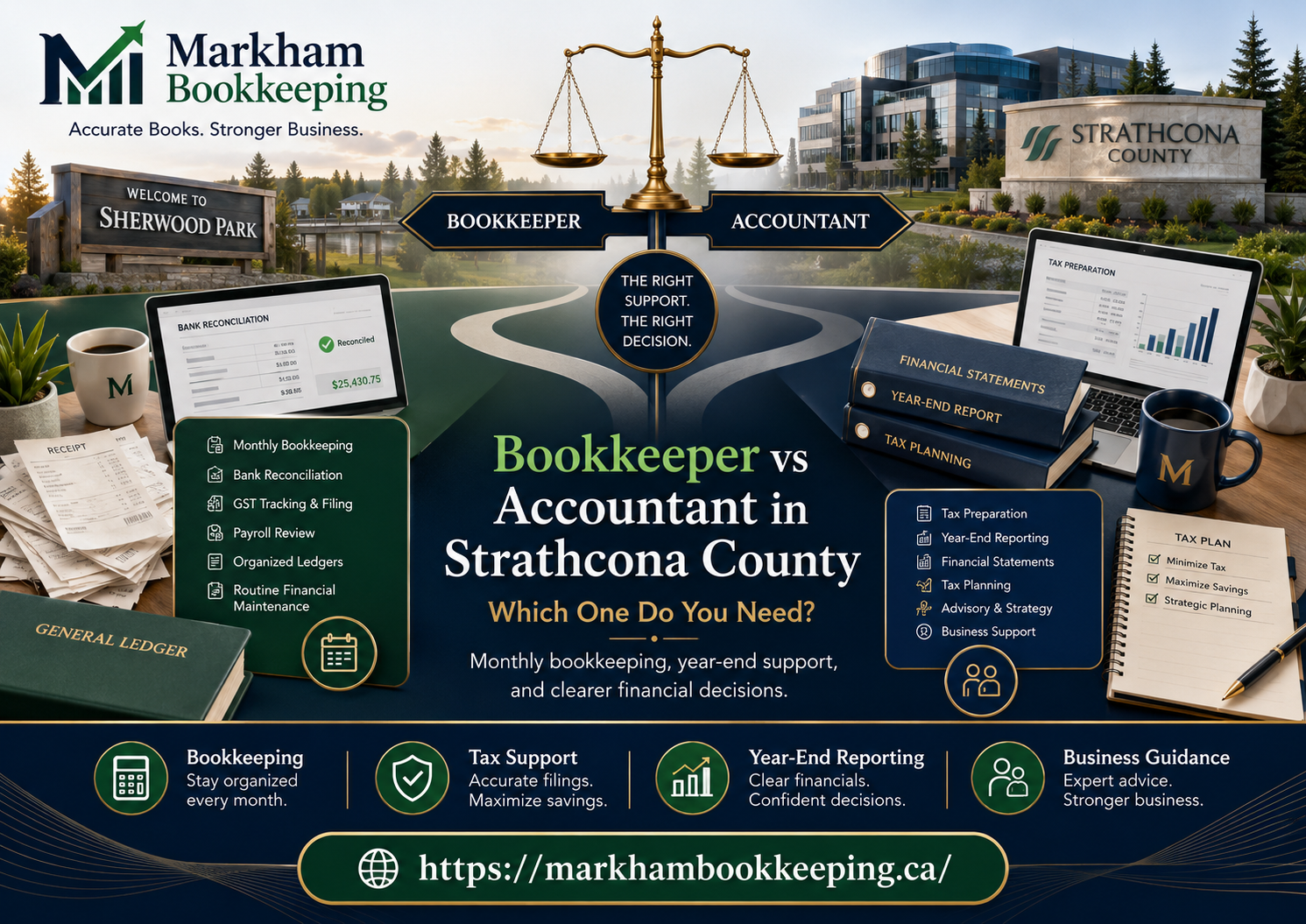
For business owners in Strathcona County, Sherwood Park, and the greater Edmonton area, bookkeeping and accounting are both important. But they are not the same thing. A bookkeeper usually helps you keep your financial records organized month to month. An accountant usually helps with tax filings, year-end adjustments, financial statements, and higher-level tax advice.
If you are a contractor, consultant, retailer, restaurant owner, tradesperson, real estate professional, incorporated business owner, or self-employed professional, understanding the difference can save you time, reduce stress, and help you avoid expensive cleanup work later.
This guide explains the difference between a bookkeeper and an accountant, when Strathcona County businesses need each one, and why many small businesses benefit from using both.
Why This Question Matters for Strathcona County Business Owners
Small business owners often wear too many hats. You may be handling sales, customer service, staff, inventory, supplier payments, marketing, invoicing, GST, payroll, and tax deadlines all at once. When the financial side gets messy, it becomes difficult to know where to start.
Some business owners call an accountant when they are actually behind on bookkeeping. Others hire a bookkeeper when they really need tax planning or year-end corporate tax support. Both situations can create confusion.
For example, if your bank accounts are not reconciled, receipts are missing, and expenses are uncategorized, your accountant may not be able to prepare your tax return efficiently. The bookkeeping needs to be cleaned up first.
On the other hand, if your books are clean but you need corporate tax filing, tax planning, year-end adjustments, or advice about salary versus dividends, that is usually accountant territory.
Understanding the difference helps you get the right support at the right time.
What Does a Bookkeeper Do?
A bookkeeper handles the regular financial records of your business. Their job is to keep your books accurate, organized, and up to date.
For Strathcona County businesses, bookkeeping services may include:
Bank reconciliation, credit card reconciliation, recording sales, categorizing expenses, organizing receipts, posting supplier bills, tracking customer invoices, reviewing accounts receivable, reviewing accounts payable, recording payroll entries, tracking GST/HST, preparing monthly reports, and keeping accounting software updated.
In simple terms, a bookkeeper keeps your day-to-day and month-to-month numbers clean.
A bookkeeper helps answer questions like:
How much income did the business earn this month?
What expenses were paid?
Which customers still owe money?
Which supplier bills are unpaid?
Does the bank balance match the books?
How much GST may be owing?
Are payroll liabilities clearing properly?
Is the business profitable this month?
For many Edmonton-area small businesses, a bookkeeper is the person who keeps financial chaos under control before tax season arrives.
What Does an Accountant Do?
An accountant usually works at a higher level than a bookkeeper. Accountants often focus on tax filings, year-end adjustments, financial statements, corporate tax returns, personal tax returns, tax planning, and business advisory support.
For Strathcona County business owners, an accountant may help with:
Corporate tax returns, personal tax returns for self-employed income, year-end financial statements, tax planning, CRA correspondence, capital asset treatment, shareholder loan review, salary versus dividend planning, tax instalment planning, business structure advice, and year-end adjusting entries.
An accountant helps answer questions like:
How much tax will the business owe?
Should I pay myself wages or dividends?
Are year-end adjustments needed?
How should major asset purchases be handled?
Is the shareholder loan balance a concern?
How can I plan ahead for tax?
What does CRA need from me?
Is incorporation the right move?
An accountant often depends on clean bookkeeping records. If the books are messy, the accountant may need to spend extra time cleaning them up or send the work back to a bookkeeper first.
The Simple Difference: Bookkeepers Maintain, Accountants Review and File
A simple way to understand the difference is this:
A bookkeeper keeps the records clean during the year. An accountant uses those records for tax filing, year-end reporting, and planning.
Bookkeeping is ongoing. Accounting is often periodic or year-end focused.
Bookkeeping is about transaction accuracy. Accounting is about interpretation, tax treatment, compliance, and reporting.
Bookkeeping helps you know what happened. Accounting helps you understand what it means for tax and business planning.
Both are valuable. The mistake many business owners make is thinking they only need one.
When Do You Need a Bookkeeper in Strathcona County?
You probably need a bookkeeper if your daily or monthly records are not organized.
A bookkeeper is helpful when:
Your transactions are uncategorized, your bank accounts are not reconciled, receipts are missing, you are behind by several months, GST filings are stressful, you do not know if your reports are accurate, invoices are not being tracked properly, supplier bills are being missed, payroll entries are confusing, or your accountant keeps asking for better records.
A bookkeeper is also useful if you simply do not have time to manage the books yourself.
For example, a contractor in Sherwood Park may have fuel, materials, subcontractors, tools, customer deposits, invoices, and GST to track. A consultant in Strathcona County may have client invoices, software costs, home office expenses, GST, and tax instalments. A retail business may have sales, merchant fees, inventory, supplier bills, payroll, and refunds.
Each business has different needs, but the goal is the same: clean and reliable records.
Monthly bookkeeping services can help Strathcona County businesses stay organized instead of rushing at year-end.
When Do You Need an Accountant?
You likely need an accountant when you need tax filing, year-end work, or advice that goes beyond regular transaction entry.
An accountant is helpful when:
You need a corporate tax return filed, you need a personal tax return with self-employed income, you want tax planning advice, you are deciding between salary and dividends, you purchased major equipment, you have shareholder loan questions, CRA has contacted you, you need year-end financial statements, or your business structure is changing.
An accountant can also help when your business is growing and you need a better plan for taxes, owner compensation, or future expansion.
For incorporated businesses in Strathcona County, an accountant is especially important at year-end. Corporate tax filing usually requires more than simply printing a Profit and Loss report. The accountant may need to review assets, liabilities, loans, shareholder accounts, retained earnings, expenses, and tax adjustments.
But the accountant’s work is much smoother when bookkeeping has been done properly throughout the year.
Why Many Businesses Need Both
The best setup for many Strathcona County businesses is to use both a bookkeeper and an accountant.
The bookkeeper keeps the books clean monthly. The accountant handles tax filing and year-end adjustments. Together, they help the business owner stay organized and compliant.
This combination works well because each role supports the other.
The bookkeeper can make sure income, expenses, GST, payroll, bank accounts, credit cards, receivables, and payables are organized. The accountant can then review the year-end information, make adjustments, prepare tax filings, and provide tax advice.
When both roles work together, tax season becomes much easier.
Instead of sending a box of receipts to the accountant in April, the business has organized books, reconciled accounts, and clear reports. This can reduce stress, reduce delays, and make the tax preparation process smoother.
Common Mistake: Waiting Until Tax Season
Many business owners wait until tax season to think about bookkeeping. This is one of the most expensive mistakes a business can make.
If your books are not updated monthly, year-end cleanup can become time-consuming. Someone has to review every transaction, ask questions, find receipts, separate personal expenses, reconcile bank accounts, fix GST, and prepare reports.
This can lead to delays and higher professional fees.
For Strathcona County business owners, monthly bookkeeping is usually a better approach. It spreads the work throughout the year and keeps records current.
When transactions are fresh, you are more likely to remember what they were for. Missing receipts are easier to find. GST issues can be corrected earlier. Cash flow can be monitored before problems become serious.
Clean monthly bookkeeping is not just easier for tax season. It helps you run the business better all year.
GST: Bookkeeper or Accountant?
GST is an area where both bookkeepers and accountants may be involved.
A bookkeeper usually tracks GST during the year. This includes GST collected on sales, GST paid on eligible expenses, GST payable, and GST payments or refunds.
An accountant may review GST at year-end, especially if there are complex issues, unusual transactions, or corrections needed.
For Strathcona County businesses, GST can become tricky when there are multiple sales channels, merchant processors, refunds, discounts, deposits, or mixed taxable and exempt activities.
If you use Stripe, Square, Shopify, PayPal, Clover, Moneris, or another processor, the bank deposit may not equal total sales. Fees, refunds, tips, and chargebacks may affect the net deposit. A bookkeeper can help record these properly so GST reporting is cleaner.
If you are unsure whether you should register for GST or how GST applies to your services, that may require accountant-level tax advice.
Payroll: Bookkeeper or Accountant?
Payroll is another area where bookkeeping and accounting overlap.
A bookkeeper may record payroll entries, wages, employer CPP, employer EI, income tax deductions, vacation pay, benefits, and payroll remittances. They can also help make sure payroll liabilities clear properly in the books.
An accountant may review payroll at year-end, especially when preparing T4s, corporate tax filings, or year-end adjustments.
If your Strathcona County business has employees, payroll bookkeeping must be accurate. Recording only the net amount paid from the bank can make your wage expense and payroll liabilities incorrect. Proper payroll entries help ensure your reports reflect the real cost of employees.
What About Self-Employed Professionals?
Self-employed professionals often need bookkeeping before they need complex accounting support.
If you are a consultant, freelancer, contractor, realtor, designer, coach, IT professional, or tradesperson in Strathcona County, your bookkeeping should track income, expenses, GST, vehicle costs, home office expenses, subcontractors, software, and client payments.
At tax time, your accountant or tax preparer can use those records to prepare your return.
If you only organize records once a year, you may miss deductions or struggle to explain transactions. Monthly bookkeeping helps you stay ready.
Self-employed professionals also need to set aside money for taxes because income tax is usually not deducted automatically from client payments. Clean books help you estimate profit and plan ahead.
What About Incorporated Businesses?
Incorporated businesses usually need both bookkeeping and accounting.
A corporation is separate from the owner, so records must be kept carefully. Owner payments, shareholder loans, dividends, wages, business expenses, GST, payroll, assets, loans, and retained earnings all need proper treatment.
A bookkeeper can maintain the records during the year. An accountant can prepare the corporate tax return and year-end adjustments.
For Strathcona County corporations, this partnership is important. If the owner uses the business account for personal spending or transfers money between accounts often, the shareholder loan account needs to be tracked properly. If loan payments are recorded incorrectly, the balance sheet may be wrong. If assets are expensed incorrectly, year-end adjustments may be needed.
Clean bookkeeping makes corporate accounting much easier.
How to Decide Which One You Need Right Now
Here is a practical way to decide.
You need a bookkeeper if your transactions are messy, your accounts are not reconciled, your receipts are not organized, your GST is unclear, your invoices are not tracked, or you need monthly financial reports.
You need an accountant if you need tax filing, year-end financial statements, tax planning, CRA advice, corporate tax support, or help with business structure and owner compensation.
You need both if you want clean records during the year and proper tax support at year-end.
For most growing Strathcona County businesses, both roles eventually become important.
Choosing the Right Support in Strathcona County
When choosing bookkeeping or accounting support, look for someone who understands small business, Canadian tax basics, GST, payroll, and Edmonton-area businesses.
A good bookkeeper should be accurate, organized, responsive, and comfortable with software like QuickBooks Online, Xero, Sage, Wave, or similar tools.
A good accountant should be able to explain tax matters clearly, review your year-end records, prepare filings properly, and guide you on tax planning.
Most importantly, your financial support should make your life easier. You should not feel more confused after speaking with your bookkeeper or accountant.
The best support gives you clear reports, better organization, and confidence in your numbers.
Final Thoughts
The difference between a bookkeeper and an accountant matters because each role supports your business in a different way. A bookkeeper keeps your financial records clean throughout the year. An accountant uses those records for tax filing, year-end adjustments, and planning.
For Strathcona County business owners, the right choice depends on your current needs. If your books are behind, start with bookkeeping. If your books are clean and you need tax filing or planning, speak with an accountant. If your business is growing, you may need both.
Clean books help create smoother tax preparation, better CRA readiness, clearer reports, and stronger business decisions.
Whether you operate in Strathcona County, Sherwood Park, or the greater Edmonton area, understanding when to use a bookkeeper versus an accountant can save time, reduce stress, and help your business stay financially organized.