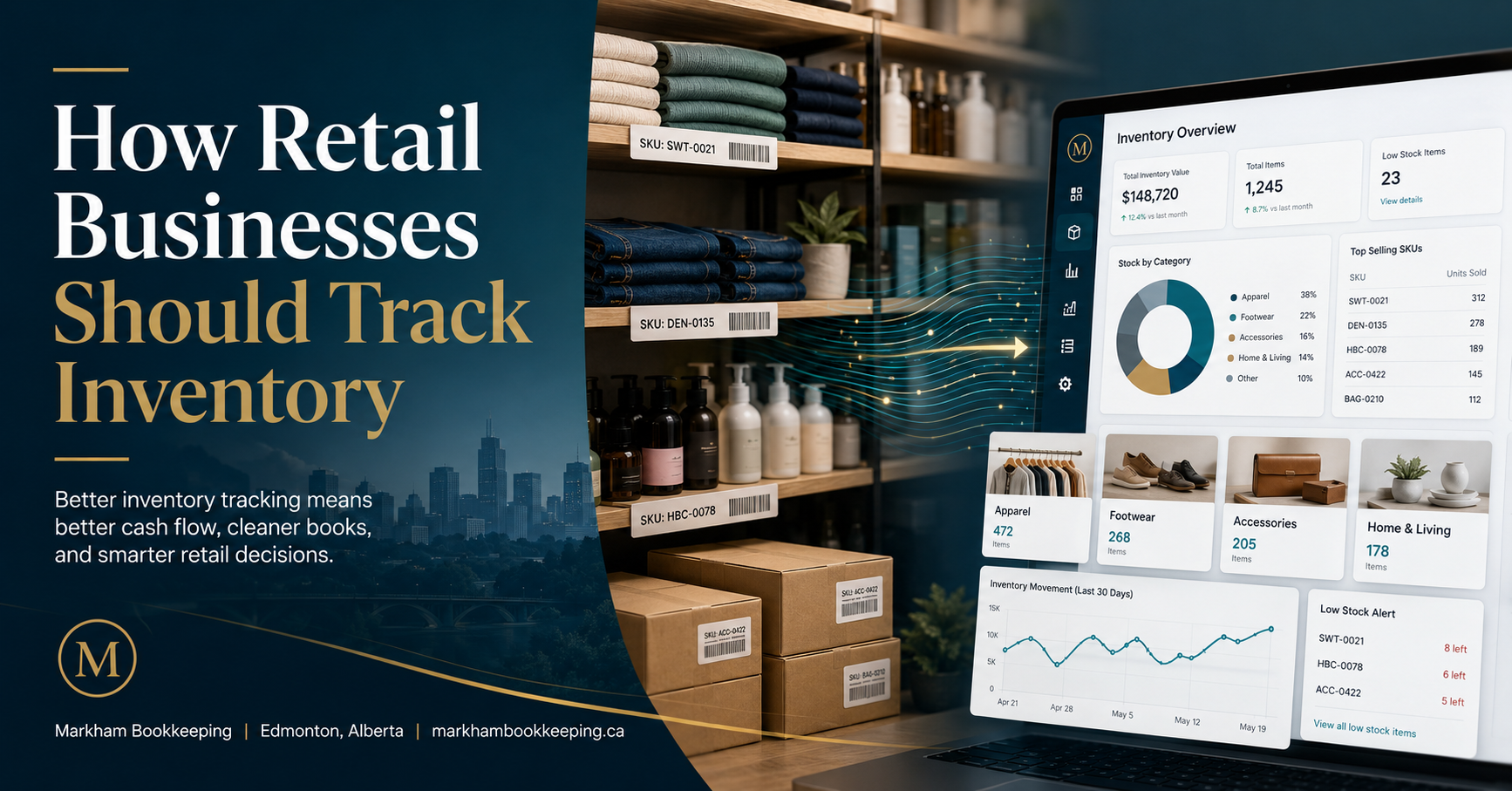
For retail businesses, inventory is not just “products sitting on shelves.” Inventory is money. Every product in your store, stockroom, warehouse, or online shop represents cash that has already been spent and is expected to turn into future sales.
That is why inventory tracking is one of the most important parts of retail bookkeeping. If inventory is not tracked properly, a business owner may think the store is profitable when the numbers are actually incomplete. Sales may look strong, but if product costs, shrinkage, damaged goods, returns, and unsold stock are not being recorded correctly, the financial reports can become misleading.
For retail businesses in Edmonton, proper inventory tracking is especially important because local businesses often deal with seasonal demand, changing supplier costs, slow-moving products, cash flow pressure, and year-end tax reporting. Whether you run a clothing store, convenience store, beauty supply shop, gift store, electronics shop, specialty retail business, or online retail store, inventory needs to be organized from both an operational and bookkeeping perspective.
This guide explains how retail businesses should track inventory and why clean inventory records matter for bookkeeping, tax preparation, cash flow, and business decisions.
Why Inventory Tracking Matters for Retail Businesses
Inventory affects several major areas of your business. It impacts your cost of goods sold, gross profit, taxable income, cash flow, and pricing decisions.
Many retail business owners focus heavily on sales. Sales are important, but sales alone do not show the full picture. A store can have strong revenue and still struggle with profit if product costs are too high, inventory is being wasted, or slow-moving stock is tying up cash.
For example, if an Edmonton retail store buys $50,000 worth of inventory but only sells part of it during the year, not all of that $50,000 should automatically be treated as an expense right away. The unsold inventory usually remains an asset until it is sold. When inventory is sold, the related cost becomes part of cost of goods sold.
This is why proper inventory tracking is so important. It helps answer questions like:
How much inventory do you currently have?
Which products are selling quickly?
Which items are sitting too long?
What is your real cost of goods sold?
What is your gross profit margin?
Are products being lost, stolen, damaged, or incorrectly recorded?
Without accurate inventory records, your bookkeeping reports may not show the real health of your business.
Inventory Is an Asset Until It Is Sold
One of the biggest bookkeeping mistakes retail businesses make is treating all inventory purchases as regular expenses immediately.
Inventory is different from normal operating expenses like rent, internet, office supplies, or advertising. When you buy products for resale, those products are usually recorded as inventory, which is an asset on the balance sheet. Once the product is sold, the cost of that product moves from inventory to cost of goods sold on the income statement.
This matters because it affects your profit.
If inventory purchases are recorded incorrectly, your profit may look too low in one period and too high in another. This can create confusion during tax time and make it harder for your accountant or bookkeeper to understand what actually happened in the business.
For Edmonton retail businesses, this becomes even more important when preparing year-end financial statements or filing corporate taxes. Clean inventory records help ensure that the cost of goods sold is reasonable and that the year-end inventory balance is supported.
Track Inventory by Product Category
Retail businesses should organize inventory by product category. This makes reports easier to understand and helps business owners see which areas are performing well.
For example, a clothing store may track inventory by categories such as:
Men’s clothing
Women’s clothing
Children’s clothing
Shoes
Accessories
Seasonal items
A convenience store may track:
Beverages
Snacks
Tobacco products
Household goods
Lottery-related items
Personal care products
A beauty supply store may track:
Hair products
Skin care
Tools and accessories
Cosmetics
Professional supplies
The goal is not to make the bookkeeping too complicated. The goal is to create enough detail so the business owner can understand product performance without creating hundreds of unnecessary accounts.
A good retail bookkeeping system should be simple, useful, and consistent.
Use a Proper Point-of-Sale System
A strong point-of-sale system can make inventory tracking much easier. A POS system can help track sales, product quantities, returns, discounts, and sometimes even supplier information.
However, business owners should not assume that the POS system and accounting software are always perfectly aligned. POS reports, bank deposits, merchant processor deposits, and accounting software often show different numbers because of timing differences, fees, returns, tips, gift cards, discounts, and chargebacks.
This is why retail businesses should regularly reconcile POS sales with bank deposits and accounting records.
For example, a retail store may have $5,000 in daily sales according to the POS system, but only $4,850 deposited into the bank because merchant fees were deducted. If the bookkeeping only records the bank deposit as sales, the sales number may be understated and merchant fees may not be properly recorded.
This is a common issue in retail bookkeeping. The POS system may show one number, the bank may show another, and the bookkeeping needs to explain the difference.
Separate Sales From Cost of Goods Sold
Retail businesses should clearly separate sales from cost of goods sold.
Sales represent the money earned from customers.
Cost of goods sold represents the direct cost of the products that were sold.
The difference between sales and cost of goods sold is gross profit.
For example:
Sales: $100,000
Cost of Goods Sold: $60,000
Gross Profit: $40,000
In this example, the gross profit margin is 40%.
Gross profit margin is one of the most important numbers for a retail business. It helps show whether products are being priced properly and whether supplier costs are leaving enough room for profit after rent, payroll, utilities, marketing, and other operating costs.
If inventory is not tracked properly, cost of goods sold may be wrong. If cost of goods sold is wrong, gross profit will also be wrong. That means the owner may be making decisions based on inaccurate numbers.
Count Inventory Regularly
Retail businesses should perform regular inventory counts. This does not always mean counting every single item every day. But there should be a system.
There are two common approaches:
A full physical count, usually done monthly, quarterly, or at year-end.
Cycle counts, where smaller sections of inventory are counted regularly throughout the year.
Cycle counting can be useful for busy retail stores because it avoids the stress of counting everything at once. For example, a store may count one product category each week. Over time, this helps identify errors, theft, damage, and slow-moving stock.
At minimum, retail businesses should do a proper year-end inventory count. This year-end inventory number is important for bookkeeping and tax reporting because it supports the inventory value shown on the balance sheet.
For Edmonton retail businesses, year-end inventory counts should be planned before tax season becomes stressful. Waiting until the last minute can create errors, missing records, and confusion.
Track Shrinkage, Damaged Goods, and Obsolete Inventory
Inventory does not always disappear because of sales. Products can be stolen, broken, damaged, expired, lost, or become outdated.
This is called shrinkage.
Retail businesses should track shrinkage separately instead of ignoring it. If the inventory system says you should have 100 items but the physical count shows only 92, the difference needs to be reviewed and adjusted.
Shrinkage can happen due to:
Shoplifting
Employee theft
Supplier shortages
Data entry errors
Damaged goods
Expired products
Unrecorded returns
Incorrect stock counts
If shrinkage is not tracked, the business owner may not notice a serious problem until much later. Proper inventory tracking helps identify whether losses are small and normal or large enough to require action.
Obsolete inventory also matters. Some items become difficult to sell because trends change, seasons end, packaging changes, or newer products replace older products. These items may need to be discounted, written down, or removed from active inventory.
Track Returns and Refunds Properly
Returns are common in retail, but they must be recorded correctly.
When a customer returns a product, the bookkeeping should reflect both the refund and the inventory movement. If the item is returned in sellable condition, it may go back into inventory. If it is damaged or cannot be resold, it should not simply be treated like normal stock.
This is especially important for businesses selling both in-store and online. Online returns, shipping refunds, payment processor fees, and restocking issues can make the bookkeeping messy.
Retail businesses should have a clear return process so that sales, refunds, GST, inventory, and payment deposits are all recorded properly.
Understand GST and Inventory
Retail businesses in Edmonton generally need to charge GST if they are registered for GST. Alberta does not have a provincial sales tax, but GST still applies to most taxable retail sales.
From a bookkeeping perspective, GST collected from customers is not business income. It is money collected on behalf of the government. This should be tracked separately in the accounting software.
Inventory purchases may also include GST paid to suppliers. If the business is registered for GST and the purchase qualifies, the GST paid may be tracked as an input tax credit.
If GST is mixed into sales, expenses, or inventory incorrectly, the GST return may become inaccurate. That is why retail bookkeeping should properly separate sales, GST collected, inventory cost, and GST paid.
Use Accounting Software Correctly
Accounting software such as QuickBooks Online, Sage, Xero, or another system can help retail businesses track inventory, but only if it is set up properly.
A common mistake is connecting bank feeds and assuming the software will automatically understand everything. Bank feeds are helpful, but they do not replace proper bookkeeping.
For retail businesses, the accounting system should be set up to track:
Sales
GST collected
Merchant fees
Cost of goods sold
Inventory asset
Supplier purchases
Returns and refunds
Discounts
Shipping costs
Damaged or lost inventory
Owner withdrawals
Payroll and rent
If the chart of accounts is poorly organized, the reports will not be useful. A retail business does not need an overly complicated setup, but it does need clear categories that match how the business operates.
Watch Slow-Moving Inventory
One of the biggest cash flow problems in retail is slow-moving inventory.
Slow-moving inventory is stock that sits for a long time without selling. The business has already paid for it, but the cash is stuck on the shelf. This can create serious cash flow pressure, especially for small retail stores.
A retail business should regularly review which products are selling quickly and which products are not moving. This helps with purchasing decisions, discounts, promotions, and seasonal planning.
For example, if an Edmonton retail store keeps buying products that customers are not buying, the owner may run out of cash even though the store looks full. A full store does not always mean a healthy business. Sometimes it means cash is trapped in products that are not selling.
Review Gross Profit by Product Category
Retail business owners should not only look at total sales. They should review gross profit by product category whenever possible.
Some products may sell quickly but have low margins. Other products may sell slower but produce better profit. Some items may attract customers but not contribute much to the bottom line.
By reviewing gross profit by category, business owners can make better decisions about pricing, supplier negotiations, discounts, and product mix.
This is where good bookkeeping becomes more than recordkeeping. It becomes a business decision tool.
Keep Supplier Records Organized
Inventory tracking also depends on good supplier records. Retail businesses should keep invoices, purchase orders, receipts, supplier statements, and payment records organized.
Supplier invoices should show:
Product details
Quantity purchased
Unit cost
GST charged
Shipping or freight charges
Discounts or rebates
Payment terms
If supplier invoices are missing or entered incorrectly, inventory costs may be wrong. This can affect cost of goods sold, gross profit, GST, and year-end reporting.
A clean supplier system also helps business owners avoid duplicate payments and missed bills.
Build a Monthly Inventory Review Process
Retail businesses should not wait until year-end to think about inventory. A monthly review process can help catch issues early.
A simple monthly inventory review may include:
Comparing POS reports to accounting software
Reviewing inventory purchases
Checking gross profit margin
Reviewing returns and refunds
Investigating unusual shrinkage
Looking at slow-moving stock
Reconciling bank deposits to sales
Reviewing supplier balances
Making sure GST is tracked correctly
This does not need to be complicated, but it does need to be consistent. Consistency is what keeps bookkeeping clean.
How Markham Bookkeeping Can Help Edmonton Retail Businesses
Retail bookkeeping can get messy quickly. Between POS systems, supplier invoices, merchant fees, GST, returns, discounts, inventory counts, payroll, and bank deposits, it is easy for business owners to fall behind.
Markham Bookkeeping helps small businesses organize their books, clean up old records, and build better monthly bookkeeping systems. For Edmonton retail businesses, proper bookkeeping can help you understand your real profit, track inventory more accurately, prepare for tax season, and make better business decisions.
If your retail business books are behind, your inventory numbers do not make sense, or your sales reports do not match your bank deposits, it may be time to review your bookkeeping system.
Clean books help you see what is actually happening in your business.
Final Thoughts
Inventory tracking is one of the most important parts of retail bookkeeping. It affects profit, tax reporting, cash flow, pricing, purchasing, and decision-making.
Retail businesses should track inventory as an asset, record cost of goods sold properly, count inventory regularly, monitor shrinkage, track returns, separate GST, and review gross profit by product category.
For Edmonton retail businesses, good inventory tracking can make the difference between guessing and making informed decisions. When your inventory records are accurate, your financial reports become more useful, your tax preparation becomes easier, and your business becomes easier to manage.
If you run a retail business and your inventory or bookkeeping feels messy, Markham Bookkeeping can help you organize the numbers and build a system that supports your business growth.
FAQ
Why is inventory important in retail bookkeeping?
Inventory is important because it affects cost of goods sold, gross profit, cash flow, and taxable income. If inventory is not tracked properly, the financial reports may not show the real profit of the business.
Should inventory purchases be recorded as expenses?
In many cases, inventory purchases should be recorded as inventory assets first. When the products are sold, the related cost is moved to cost of goods sold. This helps match the cost of the product with the sale.
How often should a retail business count inventory?
Retail businesses should count inventory regularly. Some businesses do full counts monthly, quarterly, or annually. Others use cycle counts throughout the year. At minimum, a proper year-end inventory count is important.
What is cost of goods sold?
Cost of goods sold is the direct cost of the products that were sold during a period. It helps calculate gross profit and shows how much it cost the business to generate sales.
Why do POS sales not always match bank deposits?
POS sales may not match bank deposits because of merchant fees, refunds, timing differences, chargebacks, discounts, gift cards, and payment processor deductions. These differences should be reconciled in the bookkeeping.
Do Edmonton retail businesses need to charge GST?
If a retail business is registered for GST, it generally needs to charge GST on taxable sales. Alberta does not have provincial sales tax, but GST still applies to most taxable retail sales.
How can bookkeeping help retail businesses manage inventory?
Bookkeeping helps retail businesses track inventory purchases, cost of goods sold, supplier invoices, GST, sales, returns, and profit margins. Clean bookkeeping gives business owners better information for pricing, purchasing, and cash flow planning.