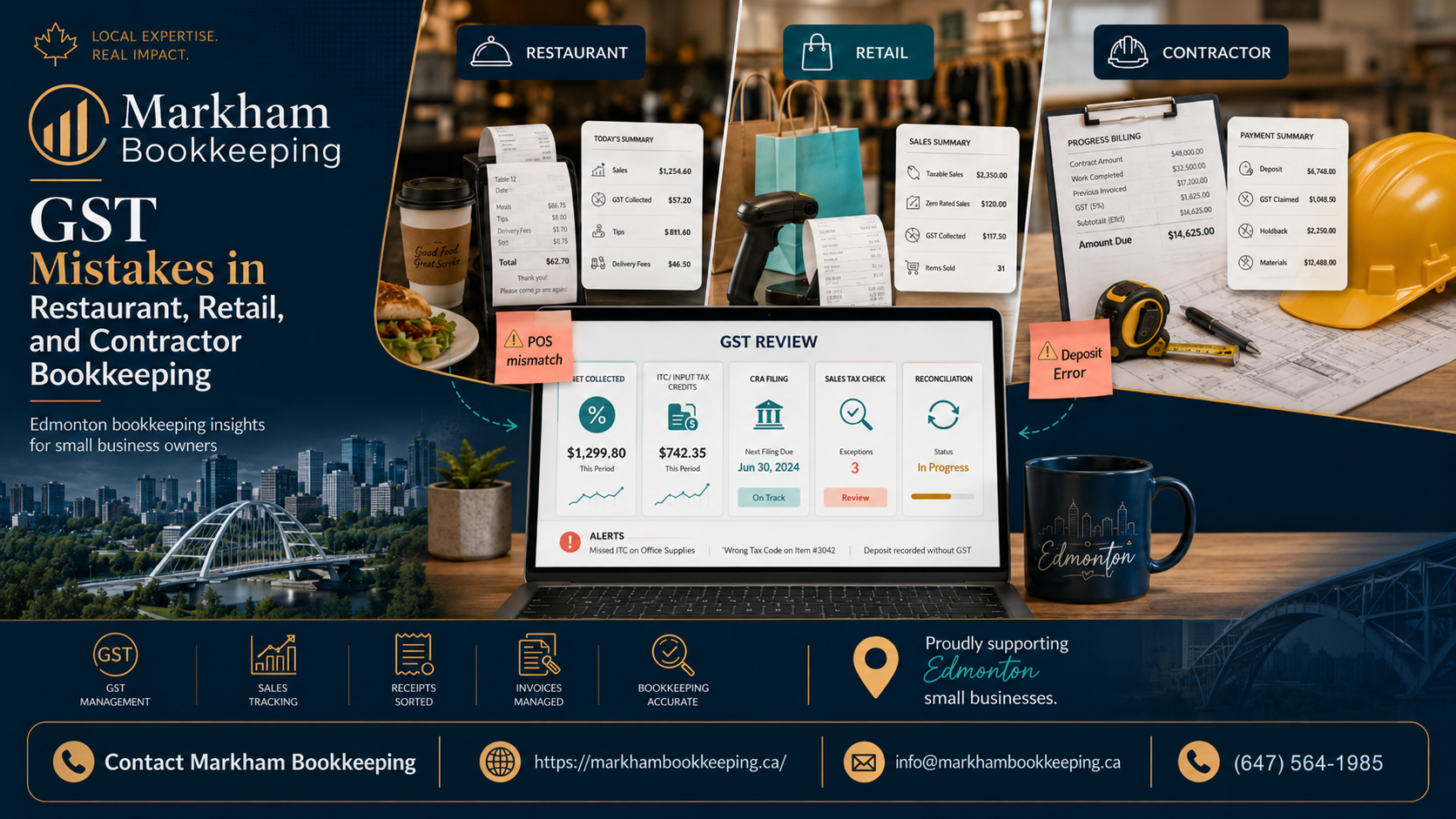
GST mistakes can quietly create serious bookkeeping problems for Edmonton small businesses. A restaurant may collect GST through a POS system but record sales incorrectly. A retail store may forget to separate taxable and zero-rated items. A contractor may receive deposits, progress payments, or holdbacks without recording GST properly.
At first, these mistakes may look small. The bank reconciles, invoices are paid, and the business keeps moving. But when GST is not tracked correctly, the numbers can become messy fast. GST payable may not match the balance sheet. Input tax credits may be missed. Sales may be overstated or understated. CRA filings may become harder to support.
For Edmonton business owners, GST bookkeeping matters because Alberta businesses generally charge 5% GST on taxable supplies, while HST applies in certain other provinces depending on the place of supply. CRA’s GST/HST rate table lists Alberta at 5% GST.
Whether you operate a restaurant, retail shop, construction company, trade business, renovation service, or contracting company, the goal is the same: collect GST properly, claim eligible input tax credits correctly, file on time, and keep records clean.
Below are common GST mistakes accountants and bookkeepers look for in restaurant, retail, and contractor bookkeeping.
1. Not Registering for GST at the Right Time
One of the biggest GST mistakes is waiting too long to register.
Many Edmonton small businesses start small and assume GST registration can wait until year-end. But the GST small supplier rules are based on taxable supplies and timing. CRA explains that a business is no longer a small supplier when it exceeds the $30,000 threshold, and if the threshold is exceeded in a single calendar quarter, the business must start charging GST on the supply that caused it to exceed the threshold.
This matters for restaurants, retail stores, and contractors because revenue can rise quickly.
A restaurant may cross the threshold after a strong opening month. A retail store may exceed it during a holiday season. A contractor may cross it after one large renovation project.
The mistake is thinking, “I will register later.” If the business should have been collecting GST and did not, the owner may still be responsible for the GST amount. That can turn into a surprise tax bill.
Bookkeeping tip: Review gross taxable sales monthly, especially for new Edmonton businesses. Do not wait until tax season to check whether GST registration was required.
2. Recording GST Collected as Revenue
GST collected from customers is not business income. It is money collected on behalf of the government.
For example, if a contractor invoices a customer $10,000 plus $500 GST, the full $10,500 may arrive in the bank. But the revenue is $10,000, and the $500 should go to GST payable.
A common bookkeeping mistake is recording the full deposit as sales revenue. This overstates income and hides the GST liability.
This problem happens often when business owners use bank deposits as the main source of bookkeeping. The bank only shows the total cash received. It does not automatically explain what portion was sales, GST, customer deposit, tip, refund, or payment processor fee.
Bookkeeping tip: Sales reports, invoices, and POS reports should be used with bank deposits. Do not rely only on bank feed descriptions.
3. Restaurant POS Sales Not Matching GST Reports
Restaurant bookkeeping can be tricky because sales may come from multiple sources:
- Dine-in sales
- Takeout
- Delivery apps
- Catering
- Gift cards
- Tips
- Discounts
- Refunds
- Cash
- Debit and credit card deposits
The POS system may show gross sales, net sales, GST, tips, discounts, refunds, and payment methods. The bank may only show the net amount deposited after merchant fees or delivery app deductions.
A common GST mistake in restaurant bookkeeping is recording bank deposits as sales without reconciling them to POS reports. This can cause GST collected to be wrong.
For example, if the restaurant receives a $950 card deposit after fees, but actual taxable sales were $1,000 plus GST, recording only the net deposit can understate sales and GST.
Restaurant owners in Edmonton should review POS reports monthly and confirm that GST collected agrees with the accounting records.
4. Mixing Tips, Sales, and GST in Restaurant Books
Restaurants must be careful with tips because tips are not always the same as taxable sales. A customer payment may include food, GST, and tips, but the bookkeeping needs to separate each part correctly.
If tips are recorded as restaurant sales, revenue may be overstated. If GST is calculated on amounts that are not taxable sales, GST payable may be wrong. If tips are paid out to employees but not tracked properly, payroll and accounting reports may become messy.
This is why restaurant bookkeeping should not be handled only through bank feeds. POS reports and payroll records need to be reviewed together.
Bookkeeping tip: Set up clear accounts for food sales, beverage sales if needed, GST payable, tips payable, merchant fees, delivery app fees, discounts, refunds, and cash over/short.
5. Retail Stores Applying GST Incorrectly to Products
Retail bookkeeping has its own GST risks. Not every item is treated the same way for GST purposes. CRA notes that zero-rated supplies have a 0% GST/HST rate throughout Canada, and basic groceries are one example of items that may be zero-rated.
This can matter for Edmonton retail stores that sell mixed products. A store may sell taxable items and zero-rated items. If the POS system is not set up correctly, GST may be charged incorrectly or not charged when it should be.
Common retail GST mistakes include:
- Charging GST on items that should be zero-rated
- Not charging GST on taxable items
- Using one tax code for all products
- Recording refunds without reversing GST properly
- Not reviewing POS tax settings after adding new products
- Treating gift cards like regular sales too early
For retail businesses, clean product setup is just as important as clean bookkeeping. If the POS system is wrong, the accounting records will likely be wrong too.
6. Forgetting GST on Online and Out-of-Province Sales
Many Edmonton retail businesses sell through Shopify, Amazon, marketplaces, social media, or direct shipping. GST can become more complicated when customers are outside Alberta.
A local sale in Alberta may be 5% GST, but sales to customers in HST provinces may require different treatment depending on the place-of-supply rules. CRA explains that the rate to charge depends on the place of supply, and the rate for taxable supplies depends on the province or territory.
The mistake is using one default tax setting everywhere without checking whether it fits the sales channel and customer location.
Bookkeeping tip: Edmonton businesses selling outside Alberta should review tax settings in Shopify, POS systems, invoicing software, and marketplaces. The accounting should match the sales tax actually charged.
7. Contractor Deposits Recorded Incorrectly
Contractor bookkeeping often includes deposits, progress billings, completion invoices, change orders, holdbacks, and customer advances. GST mistakes are common when deposits are treated casually.
For example, a contractor may receive a $5,000 deposit before work begins. If that amount is recorded directly as revenue without reviewing the invoice and GST treatment, the books may be wrong.
Some contractors also forget to charge GST on deposits or progress invoices. Others record deposits as liabilities but forget to move them properly when the work is invoiced.
This can make both revenue and GST payable inaccurate.
Bookkeeping tip: Use proper invoices for deposits and progress billings. Make sure GST is handled consistently and customer deposits are tracked clearly.
8. Contractor Holdbacks Not Tracked Properly
Construction and contractor businesses may deal with holdbacks. A customer may hold back part of the invoice until work is completed, deficiencies are cleared, or a contract condition is met.
The bookkeeping mistake is ignoring holdbacks or treating the unpaid portion as if it does not exist. This can create problems with accounts receivable, revenue, GST reporting, and cash flow.
If holdbacks are common, the books should clearly show:
- Original invoice amount
- GST charged
- Amount received
- Holdback receivable
- Remaining customer balance
- Collection status
For Edmonton contractors, holdbacks should not be buried inside general accounts receivable without review. They need to be tracked so the business understands what is collectible and what is still outstanding.
9. Missing Input Tax Credits
A GST registrant can generally recover GST/HST paid or payable on purchases and expenses related to commercial activities by claiming input tax credits, commonly called ITCs.
Many small businesses miss ITCs because receipts are missing, vendors are coded incorrectly, or transactions are posted with the wrong tax code.
Restaurants may miss ITCs on supplies, equipment, repairs, professional fees, cleaning services, and software. Retail stores may miss ITCs on inventory, packaging, merchant fees, rent, and advertising. Contractors may miss ITCs on materials, tools, fuel, subcontractor invoices, equipment rentals, and professional fees.
The mistake is assuming expense categorization alone is enough. GST coding must also be correct.
Bookkeeping tip: During monthly bookkeeping, review expenses with GST, no GST, exempt, and zero-rated tax codes. Make sure the tax treatment matches the vendor invoice.
10. Claiming ITCs Without Proper Documents
The opposite problem is claiming ITCs without proper support.
CRA requires businesses to keep records that support tax charged and remitted on taxable supplies, as well as tax paid on purchases claimed as ITCs or rebates. CRA also says businesses usually must keep GST/HST records for six years from the end of the year to which they relate.
This matters because bank statements alone may not be enough to support GST claims. A bank transaction may show that money was paid, but it may not show what was purchased, whether GST was charged, or whether the supplier had a valid GST number.
Common documentation issues include:
- Missing receipts
- No supplier invoice
- Receipt does not show GST
- Invoice is under someone else’s name
- Vendor GST number missing where required
- Personal and business purchases mixed together
Bookkeeping tip: Attach receipts and supplier invoices inside the accounting software whenever possible. This makes GST filing and year-end review much easier.
11. Recording CRA GST Payments as Expenses
GST payments to CRA are usually not regular business expenses. If the business collected GST and later remitted it, the payment should reduce the GST payable liability.
A common bookkeeping mistake is coding CRA GST payments to “tax expense” or “miscellaneous expense.” This can understate profit and leave the GST payable account incorrect.
For example, if the business owes $3,000 GST and pays CRA, the bookkeeping should reduce the GST payable balance. If it is posted to an expense account instead, the balance sheet may still show GST owing even though it was paid.
Bookkeeping tip: Reconcile the GST payable account after every filing and payment. The balance should make sense after the return is filed.
12. Filing GST Late or Using the Wrong Reporting Period
GST filing deadlines depend on the business’s reporting period. CRA explains that most annual GST/HST filers have a filing and final payment deadline three months after fiscal year-end, with special rules for sole proprietors who meet specific conditions.
The mistake is assuming every business has the same GST deadline. Monthly, quarterly, and annual filers may have different due dates. Some businesses also forget that filing and payment are separate concepts.
Late filing can lead to penalties and interest, but even before that, it creates stress. If the books are not reviewed monthly, the GST return becomes a rushed cleanup project.
Bookkeeping tip: Add GST deadlines to your monthly bookkeeping calendar. Review GST payable before the deadline, not on the due date.
13. Not Reconciling GST Payable to the Balance Sheet
A GST return is not just a form. It should connect back to the books.
At the end of the reporting period, the GST collected, GST paid, adjustments, and net GST owing or refund should agree with the GST accounts in the accounting software.
If the return says one number and the balance sheet says another, something may be wrong.
Common causes include:
- Manual journal entries to GST accounts
- GST payments coded as expenses
- Old GST balances never cleared
- Incorrect tax codes
- Duplicate sales entries
- Missing ITCs
- POS reports not reconciled
- CRA payments posted to the wrong period
For Edmonton businesses, this is one of the most important monthly bookkeeping checks. The GST payable account should not be ignored until year-end.
14. Using Too Many or Too Few GST Tax Codes
Accounting software often allows several tax codes. Some businesses use too many. Others use only one.
Both can create problems.
If there are too many tax codes, transactions may be coded inconsistently. If there are too few, taxable, zero-rated, exempt, and no-tax transactions may be mixed together.
Restaurants, retail stores, and contractors should use tax codes in a simple but accurate way. The exact setup depends on the business, but the goal is to make GST reporting clean and reviewable.
Bookkeeping tip: Review tax code usage monthly. Look for expenses with unusual tax codes and sales posted with missing GST.
Final Thoughts
GST mistakes in restaurant, retail, and contractor bookkeeping can affect more than tax filings. They can distort revenue, expenses, cash flow, accounts receivable, accounts payable, and year-end financial reports.
For Edmonton restaurants, GST issues often start with POS reports, delivery apps, tips, and merchant deposits. For Edmonton retail stores, mistakes often come from product tax settings, refunds, zero-rated items, and online sales. For Edmonton contractors, GST errors often happen with deposits, progress invoices, holdbacks, materials, subcontractors, and loan or equipment transactions.
The best solution is monthly review. Do not wait until year-end to find GST problems. Review sales reports, invoices, receipts, expense tax codes, ITCs, CRA payments, and the GST payable account every month.
Clean GST bookkeeping gives business owners better reports, fewer surprises, and stronger records if questions come up later.
Need help with GST bookkeeping in Edmonton? Markham Bookkeeping helps small businesses with GST review, restaurant bookkeeping, retail bookkeeping, contractor bookkeeping, reconciliations, payroll, cleanup, and monthly financial reporting.
Website: https://markhambookkeeping.ca/