
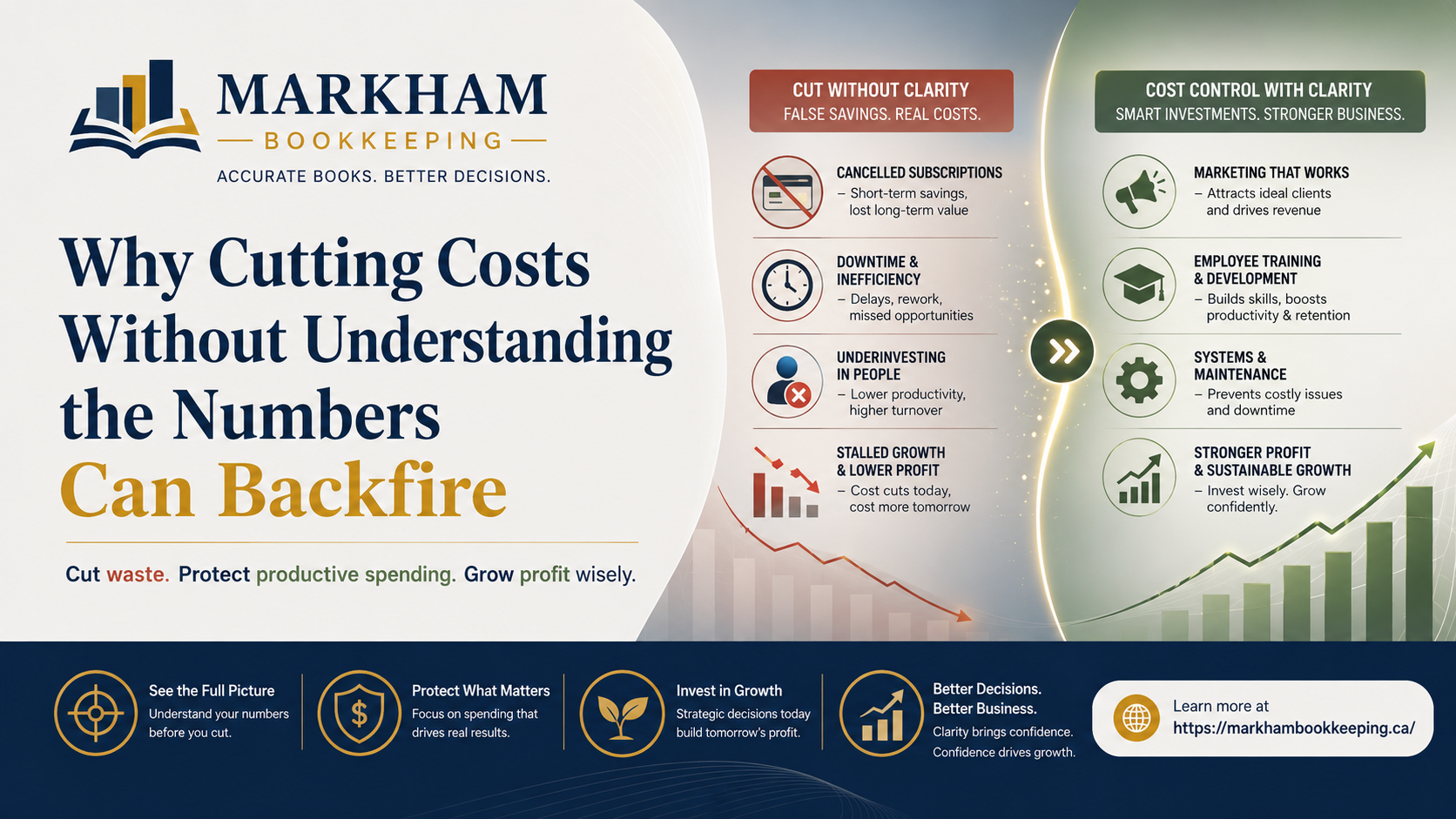
When profits tighten, the first reaction in many businesses is predictable:
Cut expenses.
Cancel subscriptions. Reduce staff hours. Freeze hiring. Stop advertising. Delay equipment purchases. Negotiate suppliers. Eliminate benefits. Reduce training. Cut anything that does not appear absolutely necessary.
On the surface, this seems logical. If a business spends less money, profit should improve.
But that is not always what happens.
Some expenses simply consume cash. Others help the business generate revenue, maintain capacity, retain customers, protect margins, or prevent larger costs later.
Cutting both categories indiscriminately can make the financial statements look better temporarily while weakening the business underneath.
For Edmonton business owners trying to improve profitability, the better question is not:
“What can we cut?”
It is:
“Which costs are creating value, and which costs are not?”
That distinction can completely change the outcome of a cost-reduction strategy.
Not Every Expense Is a Bad Expense
Business owners naturally focus on expenses when profitability declines.
But an expense is not automatically a problem simply because it appears on the profit and loss statement.
Consider two businesses.
Business A spends $8,000 per month on marketing and generates $60,000 of profitable new sales from that activity.
Business B spends $3,000 per month on software licenses that employees barely use.
Technically, both are expenses.
Financially, they are very different.
Eliminating Business B’s unused software may improve profitability with little operational impact.
Eliminating Business A’s marketing budget could save $8,000 this month but potentially eliminate far more than $8,000 in future gross profit.
That is the difference between productive spending and non-productive spending.
A strong cost-cutting exercise should attempt to separate the two.
Productive Expenses vs. Non-Productive Expenses
A productive expense contributes to the company’s ability to generate revenue, serve customers, operate efficiently or reduce meaningful business risk.
Examples may include:
- effective advertising
- productive employees
- essential software
- preventative equipment maintenance
- sales commissions that generate profitable revenue
- bookkeeping and financial controls
- employee training tied to measurable performance
- technology that reduces labour requirements
- inventory required to meet customer demand
A non-productive expense provides little measurable benefit relative to what the business pays for it.
Examples could include:
- unused subscriptions
- duplicate software
- unnecessary overtime
- excessive administrative layers
- avoidable penalties and interest
- unused office space
- poor purchasing practices
- recurring expenses nobody has reviewed in years
- unnecessary rush shipping
- inefficient scheduling
The categories are not universal.
A $5,000 marketing expense may be extremely productive for one Edmonton company and completely ineffective for another.
The numbers have to tell you which is which.
The Dangerous Appeal of Across-the-Board Cuts
One of the easiest cost-cutting strategies is an across-the-board reduction.
Management might decide:
Every department must reduce expenses by 10%.
It sounds fair.
It is also potentially financially irrational.
Suppose one department already operates very efficiently while another contains significant waste.
Reducing both budgets by the same percentage penalizes the efficient department while allowing some of the waste in the other department to remain.
Even worse, departments producing the strongest financial returns may receive the same cuts as areas contributing very little.
A business should not necessarily cut costs evenly.
It should cut costs intelligently.
That requires good financial information.
Cutting Marketing Can Reduce More Than Marketing Expense
Marketing is often one of the first expenses businesses reduce because it feels discretionary.
Sometimes that is the correct decision.
If the business is spending thousands every month on advertising without knowing whether it produces customers, the expense deserves scrutiny.
But stopping effective advertising simply to improve this month’s profit and loss statement can be dangerous.
Suppose an Edmonton business spends $10,000 per month on advertising.
That advertising generates $50,000 of additional sales with a 40% gross margin.
Those sales therefore contribute roughly $20,000 toward gross profit before considering the advertising cost.
The $10,000 marketing expense is helping create $20,000 of gross profit.
Removing it saves $10,000 but potentially removes $20,000 of contribution.
The company becomes smaller and less profitable, despite reducing expenses.
This is why good bookkeeping and management reporting matter.
The expense itself does not tell the entire story.
The relationship between the expense and the revenue it creates is what matters.
Cutting Employees Can Create Hidden Costs
Payroll is commonly the largest expense for service-based businesses and many other Edmonton companies.
When costs need to fall quickly, reducing employees or employee hours can produce an immediate financial impact.
But payroll decisions need careful analysis.
Imagine a company removes one employee earning $50,000 per year.
On paper, that looks like a $50,000 annual saving, plus applicable employer costs.
But what happens next?
Other employees may need to work overtime.
Managers may spend more time performing operational tasks.
Customer response times may deteriorate.
Salespeople may spend less time selling.
Service quality may decline.
Existing employees may burn out.
The business may eventually hire someone else at a higher wage.
Suddenly the real saving is considerably smaller than expected.
This does not mean payroll should never be reduced.
It means businesses should analyze productivity, not simply headcount.
Useful questions include:
- How much revenue does this role support?
- Is there enough work for the position?
- Can processes be automated?
- Is overtime caused by understaffing or poor scheduling?
- Are employees performing work appropriate for their compensation level?
- Are administrative tasks consuming expensive employee time?
- Has revenue per employee improved or declined?
An Edmonton bookkeeping service that provides useful management reporting can help identify these trends before management makes major staffing decisions.
Cutting Maintenance Can Become an Expensive Mistake
Maintenance is another expense that may seem easy to delay.
A business saves money immediately by postponing vehicle servicing, equipment repairs or preventative maintenance.
But the financial impact may simply be transferred into the future.
A $1,000 preventative repair might eventually become a $10,000 breakdown.
The company may also experience downtime, lost production, emergency labour costs or customer delays.
The same principle applies to technology.
Businesses sometimes continue operating outdated systems because upgrading costs money.
But if employees lose several hours every week performing manual work because of those systems, the business may already be paying for the upgrade indirectly through labour inefficiency.
Good cost management considers total cost, not just the invoice currently being avoided.
Cheap Suppliers Can Be Surprisingly Expensive
Supplier negotiations can generate excellent savings.
But choosing the lowest-cost supplier is not always the same thing as lowering total business costs.
A cheaper supplier may create:
- poorer product quality
- more returns
- longer delivery times
- higher shipping charges
- inconsistent availability
- additional employee time dealing with problems
- customer complaints
- lost sales
For example, saving $4 per unit sounds attractive.
But if the cheaper product creates substantially more warranty claims, rework or customer dissatisfaction, the actual economics may be worse.
Edmonton businesses should look beyond purchase price and consider the total cost of procurement.
Sometimes paying slightly more produces a better financial result.
Cutting Bookkeeping Can Create False Savings
When businesses experience financial pressure, administrative functions often get reduced first.
Bookkeeping can look like overhead.
After all, bookkeeping does not manufacture products, perform construction work, sell vehicles or directly serve restaurant customers.
But weak financial records can make cost reduction more difficult because management loses the information needed to determine which costs are actually causing problems.
Poor bookkeeping can also create:
- inaccurate profit reporting
- missed customer invoices
- overdue accounts receivable
- duplicate payments
- unreconciled transactions
- incorrect GST treatment
- unreliable supplier balances
- unexpected payroll liabilities
- difficulty monitoring cash flow
Saving several hundred dollars on bookkeeping while losing thousands through poor financial control is not really a saving.
For a growing company, reliable bookkeeping in Edmonton should help management understand where money is going rather than simply record where it went.
Watch Gross Margin Before Cutting Overhead
A company experiencing declining profits may immediately attack overhead.
But sometimes overhead is not the real problem.
The problem may be gross margin.
Suppose revenue remains at $1 million.
At a 40% gross margin, the company generates $400,000 toward overhead and profit.
If gross margin falls to 35%, the company generates only $350,000.
That five-percentage-point decline costs the business $50,000.
Management could spend months attempting to cut office supplies, telephone costs, software and minor administrative expenses when the much larger problem is occurring in pricing or direct costs.
A declining gross margin can result from:
- supplier price increases
- excessive discounting
- poor job estimating
- overtime
- material waste
- higher freight costs
- changing product mix
- unprofitable customers
- underpriced services
This is why reviewing financial statements regularly is so important.
The right solution depends on identifying where profitability is actually being lost.
Some Savings Are Really Deferred Expenses
Businesses under cash pressure sometimes delay expenses rather than eliminate them.
There is an important difference.
For example:
A company postpones replacing worn equipment.
Cash flow improves this month.
But the equipment still needs to be replaced eventually.
A business delays paying suppliers.
Cash temporarily increases.
But accounts payable also increases.
A company delays repairs.
Expenses fall this month.
But the repair requirement remains.
These decisions can sometimes be necessary during short-term cash management.
However, they should not be confused with permanent cost savings.
A good financial review distinguishes between:
true savings and costs that have simply been pushed into the future.
Cost Cutting Should Protect the Core Business
An effective cost reduction strategy should attempt to remove waste while protecting the activities that make the company successful.
Think of the business as having three broad categories of spending.
1. Revenue-producing costs
These directly or indirectly help generate profitable sales.
Examples may include productive employees, effective advertising, sales commissions and essential inventory.
These should generally be analyzed carefully before being reduced.
2. Operationally necessary costs
These may not directly generate revenue but are necessary to keep the business functioning.
Examples include insurance, accounting, cybersecurity, certain software, maintenance and regulatory compliance.
The goal is often to make these costs efficient rather than eliminate them.
3. Low-value or unnecessary costs
These are the first places management should investigate.
Examples may include duplicate subscriptions, unnecessary overtime, poor vendor arrangements, excessive administrative spending and recurring costs that no longer serve a meaningful business purpose.
This framework produces better decisions than simply sorting expenses from largest to smallest and cutting from the top.
Look at Cost Per Dollar of Revenue
Absolute expenses can sometimes be misleading.
Imagine payroll increased from $500,000 to $600,000.
At first glance, payroll increased substantially.
But suppose revenue increased from $1 million to $1.5 million.
Payroll represented 50% of revenue before.
It now represents 40%.
Payroll increased in dollars but became more efficient relative to revenue.
Now consider the opposite.
Payroll remains at $500,000 while revenue drops from $1 million to $800,000.
Payroll did not increase at all.
Yet it has become a much larger financial burden relative to revenue.
This is why percentage-based analysis can be valuable.
Useful ratios for small businesses may include:
- payroll as a percentage of revenue
- gross margin percentage
- advertising as a percentage of sales
- occupancy costs as a percentage of revenue
- administrative costs as a percentage of revenue
- revenue per employee
The appropriate ratios vary by industry, but comparing a company against its own historical performance can reveal important changes.
Small Expenses Matter — But Large Drivers Matter More
Business owners sometimes focus heavily on small visible expenses.
Employees are told to stop ordering coffee.
Office supplies are restricted.
A $40 software subscription is cancelled.
Those actions may be reasonable.
But they should not distract management from larger financial drivers.
If a company loses $30,000 per month, eliminating $400 of subscriptions will not solve the underlying problem.
Management may need to investigate:
- pricing
- payroll structure
- gross margins
- staffing levels
- rent
- financing costs
- customer profitability
- purchasing
- overtime
- low-margin products
- underperforming locations
Good cost reduction starts with the material numbers first.
Use Normalized Numbers, Not Just One Strange Month
Another danger is making major decisions based on unusual financial periods.
Imagine one month contains:
- a large annual insurance payment
- major repairs
- a one-time professional fee
- an equipment expense
- an unusual payroll period
That month’s profit may look terrible.
But it may not represent the company’s normal operations.
Before making significant cuts, management should consider whether the results need to be normalized.
A normalized financial view attempts to separate recurring operating performance from unusual or one-time events.
For example, rather than concluding:
“Expenses were $100,000 this month, so we need to cut $20,000.”
The better analysis may show:
“Normal monthly expenses are approximately $82,000, and $18,000 this month was unusual.”
That produces a very different management decision.
This is one of the reasons businesses benefit from regular financial reporting instead of looking at isolated bank balances or individual months.
Ask These Questions Before Cutting an Expense
Before eliminating a significant expense, an Edmonton business owner can ask:
Does this expense directly or indirectly generate revenue?
What happens operationally if we remove it?
Can we measure the return we are getting?
Is there a cheaper way to achieve the same result?
Is the expense truly unnecessary, or merely easy to see?
Will removing it create another expense somewhere else?
Is this a recurring saving or just a delayed cost?
Is the real problem actually somewhere else in the financial statements?
These questions shift cost reduction from reaction to analysis.
Better Bookkeeping Leads to Better Cost Decisions
You cannot manage costs effectively if you do not trust the numbers.
For Edmonton small businesses, reliable monthly bookkeeping makes it much easier to identify where money is being spent and whether financial performance is improving.
That means keeping accounts reconciled, reviewing expenses consistently and producing financial statements that management can actually use.
A useful month-end review may examine:
- revenue trends
- gross margin
- payroll
- major expense categories
- unusual transactions
- accounts receivable
- accounts payable
- cash balances
- debt
- taxes payable
- actual results compared with previous months
Instead of saying:
“Costs seem too high.”
Management can say:
“Payroll increased from 38% to 44% of revenue over six months while revenue remained flat.”
That is actionable information.
Cost Control Is Not About Spending the Least
The best-run business is not necessarily the business with the lowest expenses.
It is the business that gets the strongest return from the money it spends.
A company can spend aggressively and still be financially disciplined if those expenses produce profitable growth.
Another company can appear extremely frugal while wasting money through inefficient operations, poor scheduling, bad purchasing and weak financial controls.
The objective should therefore be efficient spending, not simply low spending.
For Edmonton entrepreneurs and small business owners, this distinction becomes especially important when economic conditions become more challenging.
Pressure can encourage fast decisions.
But the bigger the financial decision, the more important it becomes to understand the numbers first.
Final Thought
Cost cutting can absolutely improve a struggling business.
Waste should be eliminated.
Unnecessary expenses should be challenged.
Suppliers should be reviewed.
Processes should become more efficient.
But cutting costs without understanding what those costs actually do can create a different problem.
The company may save money while reducing its ability to make money.
That is false economy.
Before reducing marketing, payroll, software, maintenance or other major expenses, look at the relationship between the cost and the business outcome it supports.
Use the profit and loss statement.
Review gross margin.
Look at trends.
Compare expenses to revenue.
Understand which costs are productive and which ones are simply consuming resources.
And make sure the bookkeeping is reliable enough to support the decision.
Because the goal of cost control is not to create the cheapest business possible.
It is to create a more profitable, efficient and financially sustainable business.
For business owners looking for bookkeeping services in Edmonton, that is one of the most valuable purposes of good financial reporting: turning accounting data into information that helps you decide not only where to spend less, but where spending money still makes financial sense.