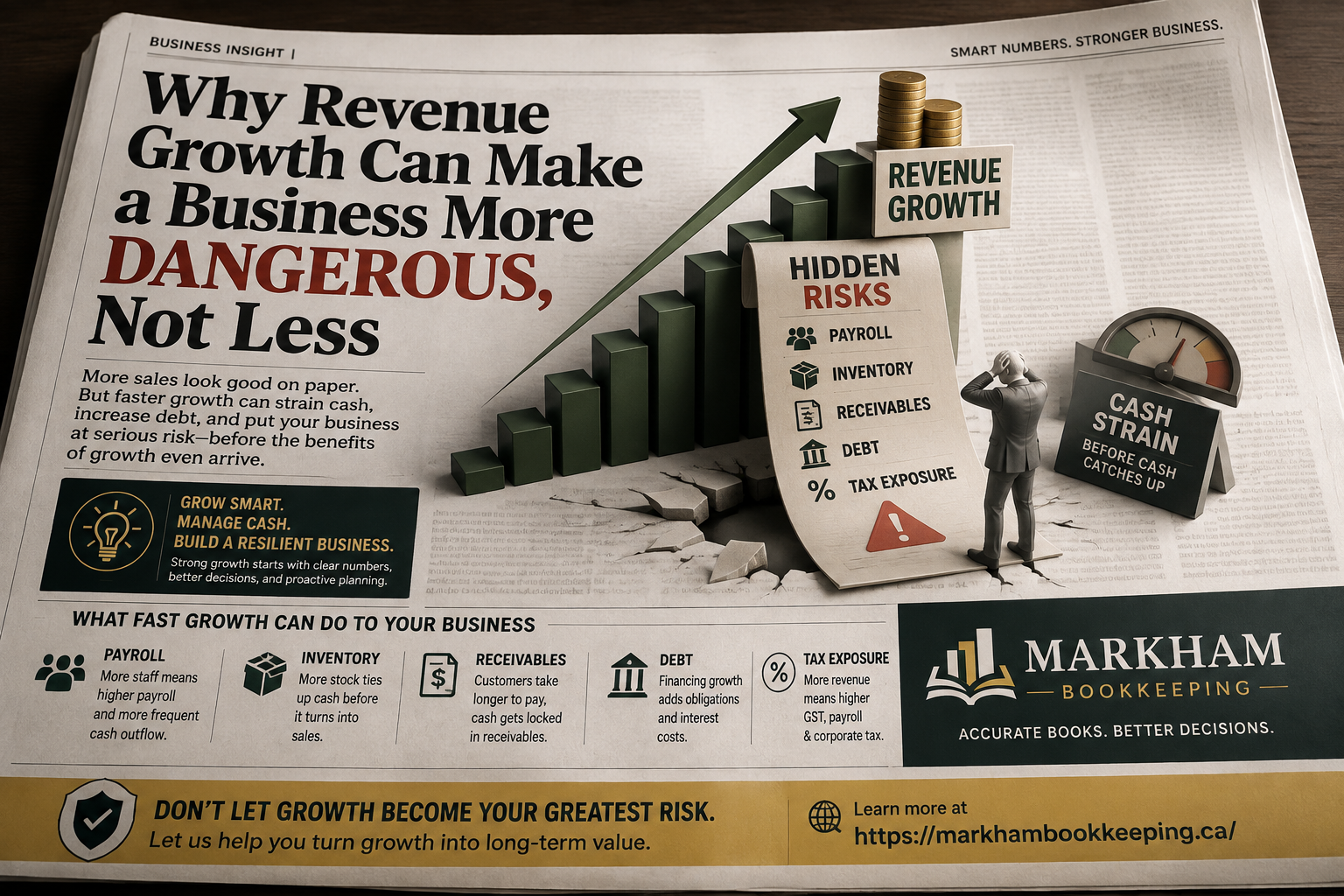
Revenue growth is usually treated as proof that a business is succeeding.
Sales are increasing. New customers are arriving. More employees are being hired. Inventory is moving. The company may be opening another location, buying equipment or taking on larger contracts.
From the outside, everything looks positive.
But rapid revenue growth can create a financial problem that catches business owners by surprise:
The business can become more financially vulnerable while sales are increasing.
Growth often requires cash before the business receives the cash generated by that growth.
More revenue may require more payroll.
More customers may create more accounts receivable.
More sales may require additional inventory.
Larger projects may require materials and subcontractors to be paid before customers pay their invoices.
Expansion may require financing.
And increasing sales can also increase GST, payroll and corporate tax obligations.
The income statement may therefore show impressive growth while the bank account becomes increasingly uncomfortable.
For growing Edmonton businesses, understanding this difference between revenue growth and financial strength can be critical.
Growth is good.
But growth that consumes cash faster than the company can generate it can become dangerous.
Revenue Is Not the Same as Cash
This is one of the most important financial concepts for any business owner.
Suppose an Edmonton company invoices a customer $100,000 today.
Revenue may be recorded.
But if the customer has 60-day payment terms, the business does not necessarily have the cash yet.
During those 60 days, the company may still need to pay:
- employees
- suppliers
- rent
- subcontractors
- insurance
- utilities
- loan payments
- GST and payroll obligations
The sale increased revenue.
It did not immediately increase available cash.
That distinction becomes increasingly important as a business grows.
A company generating $100,000 per month with customers paying in 15 days may actually have stronger cash flow than a company generating $500,000 per month where customers routinely take 60 or 90 days to pay.
Revenue measures sales.
Cash flow measures survival.
Growth Can Make Accounts Receivable Explode
Consider a business with monthly sales of $200,000.
Customers generally pay within 30 days.
The company might normally carry approximately $200,000 of accounts receivable.
Now suppose demand increases and monthly sales reach $400,000.
That sounds excellent.
But if payment terms stay the same, accounts receivable could also climb toward $400,000.
The company has effectively financed an additional $200,000 of customer purchases.
If customers begin paying more slowly because larger corporate clients have longer payment cycles, accounts receivable could grow even further.
The financial statements may show:
Revenue: Up significantly
Profit: Up
Cash: Down
All three can be true at the same time.
This is why an accounts receivable aging report can become increasingly important as a company grows.
Business owners should know:
- how much customers owe
- how old those balances are
- which customers are consistently late
- whether receivables are growing faster than sales
- how many days it typically takes to collect revenue
Growth creates opportunity.
But it can also turn the business into an unwilling bank for its customers.
More Sales Can Require More Inventory
Product-based businesses face another challenge.
You often need to purchase inventory before you can sell it.
Suppose an Edmonton retailer expects sales to increase substantially for the coming season.
To support that growth, the company purchases an additional $150,000 of inventory.
That inventory may eventually generate strong revenue.
But today, the business has converted $150,000 of cash into products sitting on shelves or in a warehouse.
The money has not disappeared.
It has changed form.
From a cash-flow perspective, however, it is no longer available for payroll, rent or other immediate obligations.
Rapid growth can therefore create what feels like a strange situation:
The warehouse is full. Sales are strong. Profit looks reasonable. The bank account is struggling.
Inventory management becomes increasingly important as businesses scale.
Too little inventory can cause lost sales.
Too much inventory traps cash.
The goal is not simply to buy more because the business is growing.
The goal is to understand how quickly inventory turns into sales and how quickly those sales turn back into cash.
Payroll Often Has to Grow Before Revenue Arrives
Service businesses experience a similar problem through payroll.
Imagine an Edmonton company wins several major contracts.
To deliver the work, it hires ten additional employees.
Employees must generally be paid every one or two weeks.
The customers may not pay for 30, 45 or 60 days.
That creates a timing gap.
The business may fund several payroll cycles before receiving cash from the revenue those employees helped generate.
And the true cost of payroll is larger than employee take-home pay.
Depending on the business and employee circumstances, costs can include:
- gross wages
- employer CPP
- employer EI
- vacation pay
- benefits
- workers’ compensation costs
- overtime
- bonuses
- payroll administration
- training and onboarding
Growth can therefore create a payroll funding requirement long before it produces usable cash.
If a business expands quickly without planning for this timing difference, strong sales can actually increase short-term financial pressure.
Larger Customers Can Sometimes Create Bigger Cash-Flow Problems
Landing a major customer can feel like a breakthrough.
Sometimes it is.
But larger customers often have more negotiating power.
They may expect:
- longer payment terms
- lower pricing
- volume discounts
- detailed billing requirements
- holdbacks
- approval processes before invoices are paid
Imagine replacing ten customers who pay within 15 days with one large customer paying in 60 days.
Revenue may increase.
Administrative work may decrease.
But cash conversion could become significantly slower.
The business may need to borrow money to finance the waiting period.
That creates interest expense.
Suddenly the profitability of the new customer is not determined solely by sales.
It also depends on:
- gross margin
- payment terms
- collection reliability
- servicing costs
- financing requirements
The biggest customer is not automatically the best customer.
Revenue Growth Can Increase GST Exposure
Increasing sales can also mean increasing indirect tax obligations.
For a GST-registered Alberta business, taxable sales generally result in GST being collected from customers.
Those amounts may sit temporarily inside the company’s bank account.
That can make the bank balance look healthier than it really is.
Suppose a business experiences a particularly strong sales month.
Cash receipts rise substantially.
Management sees extra cash and uses it to:
- purchase inventory
- make equipment deposits
- reduce supplier balances
- make owner withdrawals
- fund expansion
Then the GST payment becomes due.
The money that appeared to be available was partly connected to a tax obligation.
The same principle applies to payroll source deductions.
When a business grows, these balances can become materially larger.
Good bookkeeping for Edmonton businesses should therefore make tax liabilities visible throughout the year rather than allowing the owner to discover them only when payment deadlines arrive.
Payroll Liabilities Grow With Payroll
Growth frequently means hiring.
Hiring means larger payroll.
Larger payroll means larger payroll-related liabilities and potentially greater compliance requirements.
A business that previously had six employees might comfortably manage payroll using relatively simple processes.
At thirty employees, payroll errors or missed remittances can become far more expensive.
The amount involved is simply larger.
This is an important principle:
Growth magnifies both good systems and bad systems.
A $500 bookkeeping discrepancy in a small company may become a $5,000 or $50,000 problem when the transaction volume multiplies.
Strong payroll processes, reconciliations and clear responsibility become more important as revenue grows.
Debt Can Make Growth Look Easier Than It Really Is
Businesses often use financing to support expansion.
That can make sense.
A business may borrow money to purchase:
- vehicles
- machinery
- equipment
- inventory
- property
- technology
Financing prevents the company from paying the entire purchase price immediately.
But borrowing creates another financial commitment.
Revenue may increase after the investment.
The company now also has:
- principal payments
- interest
- potential security requirements
- additional fixed monthly obligations
One common mistake is evaluating financing only by asking:
“Can we make the payment?”
A stronger question is:
“How much cash does this investment need to generate after operating costs to safely support the payment?”
Debt can accelerate successful growth.
It can also reduce the company’s margin for error.
If revenue temporarily declines, the loan payment does not necessarily decline with it.
Fixed Costs Change the Risk Profile of the Business
Growth can also transform variable costs into fixed commitments.
A company may sign a larger lease.
Hire permanent employees.
Purchase financed equipment.
Enter long-term software contracts.
Acquire additional vehicles.
Create management positions.
These decisions may be completely appropriate.
But once made, the business needs a certain level of revenue just to support its new cost structure.
Consider an Edmonton company that previously had monthly fixed expenses of $70,000.
After expanding, monthly fixed expenses rise to $130,000.
The larger company may be substantially more profitable when sales are strong.
But if revenue falls unexpectedly, it also has an additional $60,000 of monthly commitments to cover.
Growth can therefore increase both:
potential profit
and
financial risk.
Profit Can Grow While Working Capital Gets Worse
Working capital provides another useful way to look at growth.
A simplified way to think about working capital is the short-term resources available to meet short-term obligations.
Rapid growth can put pressure on working capital because:
- receivables increase
- inventory increases
- payroll increases
- suppliers need payment
- tax liabilities increase
Cash may become trapped inside the operating cycle.
Suppose your business purchases inventory today.
Thirty days later, the inventory is sold.
The customer receives a 30-day payment term.
The customer actually pays ten days late.
That cash might have been tied up for approximately 70 days.
Now multiply that cycle across hundreds of transactions.
Understanding this timing can be more valuable than simply knowing the company’s annual profit.
A Growing Business Can Become Too Dependent on Credit
Another warning sign appears when growth is increasingly financed through:
- operating lines of credit
- credit cards
- supplier credit
- shareholder advances
- short-term loans
Borrowing itself is not necessarily a problem.
The question is why the borrowing keeps increasing.
If debt is temporarily financing a predictable working-capital cycle, it may be manageable.
If the company continuously requires more borrowing just to cover normal payroll and operating expenses, growth may not be producing enough cash.
Watch for a pattern such as:
Revenue ↑
Profit ↑
Receivables ↑
Inventory ↑
Debt ↑
Cash ↓
That combination deserves attention.
The business may be growing, but the quality of that growth may be deteriorating.
Growth Can Hide Falling Margins
Another danger is focusing exclusively on revenue.
Imagine sales increase from $2 million to $3 million.
Excellent.
But gross margin declines from 35% to 25%.
At $2 million and a 35% gross margin, the company generates $700,000 of gross profit.
At $3 million and a 25% gross margin, it generates $750,000.
Revenue increased by 50%.
Gross profit increased by only about 7%.
If the business hired employees, leased more space and added vehicles to achieve that growth, net profit could actually decline.
This is why small business owners should not celebrate revenue growth without also reviewing:
- gross margin
- net margin
- payroll percentage
- overhead
- cash flow
- working capital
More sales do not automatically mean better economics.
Fast Growth Can Create Operational Waste
Growth can also happen faster than systems can adapt.
A company that doubles in size may suddenly experience:
- duplicated work
- unnecessary overtime
- poor purchasing controls
- excessive rush orders
- inconsistent pricing
- billing delays
- inventory errors
- missing documentation
- weak expense approvals
- slow collections
These problems may not have mattered much when transaction volume was low.
At scale, they become expensive.
For this reason, Edmonton bookkeeping services should not simply record growth after it occurs.
Reliable financial reporting should help management determine whether the business is becoming more efficient or less efficient while it grows.
How Can You Tell Whether Growth Is Healthy?
Revenue is still important.
But it should be reviewed alongside other indicators.
A growing Edmonton small business should consider monitoring:
Revenue Growth
Are sales actually increasing consistently?
Gross Margin
Is the business keeping enough from each sale after direct costs?
Accounts Receivable
Are customers paying quickly enough?
Accounts Receivable Days
Is the collection cycle becoming longer?
Inventory
Is inventory growing faster than sales?
Payroll as a Percentage of Revenue
Is the additional workforce producing enough additional revenue?
Operating Cash Flow
Is the core business generating cash?
Debt
Is borrowing growing faster than the company’s ability to repay it?
GST and Payroll Liabilities
Are tax obligations being tracked and funded?
Net Profit Margin
Is the additional revenue translating into actual profit?
Looking at these numbers together provides a far better picture than revenue alone.
Forecast Cash Before You Chase Growth
One of the best financial exercises a growing business can perform is a simple cash-flow forecast.
Imagine revenue is expected to increase 30% over the next six months.
Ask:
How much additional inventory will we need?
Will we need additional employees?
When will those employees start?
When will payroll be paid?
When will customers actually pay us?
Will new equipment be required?
How much GST will additional taxable revenue generate?
Will we need a larger line of credit?
What happens if customers pay 15 days later than expected?
What happens if growth comes in at only 15% instead of 30%?
These questions help management understand the cash cost of growth before committing to it.
Good Bookkeeping Becomes More Important as Revenue Grows
A business doing $100,000 in annual revenue can sometimes operate with relatively simple bookkeeping.
At $1 million, $5 million or $10 million, poor financial information becomes much more dangerous.
Transaction volume is larger.
Balances are larger.
Payroll is larger.
Receivables are larger.
Tax obligations are larger.
Errors become larger.
For businesses looking for bookkeeping services in Edmonton, this is why bookkeeping should evolve alongside the company.
Management should be able to see:
- reliable monthly financial statements
- bank and credit card reconciliations
- accounts receivable aging
- accounts payable aging
- payroll liabilities
- GST balances
- debt balances
- departmental or project profitability where appropriate
- cash-flow trends
Growth without financial visibility is partly guesswork.
The Best Growth Creates Cash, Not Just Revenue
A financially strong business does not simply generate larger invoices every year.
Over time, successful growth should strengthen the company’s ability to generate cash.
That may not happen immediately.
Fast-growing companies often need periods of heavy investment.
But eventually the economics should work.
The company should be able to generate sufficient cash to:
- pay employees
- pay suppliers
- meet tax obligations
- service debt
- reinvest in operations
- maintain reserves
- provide returns to owners
If every additional dollar of revenue creates an ongoing need for even more borrowing, the business model deserves closer examination.
Final Thought
Revenue growth is exciting.
It means customers want what the business sells.
It creates opportunities to hire, expand and build something larger.
But growth and financial strength are not the same thing.
Growing sales can increase accounts receivable.
Growth can consume inventory.
It can require payroll before customers pay.
It can increase GST and payroll obligations.
It can create additional debt and fixed costs.
And it can place enormous pressure on cash flow before the financial benefits of growth arrive.
For Edmonton business owners, the goal should therefore not simply be:
Grow revenue.
The goal should be:
Grow profitably, grow with sufficient cash, and grow without losing financial control.
Good Edmonton bookkeeping and financial reporting can help businesses identify whether revenue growth is strengthening the organization or quietly creating a larger financial risk.
Because the most dangerous time to stop watching the numbers may be exactly when the sales numbers look their best.