
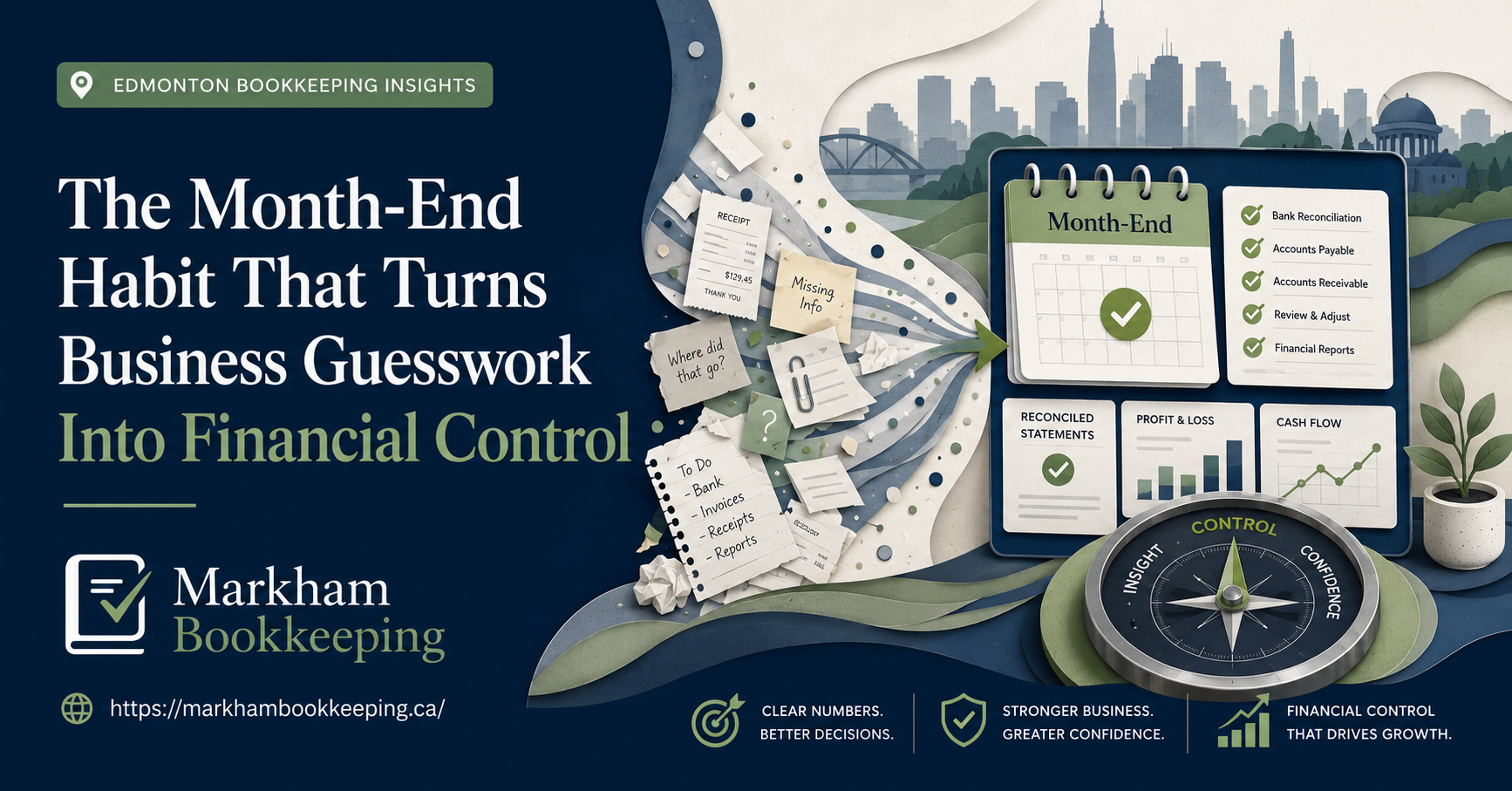
Running a business without completing a proper month-end review is a lot like driving while looking only in the rear-view mirror. You may know where you have been, but you cannot clearly see what is happening now or what may be coming next.
Many business owners check their bank balance, review a few invoices, and assume they understand their financial position. Unfortunately, a bank balance does not tell the complete story. It does not show unpaid bills, outstanding customer invoices, payroll obligations, GST payable, loan balances, inventory changes, or expenses that have not yet cleared the account.
This is why consistent month-end bookkeeping is one of the most important habits an Edmonton business can develop.
A proper month-end process turns scattered transactions into reliable financial information. It allows owners to stop guessing and begin managing their businesses with greater control.
What Is Month-End Bookkeeping?
Month-end bookkeeping is the process of reviewing, reconciling, and finalizing a company’s financial records after each month ends.
The purpose is not simply to enter transactions. The goal is to confirm that the accounting records accurately reflect what happened during the month.
A typical month-end process may include:
- Reconciling bank and credit card accounts
- Reviewing accounts receivable
- Reviewing accounts payable
- Recording payroll and payroll liabilities
- Checking GST collected and paid
- Categorizing outstanding transactions
- Reviewing loans and credit lines
- Recording depreciation or adjusting entries
- Comparing income and expenses
- Producing financial reports
When these steps are completed regularly, business owners receive a much clearer picture of their company’s financial health.
Your Bank Balance Is Not Your Profit
One of the most common mistakes in small business accounting is treating the bank balance as available profit.
Suppose an Edmonton contractor has $60,000 in the business bank account. That amount may appear healthy. However, the company may also have:
- $18,000 of supplier bills waiting to be paid
- $9,000 of payroll and source deductions due
- $7,000 of GST owing
- $12,000 required for upcoming equipment payments
- Customer deposits that have not yet been earned
After considering these obligations, the company’s actual available cash may be much lower than the bank balance suggests.
Month-end bookkeeping helps separate cash, profit, liabilities, and working capital. That distinction is essential when deciding whether the business can afford to hire employees, purchase equipment, increase owner withdrawals, or take on another project.
Bank Reconciliation Creates a Reliable Starting Point
Bank reconciliation is one of the foundations of the month-end process.
During a reconciliation, the transactions recorded in the accounting system are compared with the transactions appearing on the bank statement. The goal is to identify missing transactions, duplicate entries, incorrect amounts, uncleared payments, and other differences.
Without monthly reconciliation, bookkeeping errors may remain unnoticed for months.
For example, a business could accidentally record the same expense twice. A customer payment might be deposited but never applied to the correct invoice. A bank fee, loan payment, or automatic withdrawal may be missing from the books.
An experienced Edmonton bookkeeper will generally reconcile each bank account, credit card, line of credit, and payment-processing account before relying on the financial reports.
Financial statements produced from unreconciled accounts may look professional, but the numbers may not be dependable.
Accounts Receivable Shows What Customers Still Owe
A business may report strong sales and still experience cash-flow problems.
The reason is simple: sales do not always mean cash has been collected.
A month-end review of accounts receivable shows:
- Which customers owe money
- How long invoices have been outstanding
- Which balances require follow-up
- Whether payments were applied correctly
- Whether old balances may be uncollectible
This information is especially valuable for Edmonton construction companies, consultants, wholesalers, professional service providers, and other businesses that invoice customers after providing goods or services.
When receivables are not reviewed regularly, overdue invoices can quietly become serious collection problems.
A monthly accounts receivable aging report allows the owner to follow up early rather than discovering several months later that a major invoice remains unpaid.
Accounts Payable Prevents Unpleasant Surprises
Accounts payable represents bills and expenses the business owes to suppliers, contractors, lenders, and service providers.
A company may appear profitable while carrying large unpaid obligations.
Reviewing accounts payable at month-end helps business owners plan for:
- Supplier payments
- Credit card balances
- Subcontractor invoices
- Rent and utilities
- Equipment financing
- Professional fees
- Insurance payments
- Tax and payroll obligations
It also helps identify duplicate bills, bills entered under the wrong supplier, missed payment deadlines, and expenses that were paid but remain open in the accounting system.
For Edmonton small businesses operating with tight margins, knowing what must be paid over the next few weeks can be just as important as knowing how much revenue was earned.
Month-End Reports Turn Transactions Into Decisions
Bookkeeping becomes valuable when the information is used to make decisions.
After the records have been reconciled and reviewed, the business can generate meaningful financial reports.
The three most useful reports are generally the profit and loss statement, balance sheet, and cash-flow report.
Profit and Loss Statement
The profit and loss statement shows revenue, expenses, and net income over a specific period.
It can help answer questions such as:
- Are sales increasing or decreasing?
- Are labour costs becoming too high?
- Is advertising producing enough revenue?
- Are material costs affecting margins?
- Is the business actually profitable?
Balance Sheet
The balance sheet shows the company’s assets, liabilities, and equity at a particular date.
It provides information about bank balances, receivables, equipment, loans, credit cards, taxes payable, and owner equity.
Cash-Flow Information
Cash-flow reporting explains how money moves through the company.
A profitable business can still struggle if customers pay slowly, inventory consumes too much cash, or loan payments are high.
Together, these reports provide much more useful information than a bank balance alone.
Monthly Review Helps Catch Problems Early
Small bookkeeping problems become expensive when they are ignored.
An expense recorded in the wrong category may not seem important at first. However, hundreds of misclassified transactions can make year-end cleanup difficult and reduce the usefulness of financial reports.
The same applies to unpaid invoices, duplicate charges, incorrect payroll entries, unrecorded loans, and GST mistakes.
Monthly review helps identify problems while the information is still fresh. Receipts are easier to locate, unusual transactions are easier to remember, and corrections are usually easier to complete.
Waiting until tax season often means reviewing transactions that occurred many months earlier. By then, documents may be missing and explanations may be difficult to obtain.
Consistent Edmonton bookkeeping can reduce year-end stress because the records are already organized and reviewed throughout the year.
Month-End Bookkeeping Improves Tax Readiness
Month-end bookkeeping is not only about management reporting. It also improves tax preparation.
Organized financial records make it easier to calculate GST, prepare payroll reconciliations, identify deductible expenses, and provide information to a tax preparer or accountant.
Regular bookkeeping may also help prevent situations where a business suddenly discovers a significant GST balance, payroll remittance issue, or corporate tax obligation.
The business can estimate upcoming liabilities and reserve funds in advance instead of reacting after a filing deadline approaches.
This is particularly valuable for growing Edmonton businesses whose sales, payroll, and tax obligations are becoming more complex.
Create a Consistent Month-End Routine
The month-end process does not need to be complicated, but it does need to be consistent.
Business owners should establish a monthly closing date and ensure that all receipts, invoices, bank statements, payroll reports, and supporting documents are available.
The bookkeeping should then be completed and reviewed within a reasonable period after the month ends.
A simple monthly discussion with an Edmonton bookkeeper can focus on:
- Major changes in revenue
- Unexpected expenses
- Overdue customer invoices
- Upcoming payments
- Cash-flow pressure
- Tax liabilities
- Unusual transactions
- Decisions required from the owner
This turns bookkeeping from a historical data-entry exercise into an active business-management tool.
Stop Guessing and Start Managing
Real financial control does not come from checking the bank account occasionally. It comes from knowing that the numbers are complete, reconciled, and current.
A reliable month-end bookkeeping process gives business owners the information they need to understand profitability, protect cash flow, manage obligations, and make better decisions.
For Edmonton businesses, this habit can create a major advantage. Instead of discovering problems at year-end, the owner can respond while there is still time to make changes.
Markham Bookkeeping provides Edmonton bookkeeping, account reconciliation, cleanup, payroll, GST, and financial reporting support for small and growing businesses. Consistent monthly records can help transform bookkeeping from a tax-season burden into a practical system for controlling the business.