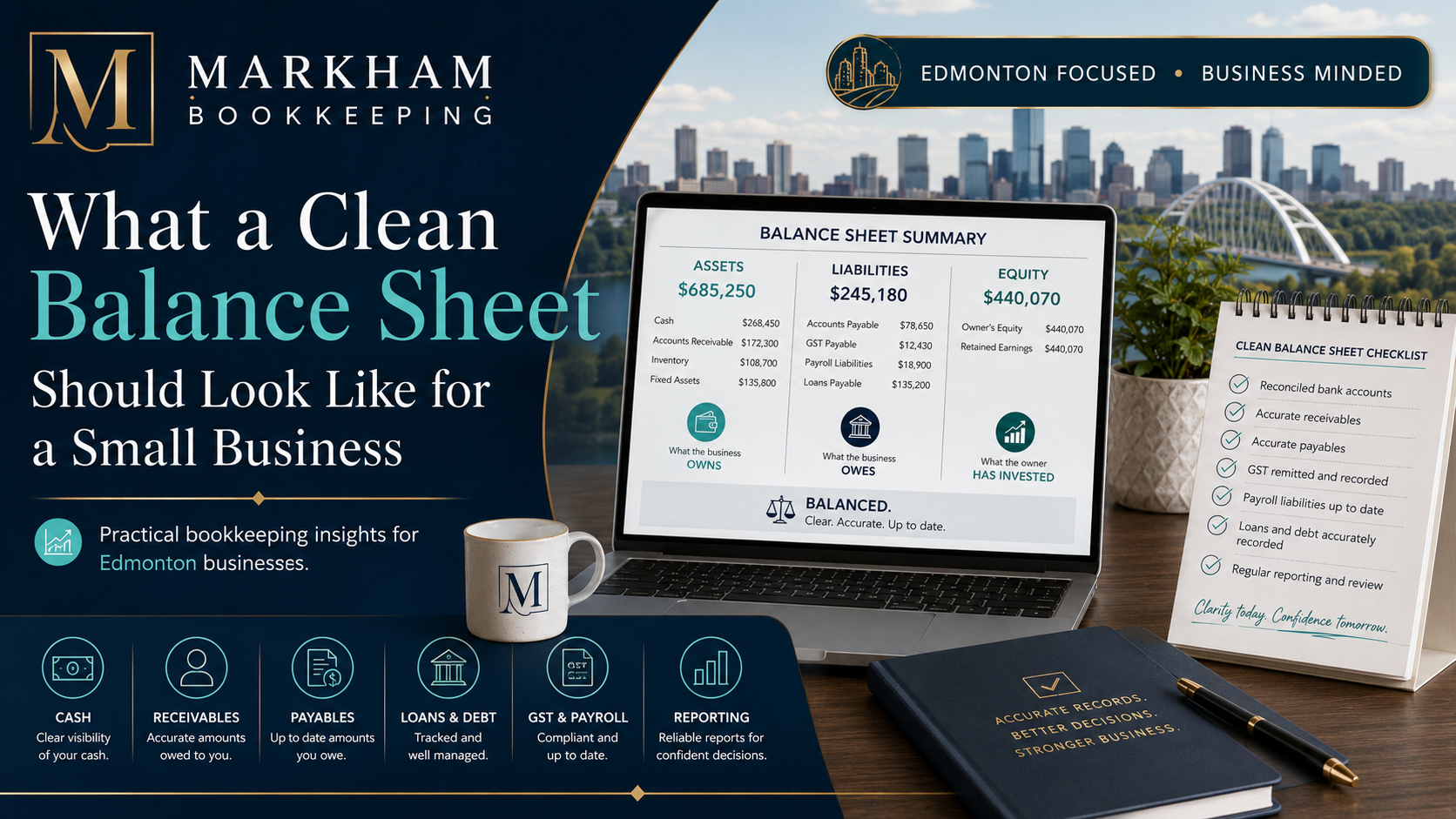
For many Edmonton small business owners, the balance sheet is one of the most important financial reports, but also one of the most misunderstood. Most owners look at the profit and loss statement first because it shows sales, expenses, and profit. That makes sense. But the balance sheet tells a different story. It shows what the business owns, what it owes, and what belongs to the owner.
A clean balance sheet gives you a clear picture of the financial health of your business. It helps you understand cash, receivables, inventory, loans, credit cards, taxes payable, payroll liabilities, equity, and retained earnings. For Edmonton small businesses, contractors, restaurants, retailers, consultants, trades businesses, professional firms, and service providers, a clean balance sheet can make month-end bookkeeping, tax preparation, financing, and business decisions much easier.
A messy balance sheet, on the other hand, can hide problems. It may show old balances that no longer exist, negative accounts that do not make sense, duplicate loans, unpaid taxes, unreconciled bank accounts, incorrect inventory, or owner draws recorded in the wrong place. If the balance sheet is not clean, the profit and loss report may also be unreliable.
This guide explains what a clean balance sheet should look like for a small business and what Edmonton business owners should review each month.
What Is a Balance Sheet?
A balance sheet is a financial report that shows your business position at a specific date. It usually has three main sections:
Assets.
Liabilities.
Equity.
The basic formula is:
Assets = Liabilities + Equity
Assets are what the business owns or controls. Liabilities are what the business owes. Equity is the owner’s remaining interest in the business after liabilities are deducted from assets.
For example, if an Edmonton small business has $150,000 in assets and $90,000 in liabilities, the remaining $60,000 is equity.
A clean balance sheet should be organized, accurate, and easy to understand. It should not be full of old unknown balances, unreconciled amounts, or accounts that nobody can explain.
Why a Clean Balance Sheet Matters for Edmonton Small Businesses
A clean balance sheet helps owners make better decisions. It shows whether the business has enough cash, whether customers owe too much, whether supplier bills are building up, whether loans are recorded correctly, and whether tax obligations are being tracked.
For Edmonton businesses, this matters because many companies deal with seasonal work, supplier credit, payroll, GST, financing, equipment purchases, and cash flow pressure. A business may look profitable on the income statement but still have poor cash flow because customers are not paying or debt payments are too high.
A clean balance sheet can help answer questions such as:
How much cash does the business really have?
How much do customers owe?
How much does the business owe suppliers?
Are CRA payroll and GST liabilities accurate?
Are loans and credit cards reconciled?
Is inventory recorded properly?
Are owner draws or shareholder loans tracked correctly?
Are there old balances that need cleanup?
These answers are important for month-end reporting, year-end tax preparation, financing applications, and business planning.
1. Bank Accounts Should Match the Bank Statements
The first sign of a clean balance sheet is that all bank accounts are reconciled. Your bookkeeping records should match the actual bank statements as of the report date.
For example, if your Edmonton business bank statement shows $18,450 at month-end, your accounting software should reconcile to that amount after accounting for outstanding cheques or deposits.
Bank accounts should not have unexplained differences. If your bank balance in QuickBooks Online, Xero, Sage, or another system does not match the bank statement, the issue should be reviewed before month-end is closed.
Common problems include duplicate bank feed transactions, missing deposits, deleted payments, incorrect dates, uncleared old cheques, transfers recorded incorrectly, or personal transactions mixed into the business account.
A clean balance sheet should show bank accounts that are current, reconciled, and supported by bank statements.
2. Credit Cards Should Be Reconciled
Credit card accounts are liabilities because the business owes the card issuer. A clean balance sheet should show credit card balances that match the credit card statements.
Many Edmonton small businesses use credit cards for fuel, meals, supplies, software, travel, tools, repairs, and online purchases. If credit card accounts are not reconciled, expenses may be missing or duplicated.
Common credit card bookkeeping issues include:
Payments recorded as expenses instead of credit card payments.
Missing receipts.
Personal purchases recorded as business expenses.
Duplicate transactions from bank feeds.
Interest and fees not recorded.
Credit card accounts showing old unreconciled balances.
A clean credit card section should show the correct balance owing at month-end. If the credit card was paid after month-end, it should still show as payable at month-end until the payment date.
3. Accounts Receivable Should Be Current and Collectible
Accounts receivable shows money owed by customers. A clean balance sheet should have an accounts receivable balance that matches the A/R aging report.
For Edmonton businesses that invoice customers, this is very important. Contractors, consultants, professional services, wholesale businesses, and service providers often rely on customer payments after work is completed.
A clean accounts receivable section should show:
Open invoices that are actually unpaid.
Customer payments applied correctly.
No duplicate invoices.
No old balances that should have been written off.
No negative customer balances without explanation.
No invoices dated in the wrong period.
If your balance sheet shows $75,000 in accounts receivable, the aging report should support that amount. If many invoices are over 90 days old, the business should review whether those amounts are still collectible.
A clean balance sheet does not mean every customer has paid. It means the receivable balance is accurate, reviewed, and explainable.
4. Inventory Should Be Reasonable and Supported
If your Edmonton business sells products, vehicles, parts, materials, food, or retail goods, inventory may be one of the largest assets on the balance sheet.
A clean inventory balance should be supported by actual stock records, inventory counts, purchase records, or inventory management reports.
For example, an Edmonton retail store should know whether the inventory value on the balance sheet matches what is actually on hand. An auto dealer should track vehicle inventory properly. A construction business should be careful with materials, work in progress, and job costs.
Inventory issues can distort profit. If inventory is overstated, cost of goods sold may be understated and profit may look too high. If inventory is understated, profit may look too low.
A clean balance sheet should not have an inventory number that is simply carried forward without review.
5. Prepaid Expenses Should Make Sense
Prepaid expenses are payments made in advance for future benefits. Common examples include insurance, rent, software subscriptions, licenses, deposits, and annual memberships.
A clean balance sheet may include prepaid expenses, but those balances should be reviewed regularly. The amount should reduce over time as the expense is used.
For example, if an Edmonton business pays $12,000 for one year of insurance, the full amount should not remain as prepaid forever. Each month, a portion should move to insurance expense.
A messy balance sheet often has old prepaid balances that nobody understands. A clean balance sheet should have prepaid expenses that are current, supported, and properly adjusted.
6. Fixed Assets Should Be Properly Recorded
Fixed assets are long-term assets used in the business, such as vehicles, equipment, computers, furniture, leasehold improvements, machinery, and tools.
For Edmonton small businesses, fixed assets are common in construction, trades, transportation, restaurants, clinics, retail, and automotive businesses.
A clean balance sheet should show fixed assets separately from regular expenses. Large purchases should not always be expensed immediately without review. At the same time, small repairs and supplies should not be incorrectly recorded as assets.
Fixed assets should include:
Asset cost.
Accumulated depreciation or amortization.
Net book value.
The balance should be supported by purchase records, loan documents, and year-end accountant adjustments where applicable.
A clean fixed asset section helps with tax preparation, financing, insurance, and understanding the true value of business equipment.
7. Accounts Payable Should Match Vendor Bills
Accounts payable shows unpaid vendor bills. A clean balance sheet should have an A/P balance that matches the accounts payable aging report.
For Edmonton businesses, this is important because supplier bills, subcontractor invoices, rent, utilities, software, equipment rentals, and professional fees may all flow through accounts payable.
A clean accounts payable balance should show:
Bills that are actually unpaid.
No duplicate vendor invoices.
Payments applied properly.
Vendor credits recorded and used.
No old balances that were already paid.
No bills entered to the wrong vendor.
If the balance sheet shows $42,000 in accounts payable, the vendor aging report should support the same amount. If the two do not match, the difference should be investigated.
A clean balance sheet helps business owners understand upcoming cash needs and avoid missed payments.
8. Payroll Liabilities Should Be Accurate
Payroll liabilities include amounts owed for source deductions, CPP, EI, income tax, vacation pay, benefits, garnishments, and other payroll-related items.
For Edmonton employers, payroll liability accuracy is very important. If payroll deductions are not tracked properly, the business may fall behind on CRA remittances or show incorrect liabilities.
A clean payroll liability section should show what is actually owed at month-end. Once payroll remittances are paid, the liability should clear properly.
Common payroll balance sheet problems include:
Payroll remittances recorded as expenses instead of liability payments.
Old payroll liabilities still sitting after payment.
Vacation pay not tracked correctly.
Benefits or deductions posted to the wrong account.
Manual payroll entries not matching payroll reports.
A clean balance sheet should allow the owner to see what payroll amounts are owed and whether payments have been made correctly.
9. GST Payable or Receivable Should Be Reviewed
GST is one of the most common areas where small business balance sheets become messy. A clean balance sheet should show whether the business owes GST or has GST receivable.
For Edmonton and Alberta businesses, GST collected on sales and GST paid on business expenses should be recorded accurately. The balance sheet should support the GST return.
A clean GST balance should make sense based on recent sales, expenses, payments, and filings. If GST payable is very high, negative, or unchanged for months, it should be reviewed.
Common GST issues include:
Wrong tax codes.
GST claimed where no GST was charged.
GST not charged on taxable sales.
GST payments recorded to the wrong account.
Old GST balances not cleared after filing.
GST included in expense accounts instead of separated.
A clean balance sheet helps make GST filing easier and reduces the chance of cleanup later.
10. Loans and Lines of Credit Should Match Statements
Business loans, vehicle loans, equipment financing, and lines of credit should be recorded as liabilities. A clean balance sheet should show loan balances that match lender statements.
For Edmonton businesses using financing, this is very important. Loan payments usually include both principal and interest. Only the principal reduces the loan balance. Interest should be recorded as an expense.
A common bookkeeping mistake is recording the full loan payment as an expense. This makes expenses too high and leaves the loan balance incorrect.
A clean loan section should show:
Correct principal balance.
Interest recorded separately.
Loan payments posted correctly.
No duplicate loan accounts.
No old loans still showing after being paid off.
Owner or shareholder loans separated from bank loans.
If your balance sheet shows a loan balance, it should be supported by a lender statement or amortization schedule.
11. Owner Contributions, Draws, and Shareholder Loans Should Be Clear
For small businesses, owner transactions can make the balance sheet messy quickly. Money may move between the business and the owner for many reasons.
A sole proprietor may take owner draws. A corporation may have shareholder loans. Owners may personally pay business expenses or use business funds for personal costs.
A clean balance sheet should separate these items properly. Owner draws should not be mixed into regular expenses. Shareholder loans should be reviewed so the owner knows whether the business owes them money or they owe the business money.
For Edmonton small business bookkeeping, this is an important area because many owners use personal cards, business cards, e-transfers, and cash transactions. Without proper tracking, the equity section becomes confusing.
A clean balance sheet should clearly show owner contributions, draws, dividends, or shareholder loan balances where applicable.
12. Equity and Retained Earnings Should Make Sense
Equity represents the owner’s interest in the business. For corporations, this may include share capital, retained earnings, current year earnings, and shareholder balances. For sole proprietors, it may include owner capital, owner draws, and current earnings.
A clean balance sheet should have equity accounts that make sense and are not full of random adjustment accounts.
One common warning sign is a large “opening balance equity” account. This often appears when a business starts using accounting software and enters beginning balances. It may be temporary during setup, but it should usually be reviewed and cleaned up.
Retained earnings should normally roll forward from prior years. If retained earnings suddenly changes without explanation, there may be a prior-period adjustment, deleted transaction, or posting error.
A clean equity section helps the business owner and accountant understand the long-term position of the business.
What a Clean Balance Sheet Should Not Have
A clean balance sheet should not have unexplained old balances or accounts that nobody can support.
Warning signs include:
Bank accounts that do not reconcile.
Negative accounts receivable without explanation.
Negative accounts payable without explanation.
Old uncleared cheques from years ago.
GST balances that never clear.
Payroll liabilities still showing after remittance.
Credit card balances that do not match statements.
Loan balances that do not match lender records.
Opening balance equity with a large unexplained amount.
Suspense or clearing accounts with old balances.
Inventory that has not been reviewed.
Customer or vendor balances that are clearly wrong.
These issues should be cleaned up before relying on financial reports.
How Often Should Edmonton Businesses Review the Balance Sheet?
A small business should review the balance sheet at least monthly. It does not always need a deep review every week, but month-end is the right time to check major balances.
At minimum, Edmonton business owners or bookkeepers should review:
Bank balances.
Credit card balances.
Accounts receivable.
Accounts payable.
GST payable.
Payroll liabilities.
Loans and lines of credit.
Inventory, if applicable.
Owner or shareholder loan accounts.
The goal is not only to prepare reports. The goal is to understand whether the numbers are reliable.
How an Edmonton Bookkeeper Can Help
A professional Edmonton bookkeeper can help keep the balance sheet clean by reconciling accounts, reviewing receivables and payables, checking tax liabilities, matching payments, recording loans properly, cleaning up old balances, and preparing month-end reports.
For small business owners, this can save time and reduce stress. Instead of guessing whether the books are accurate, you can review reports with more confidence.
Clean bookkeeping also helps your accountant at year-end. If the balance sheet is organized throughout the year, tax preparation becomes easier, cleanup costs may be lower, and financial statements can be prepared more efficiently.
An Edmonton bookkeeper can also help identify problems early, such as customers not paying, supplier balances growing, payroll liabilities building up, or GST amounts not being cleared correctly.
Final Thoughts
A clean balance sheet should tell a clear financial story. It should show what your business owns, what it owes, and what belongs to the owner. Every major balance should be supported by reports, statements, invoices, reconciliations, or schedules.
For Edmonton small businesses, a clean balance sheet is more than an accounting report. It is a decision-making tool. It helps with cash flow, financing, tax preparation, month-end review, and long-term planning.
If your balance sheet has old balances, unreconciled accounts, unclear loans, GST issues, payroll liabilities, or confusing equity accounts, it may be time for a bookkeeping cleanup.
Need help reviewing your balance sheet or cleaning up your monthly bookkeeping? Contact Markham Bookkeeping for bookkeeping, payroll, GST, and month-end support for Edmonton small businesses.