
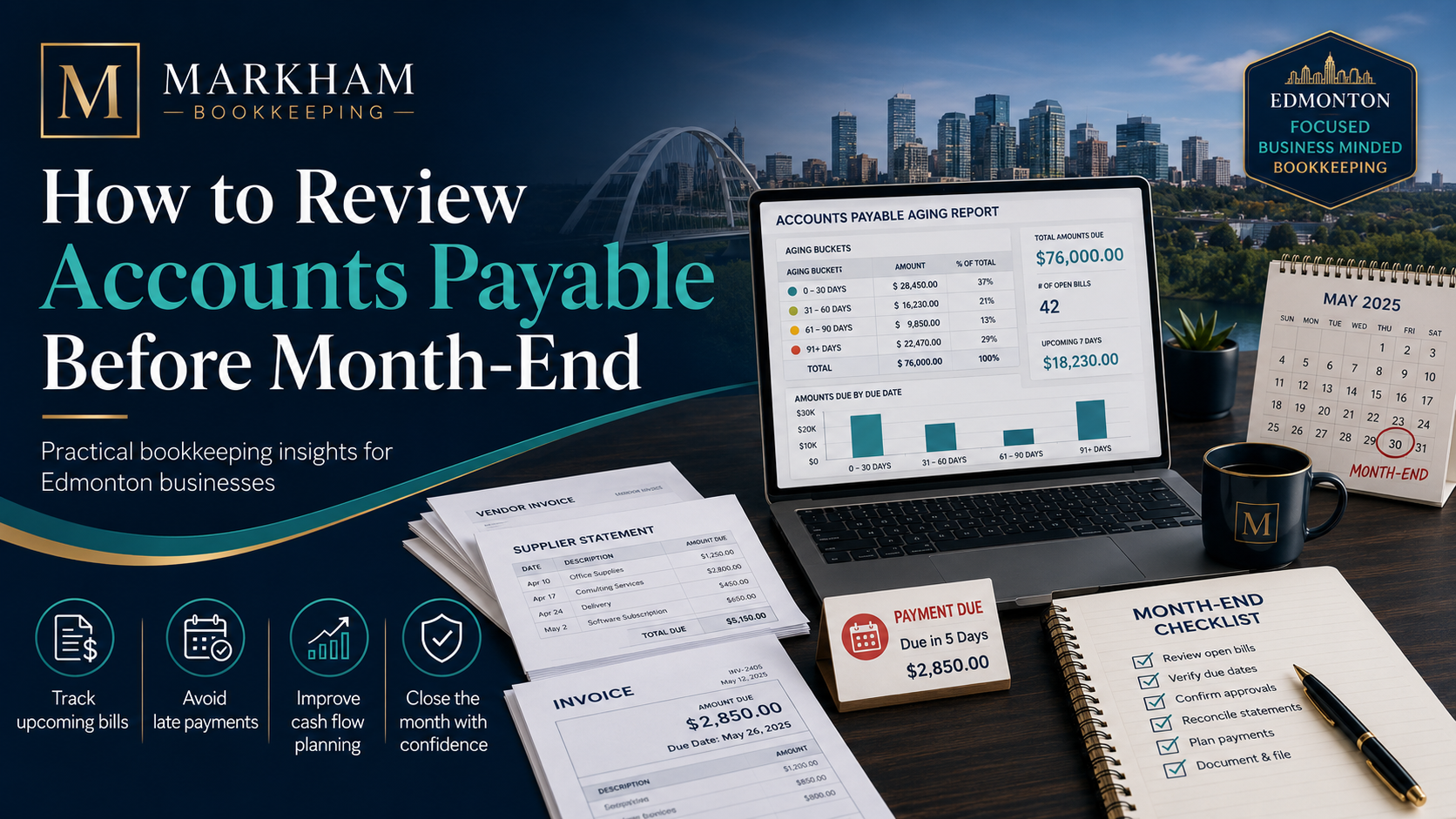
For many Edmonton small businesses, month-end bookkeeping becomes stressful because bills, vendor statements, receipts, and payment records are not reviewed on time. Sales may be coming in, customers may be paying, and operations may look busy, but if accounts payable are not accurate, the business owner may not know what they truly owe.
Accounts payable, often called A/P, represents the money your business owes to suppliers, vendors, contractors, lenders, landlords, utility providers, and other service providers. These are unpaid bills and obligations that need to be tracked properly before month-end reports are finalized.
For Edmonton businesses, reviewing accounts payable before month-end is an important part of cash flow management. It helps owners understand upcoming payments, avoid missed bills, prevent duplicate payments, keep vendor relationships strong, and prepare accurate financial reports. Whether you run a construction company, restaurant, retail business, consulting firm, auto dealership, trades business, or professional service company in Edmonton, a proper accounts payable review can make your bookkeeping cleaner and more reliable.
Month-end is not only about checking the bank balance. It is about confirming that your books show the real financial position of the business. If bills are missing, expenses may be understated. If duplicate bills are entered, expenses and liabilities may be overstated. If vendor credits are not applied, you may pay more than necessary. This is why accounts payable should be reviewed carefully before closing the month.
Why Accounts Payable Review Matters Before Month-End
Accounts payable directly affects your balance sheet, profit and loss statement, cash flow, GST reporting, and management decisions. If your Edmonton bookkeeping records do not include all vendor bills, your monthly profit may look higher than it really is. This can mislead the business owner into thinking the business performed better than it actually did.
For example, an Edmonton contractor may receive supplier invoices for materials near the end of the month. If those invoices are not entered before month-end, the project cost may not show in the correct month. Revenue may be recorded, but the related expense may be missing. This can make job profitability appear stronger than reality.
On the other hand, if a vendor bill is entered twice, the business may show higher expenses and higher payables than it actually owes. This can create confusion, poor cash flow planning, and even accidental duplicate payments.
A proper accounts payable review helps answer important questions:
How much does the business owe right now?
Which bills are due soon?
Are any vendor payments overdue?
Are all supplier invoices recorded?
Are there duplicate bills?
Are vendor credits applied?
Are GST amounts coded correctly?
Are expenses recorded in the right month?
These questions matter because month-end reports should help Edmonton business owners make better decisions, not create more uncertainty.
Step 1: Run the Accounts Payable Aging Report
The first step in reviewing accounts payable before month-end is to run the accounts payable aging report from your accounting software. This report shows unpaid vendor bills and groups them by age, such as current, 1–30 days overdue, 31–60 days overdue, 61–90 days overdue, and over 90 days overdue.
If your business uses QuickBooks Online, Xero, Sage, or another bookkeeping system, the A/P aging report should be one of your regular month-end reports.
When reviewing the report, start with the oldest balances first. Bills that are over 60 or 90 days old should be investigated. They may be unpaid, disputed, duplicated, already paid but not matched correctly, or entered with the wrong date.
For Edmonton small businesses, old vendor balances can damage relationships with suppliers. If a key supplier places your account on hold, it can interrupt operations. This is especially important for construction companies, trades businesses, restaurants, retailers, and auto-related businesses that depend on steady supplier relationships.
Step 2: Compare A/P Aging to the Balance Sheet
Your accounts payable aging report should match the accounts payable balance on your balance sheet as of the same date. This is an important month-end bookkeeping control.
If the A/P aging total does not match the balance sheet, there may be a problem. Common causes include manual journal entries posted directly to accounts payable, bills entered incorrectly, payments not applied properly, or transactions dated in the wrong period.
For example, if the balance sheet shows $85,000 in accounts payable but the vendor aging report shows $79,000, the difference should be reviewed before month-end is finalized. A clean Edmonton bookkeeping process should not ignore this difference.
The accounts payable balance is not just a number. It should be supported by actual unpaid vendor bills. When your aging report and balance sheet agree, your reports are more reliable.
Step 3: Check for Missing Vendor Bills
One of the most common accounts payable mistakes is missing bills. Business owners may receive invoices by email, mail, online vendor portals, text message, or supplier statements. Some bills may be sitting in an inbox and not yet entered into the accounting system.
Before month-end, review all possible sources of bills. This may include:
Email inboxes.
Vendor portals.
Paper invoices.
Credit card receipts.
Supplier statements.
Purchase orders.
Delivery slips.
Subcontractor invoices.
Utility bills.
Loan or lease statements.
For Edmonton contractors and trades businesses, missing supplier bills can cause serious reporting issues. If materials were used on a job in the current month but the bill is entered next month, the job costing report may be inaccurate.
For restaurants and retail businesses, missing vendor invoices can distort cost of goods sold. For professional service firms, missing software, rent, insurance, or subcontractor bills can make monthly expenses look too low.
A good month-end accounts payable review should confirm that major recurring expenses and supplier invoices have been recorded.
Step 4: Review Vendor Statements
Vendor statements are useful because they show what the supplier believes your business owes. Before month-end, compare vendor statements to your accounts payable records.
If the vendor statement shows invoices that are not in your books, those bills may need to be entered. If your books show an unpaid bill but the vendor statement does not, the bill may have been paid, credited, or entered incorrectly.
This step is especially useful for Edmonton businesses that buy from the same suppliers regularly. Construction suppliers, food suppliers, auto parts vendors, office supply companies, and equipment rental companies often issue monthly statements.
Reviewing vendor statements helps catch:
Missing invoices.
Duplicate invoices.
Unapplied payments.
Vendor credits.
Incorrect balances.
Billing disputes.
Statement review can save money because it helps prevent paying invoices that are not actually outstanding.
Step 5: Identify Duplicate Bills
Duplicate bills are common when invoices arrive through multiple channels. A vendor may email the invoice, then send a paper copy, and later show it on a monthly statement. If the same bill is entered more than once, accounts payable and expenses become overstated.
Before month-end, review vendor bills for duplicates. Check invoice numbers, dates, amounts, and vendor names. Accounting software may warn you about duplicate invoice numbers, but this does not catch every issue.
Duplicates can happen when:
The invoice number is entered slightly differently.
The vendor name is duplicated in the system.
The bill is entered once from email and once from a statement.
A receipt is entered as an expense and the bill is also entered separately.
A payment is recorded but not matched to the original bill.
For Edmonton bookkeeping, duplicate bills can cause real cash flow problems. A business may accidentally pay the same vendor twice and only notice later during reconciliation.
Step 6: Match Payments to Vendor Bills
Sometimes a bill is paid, but the payment is not matched correctly in the accounting system. This can leave the bill showing as unpaid on the accounts payable aging report even though money has already left the bank.
Before month-end, review vendor payments and make sure they are applied to the correct bills. If payments are posted directly as expenses instead of bill payments, the vendor aging report may still show unpaid invoices.
This issue is common when businesses use bank feeds. A payment may come through the bank feed and be categorized as an expense, but the original bill remains open. This causes double counting: the expense may be recorded once through the bill and again through the bank feed payment.
A clean process is to enter the bill first, then match the payment against the bill when it clears the bank. This keeps accounts payable accurate and avoids duplicate expense recording.
Step 7: Review Vendor Credits and Refunds
Vendor credits reduce what your business owes. If credits are not applied, your accounts payable balance may be overstated and you may pay more than necessary.
Before month-end, check for credit notes, refunds, returned materials, rebates, pricing adjustments, or overpayment credits. These should be recorded and applied to the correct vendor bills.
For example, an Edmonton construction business may return unused materials to a supplier and receive a credit. If that credit is not applied, the payable balance will still show too high. The same can happen with restaurant suppliers, retail inventory vendors, software providers, or equipment rental companies.
Vendor credits should not sit unused without review. They should be matched against open bills or tracked clearly for future use.
Step 8: Confirm Expense Categories
Accounts payable review is not only about whether bills are unpaid. It is also about whether bills are coded correctly.
Before month-end, review expense categories for major vendor bills. Make sure expenses are recorded to the right accounts, departments, jobs, or classes. This matters because poor coding leads to poor reporting.
For Edmonton businesses, common coding issues include:
Materials recorded as general supplies.
Subcontractors recorded as wages.
Equipment rentals recorded as repairs.
Vehicle expenses mixed with fuel.
Loan payments recorded fully as expenses.
GST included in expense accounts instead of posted separately.
Personal expenses recorded as business bills.
If the business uses job costing, department tracking, or project tracking, coding becomes even more important. A contractor may need to know which project the supplier bill belongs to. A multi-location business may need to know which branch or department incurred the cost.
Good expense coding makes monthly reports more useful.
Step 9: Check GST on Vendor Bills
GST coding should be reviewed before month-end. If GST is not entered properly, your GST return may be inaccurate. Some expenses include GST, some do not, and some may be partially claimable depending on the situation.
For Edmonton and Alberta businesses, GST is a regular part of bookkeeping. When reviewing accounts payable, check that vendor bills have the correct tax codes. Make sure GST paid is recorded properly where an input tax credit may be available.
Common GST issues include:
GST missed on vendor bills.
GST claimed where no GST was charged.
GST included in the expense amount instead of separated.
Wrong tax code used.
Vendor bills entered from receipts without checking tax details.
Credits not reversing GST properly.
A monthly GST review helps avoid a large cleanup at filing time. It also helps Edmonton businesses understand whether their GST payable is accurate.
Step 10: Review Recurring Bills and Accruals
Some expenses happen every month, such as rent, insurance, software subscriptions, utilities, leases, internet, phone, loan interest, bookkeeping fees, and payroll-related costs. Before month-end, check whether all recurring bills have been recorded.
If an invoice has not arrived yet but the expense belongs to the current month, your accountant or bookkeeper may need to record an accrual. An accrual recognizes the expense in the correct month, even if the bill arrives later.
For example, if an Edmonton business receives a utility bill after month-end, but the usage relates to the month being closed, an accrual may be needed for accurate reporting.
Accruals are especially important for businesses that want meaningful monthly financial statements. Without accruals, profit may swing up and down simply because bills were received late.
Step 11: Prioritize Payments for Cash Flow
Accounts payable review should help with cash flow planning. Once you know what bills are outstanding, you can decide which payments need priority.
Not every bill has the same urgency. Payroll, rent, critical suppliers, CRA remittances, loan payments, insurance, and essential operating costs may need priority over less urgent expenses.
Before month-end, review due dates and create a payment plan. This helps avoid late fees, supplier holds, interest charges, and cash shortages.
For Edmonton small businesses, cash flow can become tight if large vendor bills, payroll, GST, rent, and loan payments all fall around the same time. A/P review gives the owner visibility before the problem becomes urgent.
A simple payment planning process can include:
Bills due immediately.
Bills due within 7 days.
Bills due within 30 days.
Bills that can wait.
Bills under dispute.
Bills needing owner approval.
This gives a clearer picture of upcoming cash needs.
Step 12: Review Payables Under Dispute
Some vendor bills may be disputed because of incorrect pricing, missing credits, poor service, damaged goods, incorrect quantities, or unclear terms. These should not be ignored.
Before month-end, list disputed bills separately. Add notes in the accounting system where possible. Confirm whether the bill should remain payable, be adjusted, or be held until resolved.
For Edmonton businesses, disputed supplier balances can affect vendor relationships. If the dispute is valid, it should be documented clearly. If the bill is correct, it should be paid or scheduled for payment.
A good month-end process should not leave unclear balances sitting in accounts payable without explanation.
Step 13: Prepare a Month-End A/P Summary
After reviewing accounts payable, prepare a short summary for the business owner or management team. This summary helps decision-making and cash flow planning.
A useful month-end accounts payable summary may include:
Total accounts payable.
Bills due in the next 7 days.
Bills due in the next 30 days.
Overdue vendor balances.
Largest unpaid vendors.
Disputed bills.
Vendor credits available.
Recurring bills entered.
Accruals needed.
Upcoming cash requirements.
This summary gives Edmonton business owners a practical view of what needs to be paid and when. It also helps avoid surprises after month-end.
Common Accounts Payable Mistakes Edmonton Businesses Should Avoid
Many businesses make the same accounts payable mistakes every month. These mistakes may seem small, but they can create major reporting and cash flow problems over time.
Common mistakes include entering bills late, paying from statements without checking invoices, recording bill payments as new expenses, ignoring vendor credits, not matching payments properly, missing GST, using the wrong expense categories, and failing to review old vendor balances.
Another common mistake is relying only on the bank balance. A business may have cash in the bank today, but if large unpaid bills are not considered, that cash may already be committed. Accounts payable review helps owners understand the difference between available cash and upcoming obligations.
For Edmonton businesses, strong A/P habits are especially important when supplier relationships are critical. If bills are not tracked properly, operations can be interrupted, vendor trust can weaken, and cash flow can become harder to manage.
How an Edmonton Bookkeeper Can Help with Accounts Payable
A professional Edmonton bookkeeper can help organize accounts payable throughout the month instead of waiting until year-end. This includes entering vendor bills, reviewing supplier statements, matching payments, applying credits, coding expenses, checking GST, preparing payment schedules, and reconciling accounts.
For busy business owners, accounts payable can become overwhelming quickly. Bills come from different places, payments are made by different methods, and suppliers may have different terms. Without a clear system, month-end can become messy.
An Edmonton bookkeeper can help build a simple process so that bills are captured, reviewed, approved, and paid on time. This creates cleaner records and better financial reporting.
Good accounts payable bookkeeping helps answer important questions:
What do we owe?
Who needs to be paid first?
Are any bills missing?
Are we paying vendors twice?
Are expenses recorded in the correct month?
Are GST credits being tracked properly?
Do we have enough cash for upcoming payments?
These answers help business owners stay in control.
Final Thoughts
Reviewing accounts payable before month-end is one of the best ways to improve bookkeeping accuracy and cash flow visibility. It helps Edmonton businesses understand what they owe, avoid missed payments, prevent duplicate expenses, manage GST properly, and close the month with confidence.
Accounts payable should not be left until tax season or year-end. By then, missing bills, duplicate entries, unapplied credits, and vendor issues may be harder to fix. A monthly review keeps the books cleaner and makes financial reports more useful.
For Edmonton small businesses, contractors, trades, restaurants, retailers, consultants, and professional service providers, accounts payable review is a key part of responsible month-end bookkeeping.
When your payables are accurate, your reports are stronger, your cash flow planning improves, and your business decisions become clearer.
Need help reviewing accounts payable or cleaning up your monthly bookkeeping? Contact Markham Bookkeeping for bookkeeping, payroll, GST, and month-end support for Edmonton businesses.