Running a small business in Strathcona County takes more than hard work, good service, and steady customers. Whether you operate in Sherwood Park, Fort Saskatchewan, Ardrossan, Josephburg, or another Alberta community nearby, your business needs one thing that many owners overlook: clear monthly financial reports.
A lot of small business owners only look at their numbers once a year, usually when tax season arrives. By then, the information is already old. Problems that started months ago may have grown bigger. Cash flow issues may be harder to fix. Missed invoices, unpaid bills, payroll errors, GST/HST mistakes, and rising expenses can quietly damage a business before the owner even notices.
That is why monthly accounting reports matter.
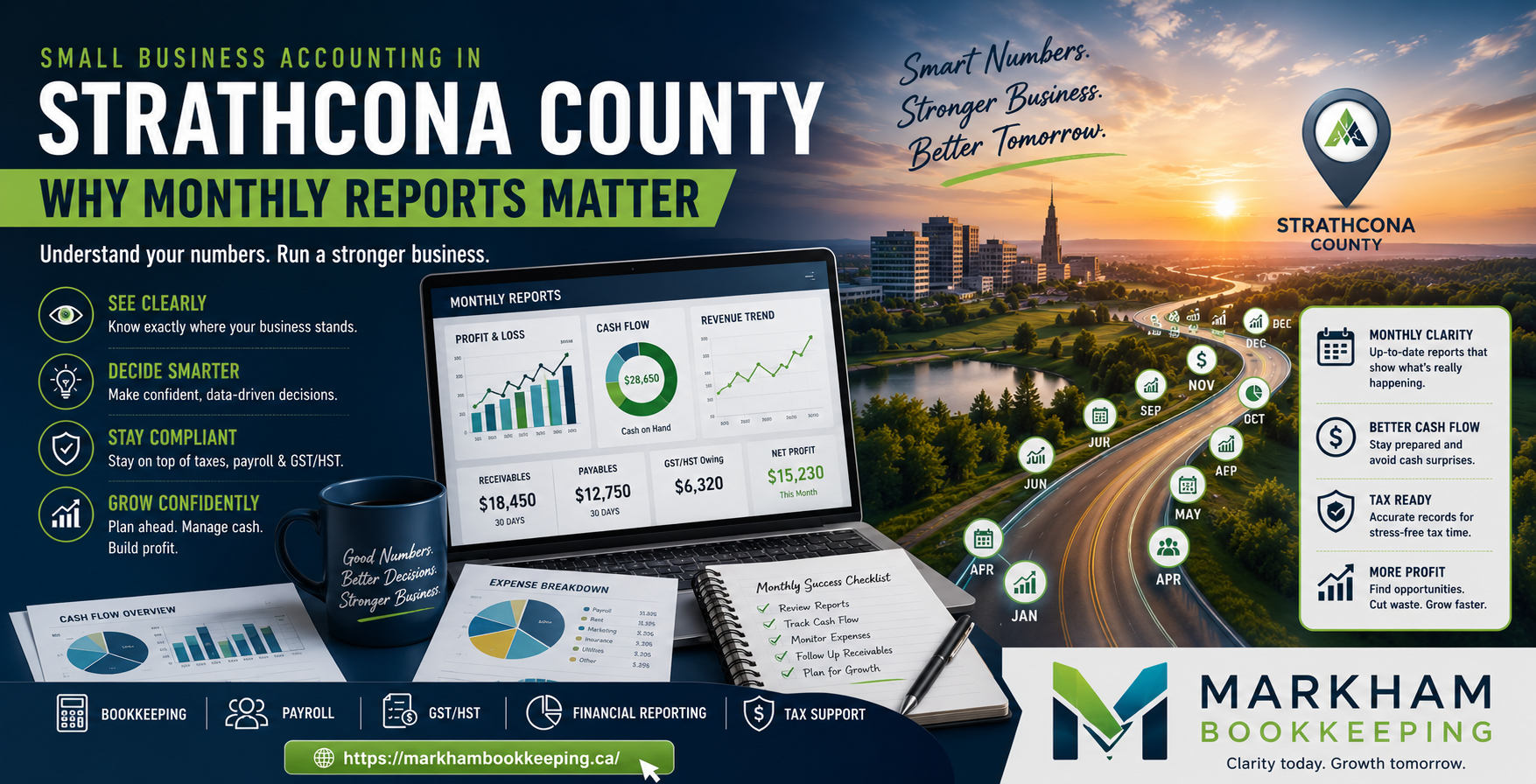
Monthly reports give Strathcona County business owners a regular snapshot of what is actually happening inside the business. They show whether the business is profitable, whether cash is tight, whether customers are paying on time, whether expenses are increasing, and whether tax obligations are being tracked properly. Good reports do not just help with compliance. They help owners make better decisions.
For small business accounting in Strathcona County, monthly reporting is one of the most practical habits an owner can build.
Why Monthly Accounting Matters for Strathcona County Businesses
Strathcona County has a mix of local service businesses, contractors, trades, retail stores, consultants, farms, transportation companies, professional service providers, and home-based businesses. Each business may look different on the outside, but most owners face the same financial questions.
Am I making enough profit?
Do I have enough cash to pay suppliers, employees, rent, loans, and taxes?
Which expenses are getting too high?
Are customers paying me on time?
Can I afford to hire, buy equipment, or expand?
How much should I set aside for GST/HST, payroll, and income tax?
Without monthly reports, these questions are answered by guessing. With monthly reports, they are answered using real numbers.
Accounting is not just about filing taxes. Bookkeeping and accounting should help business owners understand their business during the year, not only after the year is over. A monthly reporting routine gives Alberta small businesses more control, more confidence, and fewer surprises.
The Problem With Waiting Until Year-End
Many small business owners delay their bookkeeping because they are busy. They keep receipts in folders, leave bank feeds uncategorized, or wait until their accountant asks for documents. This may feel easier in the short term, but it creates problems later.
When books are only cleaned up once a year, the owner loses visibility. They may not know which months were profitable, which services made money, which customers paid late, or which expenses quietly increased. By the time the financial statements are prepared, the year is already finished.
Year-end accounting is useful, but it is not enough for decision-making. It tells you what happened. Monthly accounting tells you what is happening.
For example, a Strathcona County contractor might think the business is doing well because sales are high. But monthly reports may show that material costs, fuel, subcontractor payments, and vehicle expenses are rising faster than revenue. A retail store in Sherwood Park may have steady sales but poor cash flow because inventory purchases are too high. A consultant may show profit on paper but struggle because customers are taking too long to pay.
These issues are easier to fix when they are caught monthly.
The Key Monthly Reports Every Small Business Should Review
Small business accounting does not need to be complicated. Most Strathcona County business owners should start by reviewing a few core reports every month.
1. Profit and Loss Report
The profit and loss report, also called an income statement, shows your revenue, expenses, and profit over a period of time. This is one of the most important reports for any small business in Alberta.
It answers questions like:
How much revenue did we earn this month?
Which expenses were highest?
Did we make a profit or loss?
Is profit improving or getting worse?
Are wages, rent, insurance, advertising, fuel, software, or subcontractor costs increasing?
A profit and loss report helps owners see the difference between being busy and being profitable. A business can have lots of sales and still lose money if expenses are not controlled.
For small businesses in Strathcona County, this report should be reviewed monthly and compared to previous months. Looking at one month alone is helpful, but comparing trends is even better. If revenue is growing but profit is shrinking, the owner needs to investigate.
2. Balance Sheet
The balance sheet shows what the business owns, what it owes, and what is left as equity. Many small business owners ignore this report because it feels more technical than the profit and loss report. That is a mistake.
The balance sheet helps you understand the financial position of the business. It includes bank balances, accounts receivable, inventory, equipment, credit cards, loans, GST/HST payable, payroll liabilities, and owner equity.
This report is especially important for Alberta businesses that carry debt, hold inventory, collect deposits, finance vehicles, or have large supplier balances.
A monthly balance sheet can reveal issues such as:
Credit card balances increasing
Customer deposits not being tracked properly
GST/HST payable growing without cash being set aside
Old receivables not being collected
Loan balances not matching statements
Inventory accounts not being updated
Bank accounts not reconciled
If the balance sheet is messy, the profit and loss report may not be reliable either. Clean monthly accounting should include both reports.
3. Cash Flow Report
Profit is important, but cash flow keeps the business alive.
A business can show profit and still run short on cash. This happens when customers pay late, inventory is purchased upfront, loan payments are high, or the owner withdraws too much from the business.
A cash flow report shows how money moves in and out of the business. For Strathcona County small businesses, this is especially important when revenue changes by season. Contractors, landscapers, construction businesses, agricultural businesses, and local service providers often deal with uneven cash flow during the year.
Monthly cash flow reporting helps owners plan for:
Payroll
Supplier payments
GST/HST remittances
Corporate tax instalments
Equipment purchases
Slow seasons
Loan payments
Owner draws
Emergency expenses
Cash flow reporting also helps owners avoid one of the biggest mistakes in small business: assuming the bank balance is the same as profit. It is not. Your bank balance may include unpaid tax money, customer deposits, borrowed funds, or money needed for upcoming bills.
4. Accounts Receivable Aging Report
The accounts receivable aging report shows which customers owe money and how long invoices have been unpaid. This report is critical for businesses that invoice customers after providing goods or services.
Late payments can create serious cash flow problems. A business may have strong sales but still struggle to pay bills because customers are not paying on time.
A monthly receivables report helps answer:
Who owes us money?
How old are the unpaid invoices?
Which customers regularly pay late?
Do we need stronger payment terms?
Should we follow up earlier?
Are there invoices that may never be collected?
For a Strathcona County accountant, bookkeeper, contractor, consultant, or service business, this report should not be ignored. Collecting faster can sometimes improve cash flow more than making new sales.
5. Accounts Payable Aging Report
The accounts payable aging report shows what your business owes to suppliers, vendors, contractors, credit cards, and other payables. This report helps owners avoid missed payments, late fees, damaged vendor relationships, and surprise cash shortages.
Monthly accounts payable reporting helps owners plan payment timing. It also shows whether the business is relying too heavily on supplier credit or falling behind.
For small businesses in Alberta, clean payable tracking is especially important when multiple bills, job costs, or supplier accounts are involved. If bills are entered late or paid without proper matching, expenses may appear in the wrong month and reports may become misleading.
6. Payroll Summary Report
If your Strathcona County business has employees, payroll reporting is essential. Payroll mistakes can become expensive quickly because they affect employees, CRA remittances, T4s, vacation pay, deductions, and employer costs.
A payroll summary report helps owners review wages, employer payroll costs, deductions, benefits, vacation pay, and remittances. It also helps confirm that payroll expenses are recorded in the correct period.
Monthly payroll review can help catch:
Incorrect hours
Missed vacation pay
Wrong employee deductions
Unrecorded benefits
Payroll remittance issues
Employee advances or reimbursements
Department or job costing errors
Payroll is not an area where business owners should rely on memory. Monthly payroll reports help keep things clean and organized.
7. GST/HST and Sales Tax Tracking
Many Alberta small businesses deal with GST/HST. Even though Alberta does not have a provincial sales tax, GST still matters. If a business is registered for GST/HST, it needs to track GST collected, GST paid, and amounts owing or refundable.
Monthly accounting helps make GST/HST filing easier because transactions are categorized regularly. It also helps prevent the common mistake of spending money that should be set aside for GST/HST remittances.
A monthly review can show whether GST/HST payable is building up and whether input tax credits are being supported by proper receipts and invoices.
Good bookkeeping makes GST/HST less stressful. Waiting until the filing deadline can lead to missing documents, rushed calculations, and avoidable errors.
How Monthly Reports Help With Better Business Decisions
Monthly reports are not just for accountants. They are decision-making tools for business owners.
When your reports are current, you can make better choices about pricing, hiring, spending, financing, marketing, and growth.
For example:
If profit is low, you can review pricing or reduce expenses.
If cash flow is tight, you can speed up collections or adjust payment timing.
If payroll is rising, you can compare labour costs to revenue.
If advertising costs are increasing, you can measure whether sales are improving.
If debt is growing, you can create a repayment plan.
If certain services are more profitable, you can focus on them.
This is where small business accounting in Strathcona County becomes more valuable than basic bookkeeping. Clean reports help you understand the story behind the numbers.
Monthly Reports Make Tax Season Easier
Tax season is much easier when bookkeeping is updated monthly. Instead of rushing to collect receipts, reconcile bank accounts, fix old transactions, and explain unclear expenses, the business already has organized records.
Monthly accounting helps with:
Cleaner year-end financial statements
Better tax planning
Fewer missing receipts
More accurate expense categories
Easier GST/HST filing
Better payroll records
Less stress during corporate tax or personal tax filing
Faster answers for your accountant or tax preparer
For Alberta business owners, this can save time and reduce year-end cleanup costs. A messy file often takes longer to repair than a clean file takes to maintain.
Why Bank Reconciliation Matters Every Month
Bank reconciliation is one of the foundations of clean bookkeeping. It compares your accounting records to your bank and credit card statements. This helps confirm that all transactions are recorded correctly.
Without monthly bank reconciliation, reports may be incomplete or wrong. Missing deposits, duplicate expenses, unrecorded bank fees, merchant fees, loan payments, transfers, and credit card transactions can all affect the accuracy of your books.
A business owner may look at a profit and loss report and think it is accurate, but if the bank accounts are not reconciled, that report may not be trustworthy.
For small business bookkeeping in Strathcona County, monthly reconciliation should be non-negotiable.
Signs Your Business Needs Monthly Accounting Help
You may need help from a Strathcona County bookkeeper or accountant if:
You only update your books at tax time
You do not review monthly financial reports
Your bank accounts are not reconciled
You are unsure how much GST/HST you owe
Payroll feels confusing
You mix personal and business transactions
You do not know whether you are profitable
You have old unpaid invoices
You are behind on bookkeeping
You feel stressed every time taxes are due
You cannot explain your balance sheet
You make decisions based only on your bank balance
These are common issues. The solution is not to feel embarrassed. The solution is to build a better monthly accounting system.
What a Good Monthly Accounting Process Looks Like
A simple monthly process may include:
Collecting receipts and invoices
Categorizing bank and credit card transactions
Reconciling bank accounts
Recording sales, payments, bills, payroll, and loans
Reviewing GST/HST and payroll liabilities
Checking accounts receivable and accounts payable
Preparing monthly financial reports
Reviewing results with the business owner
Identifying issues before they become bigger problems
This does not have to be complicated. The goal is consistency. When reports are prepared every month, the numbers become easier to trust and easier to use.
Local Accounting Support for Strathcona County Businesses
If you run a small business in Strathcona County, Sherwood Park, Fort Saskatchewan, Edmonton, or surrounding Alberta areas, monthly reports can help you stay organized and make better decisions.
Markham Bookkeeping helps small business owners with bookkeeping, payroll, tax preparation support, GST/HST tracking, catch-up bookkeeping, financial reporting, and clean monthly accounting systems.
Whether your books are already organized or months behind, the right accounting process can bring clarity. You do not need to wait until year-end to understand your business. Monthly reports can show you what is working, what is not, and what needs attention next.
Final Thoughts
Small business accounting in Strathcona County is not only about taxes. It is about control, planning, and confidence.
Monthly reports help business owners see profit, cash flow, expenses, receivables, payables, payroll, and tax obligations before problems become expensive. They help owners make smarter decisions and reduce year-end stress.
If you only look at your numbers once a year, you are driving your business by looking in the rear-view mirror. Monthly accounting reports help you look through the windshield.
For Alberta small business owners, that can make all the difference.