
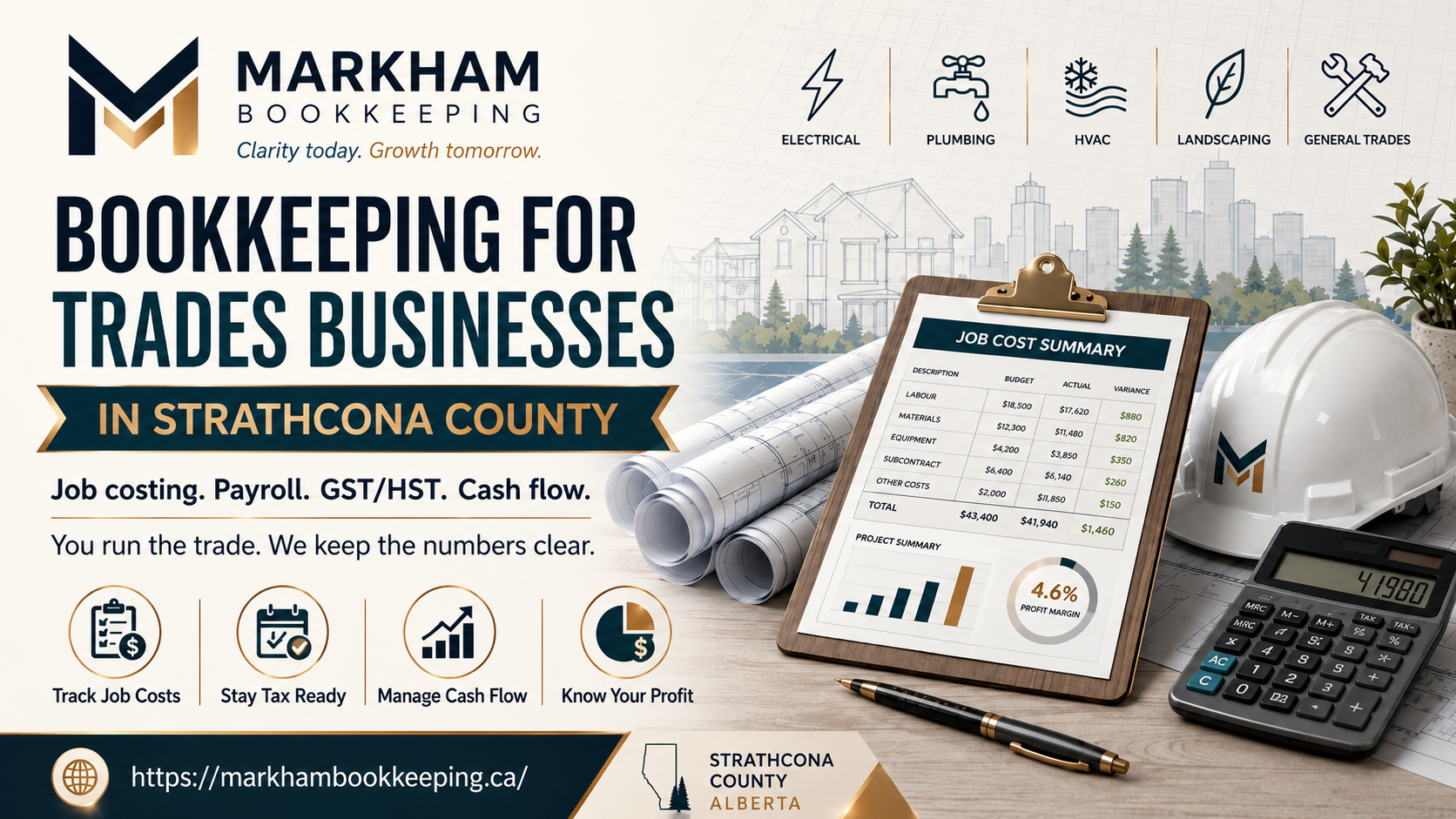
Trades businesses are the backbone of many local communities in Alberta. In Strathcona County, trades professionals support homeowners, builders, property managers, commercial clients, industrial businesses, farms, and small business owners every day. Whether you run a plumbing business, electrical company, HVAC service, landscaping business, painting company, concrete business, renovation company, flooring service, roofing business, welding operation, or general contracting trade, your work is practical, hands-on, and time-sensitive.
But while trades businesses are busy completing jobs, ordering materials, managing crews, answering customer calls, preparing estimates, and moving between job sites, bookkeeping often gets pushed to the side.
That can become a major problem.
Bookkeeping for trades businesses in Strathcona County is not just about entering receipts at tax time. It is about understanding your profit, tracking job costs, managing GST/HST, staying organized for payroll, monitoring cash flow, and knowing whether your business is actually making money.
A trades business can be busy and still have weak profits. It can have strong sales and still struggle with cash flow. It can complete many jobs but still lose money because labour, materials, fuel, subcontractors, and overhead were not tracked properly.
Clean bookkeeping gives trades business owners clarity. It helps you see where your money is going, which jobs are profitable, and what needs to change before small problems become expensive ones.
Why Trades Businesses Need Specialized Bookkeeping
A trades business is different from a simple service business. You are usually dealing with multiple types of costs at the same time. One job may involve labour, parts, fuel, permits, subcontractors, equipment rental, disposal fees, and customer deposits. Another job may be completed quickly but invoiced later. A larger project may require progress billing, change orders, and supplier payments before the customer fully pays.
This is why trades bookkeeping needs more structure.
A basic bookkeeping setup may show total income and total expenses, but that is not enough. Trades business owners need to understand job profitability, cash flow timing, and true cost control.
For example, an electrician in Sherwood Park may have strong monthly revenue, but if materials are not being marked up properly or labour hours are going over budget, profit may be lower than expected. A landscaping business in Strathcona County may appear profitable during the busy season but run into cash problems during slower months. A plumbing company may have unpaid invoices sitting for weeks while payroll and supplier bills continue.
Good bookkeeping helps connect the day-to-day work to the financial results.
Job Costing: The Most Important Report for Trades Businesses
Job costing is one of the most important parts of bookkeeping for trades businesses in Strathcona County. It means tracking income and expenses by job, project, or customer.
Without job costing, you may know that your business made money overall, but you may not know which jobs made money and which jobs quietly lost profit.
A proper job costing system can track:
Materials
Parts and supplies
Labour hours
Subcontractors
Equipment rental
Fuel and vehicle costs
Permit costs
Disposal fees
Customer deposits
Progress invoices
Change orders
Gross profit per job
This information helps you price future jobs more accurately. It also helps you spot patterns. Maybe small repair jobs are more profitable than large projects. Maybe certain types of work require too much unpaid travel time. Maybe subcontractor costs are too high on specific jobs. Maybe your estimates are missing hidden costs.
When trades businesses do not track job costs, they often rely on guesswork. Guesswork can lead to underpricing, overworking, and weak margins.
Materials, Parts, and Supplier Receipts
Trades businesses often buy materials from multiple suppliers. You may have accounts with wholesalers, hardware stores, lumber suppliers, electrical suppliers, plumbing suppliers, or industrial vendors. You may also purchase small parts from local stores when urgent repairs come up.
These purchases need to be tracked properly.
Small receipts may seem unimportant, but they add up quickly. Screws, fittings, blades, wire, pipe, sealant, paint, fasteners, filters, safety gloves, fuel, and small tools can affect profit if they are not recorded.
A clean bookkeeping system should separate:
Job-specific materials
General supplies
Tools and small equipment
Vehicle expenses
Repairs and maintenance
Office expenses
Personal purchases
Owner draws
Large equipment or asset purchases
This helps keep reports accurate. If job materials are recorded as general expenses, you lose the ability to measure project profit. If personal purchases are mixed with business expenses, year-end cleanup becomes harder. If equipment purchases are recorded incorrectly, financial reports may not show the true picture.
Trades businesses in Strathcona County should build a simple receipt system. Uploading receipts regularly, using supplier statements, and matching purchases to jobs can make a huge difference.
Payroll and Labour Tracking
For many trades businesses, labour is one of the biggest costs. If your business has employees, payroll should be tracked carefully every pay period. Wages, overtime, vacation pay, employer payroll costs, benefits, reimbursements, and deductions all affect your real labour cost.
Labour tracking is especially important when employees work across multiple jobs. If you do not know how many hours were spent on each job, it becomes difficult to measure profitability.
For example, a job may look profitable based on materials and invoice value, but once actual labour hours are included, the profit may be much lower. This happens often when jobs take longer than expected, crews return for corrections, or estimates do not include enough labour time.
Good bookkeeping helps trades businesses compare estimated labour to actual labour. This can improve future quotes and help the owner make better decisions about staffing, scheduling, and pricing.
Subcontractor Tracking
Many trades businesses use subcontractors for specialized work, overflow jobs, or larger projects. Subcontractor costs should be tracked separately and connected to the correct job whenever possible.
This helps answer important questions:
Did the subcontractor cost fit within the estimate?
Was the customer billed properly for the subcontracted work?
Did the job still make a profit after subcontractor costs?
Are certain subcontractors helping or hurting margins?
Were subcontractor invoices received and recorded on time?
If subcontractor bills arrive late or are recorded in the wrong period, reports can become misleading. A job may look profitable one month and then look worse later when the bill finally appears.
Trades businesses should avoid waiting until year-end to record subcontractor expenses. Monthly bookkeeping keeps job profit clearer.
GST/HST Tracking for Trades Businesses in Alberta
Even though Alberta does not have a provincial sales tax, many trades businesses must deal with GST/HST. If your business is registered for GST/HST, you need to track GST/HST collected on sales and GST/HST paid on eligible business expenses.
Trades businesses often have many GST/HST-related transactions, including invoices, deposits, supplier bills, fuel, parts, tools, subcontractors, and equipment purchases. If these are not entered properly, GST/HST reporting can become stressful.
Good bookkeeping helps track:
GST/HST charged to customers
GST/HST paid on purchases
Input tax credits
GST/HST payable
GST/HST filing periods
Tax on deposits and progress invoices
Supplier invoices with proper details
GST/HST on business expenses
One common mistake is treating GST/HST collected as extra business income. It is not profit. It is an amount collected from customers that must be tracked properly and remitted when required.
For trades businesses in Strathcona County, reviewing GST/HST monthly can prevent cash flow surprises.
Cash Flow: Why Busy Trades Businesses Still Feel Broke
Many trades business owners ask the same question: “If we are so busy, why is there not more cash in the bank?”
The answer is usually hidden in timing.
You may have paid employees before customers paid you. You may have bought materials upfront. You may have supplier bills due before a project is complete. You may have unpaid invoices sitting too long. You may have collected GST/HST but spent the cash before the remittance deadline. You may have loan payments, vehicle costs, insurance, software, and rent eating into cash.
Cash flow is not the same as profit.
Monthly bookkeeping helps show where the cash is going. It also helps trades businesses plan for upcoming obligations such as payroll, GST/HST, supplier payments, insurance, loan payments, equipment purchases, and slower seasons.
A cash flow report can help you decide whether to follow up on overdue invoices, change payment terms, request larger deposits, delay a purchase, or build a reserve.
Invoicing and Accounts Receivable
Trades businesses should not wait too long to invoice. Late invoicing is one of the easiest ways to create cash flow problems.
If a job is complete but the invoice has not been sent, the business is financing the customer for free. If invoices are sent but not followed up, unpaid amounts can sit for weeks or months.
An accounts receivable aging report shows who owes money and how long invoices have been outstanding. This report should be reviewed monthly.
It helps trades businesses see:
Which customers owe money
Which invoices are overdue
Which jobs have not been fully billed
Whether deposits were received
Whether change orders were invoiced
Whether payment terms need improvement
Whether collections need follow-up
Good bookkeeping helps trades businesses collect faster and reduce cash stress.
Accounts Payable and Supplier Bills
Accounts payable is the opposite side of the cash flow picture. It shows what your business owes to suppliers, subcontractors, credit cards, lenders, and other vendors.
Trades businesses often have many supplier bills coming in at different times. If bills are not recorded properly, the owner may not know what is actually due. This can lead to missed payments, late fees, supplier issues, and cash shortages.
A monthly accounts payable report helps you plan payments instead of reacting at the last minute.
It also helps identify whether supplier costs are increasing, whether credit card balances are growing, or whether certain jobs are creating too much upfront cost.
Vehicle, Fuel, and Equipment Costs
Trades businesses often rely heavily on trucks, vans, trailers, tools, and equipment. These costs can be significant and should be tracked carefully.
Common vehicle and equipment costs include:
Fuel
Repairs
Maintenance
Insurance
Lease payments
Loan payments
Registration
Parking
Equipment rentals
Tool purchases
Safety equipment
Large equipment purchases
Some purchases may be regular expenses, while others may need to be treated as assets. Keeping receipts and records organized helps your accountant or bookkeeper classify them properly.
Vehicle costs should also be supported with proper business records, especially if there is any personal use. Clear tracking makes tax time easier and helps keep reports more reliable.
Monthly Reports Trades Businesses Should Review
A trades business should not wait until year-end to understand its numbers. Monthly reports help owners make faster and smarter decisions.
Important monthly reports include:
Profit and loss report
Balance sheet
Cash flow report
Job profitability report
Accounts receivable aging report
Accounts payable aging report
GST/HST summary
Payroll summary
Bank reconciliation report
Credit card reconciliation report
These reports help answer practical questions:
Are we profitable?
Which jobs made money?
Which jobs lost money?
Are customers paying on time?
Are supplier bills under control?
Is payroll too high compared to revenue?
Do we have enough cash for GST/HST and taxes?
Are expenses rising?
Are bank and credit card accounts reconciled?
When reports are current, the owner can make decisions based on facts instead of guessing.
Common Bookkeeping Mistakes Trades Businesses Make
Trades businesses often run into similar bookkeeping problems. These include:
Mixing personal and business expenses
Not saving receipts
Not tracking jobs separately
Recording deposits incorrectly
Ignoring GST/HST until filing time
Not reconciling bank accounts
Not tracking credit card purchases
Missing subcontractor invoices
Not reviewing unpaid customer invoices
Using the bank balance as profit
Not separating owner draws from expenses
Recording equipment purchases incorrectly
Waiting until tax season to clean up books
Not reviewing monthly reports
These mistakes can lead to unclear profit, weak cash flow, tax stress, and poor decisions.
The good news is that most of these problems can be fixed with a consistent bookkeeping system.
Benefits of Professional Bookkeeping for Trades Businesses
Professional bookkeeping gives trades business owners more than clean records. It gives them better visibility.
With proper bookkeeping, you can:
Know your real job profit
Track materials and labour more clearly
Improve cash flow
Prepare for GST/HST deadlines
Keep payroll organized
Reduce year-end stress
Send invoices faster
Follow up on overdue payments
Control supplier bills
Plan for equipment purchases
Make better pricing decisions
Understand business growth
Avoid financial surprises
For trades businesses in Strathcona County, clean bookkeeping can be a competitive advantage. It helps the owner run the business with more control and confidence.
Bookkeeping Support for Trades Businesses in Strathcona County
Markham Bookkeeping helps trades businesses and small business owners stay organized with bookkeeping, payroll, GST/HST tracking, monthly reports, catch-up bookkeeping, and financial reporting.
Whether you are based in Sherwood Park, Fort Saskatchewan, Ardrossan, Josephburg, Strathcona County, Edmonton, or nearby Alberta areas, having clean books can help you understand your numbers and make better decisions.
The goal is not just to record transactions. The goal is to give you clear, useful reports that help you run a stronger business.
Final Thoughts
Bookkeeping for trades businesses in Strathcona County matters because trades businesses have many moving parts. Materials, labour, subcontractors, equipment, vehicles, GST/HST, payroll, deposits, invoicing, and cash flow all need to be tracked properly.
If the books are messy, it becomes hard to know whether the business is actually profitable. If the books are current, the owner can see what is working, what needs attention, and where money is going.
Clean bookkeeping helps trades businesses price better, collect faster, control costs, prepare for tax time, and grow with confidence.
If your business is busy but your numbers feel unclear, it may be time to improve your bookkeeping system.
FAQs
Why is bookkeeping important for trades businesses in Strathcona County?
Bookkeeping helps trades businesses track job costs, materials, labour, subcontractors, GST/HST, payroll, cash flow, receivables, and payables. It helps owners understand real profit and make better decisions.
What should trades businesses track monthly?
Trades businesses should track revenue, job costs, materials, payroll, subcontractors, vehicle expenses, GST/HST, customer invoices, supplier bills, bank balances, and credit card activity.
What is job costing for trades businesses?
Job costing means tracking income and expenses by job or project. It helps trades business owners see which jobs are profitable and which jobs need better pricing or cost control.
Can bookkeeping help with cash flow?
Yes. Monthly bookkeeping helps show unpaid invoices, upcoming supplier bills, payroll costs, tax amounts, and available cash. This helps trades businesses plan ahead and avoid cash shortages.
When should a trades business get bookkeeping help?
A trades business should consider bookkeeping help if the books are behind, receipts are missing, GST/HST is confusing, payroll is stressful, invoices are overdue, job profit is unclear, or tax season feels overwhelming.