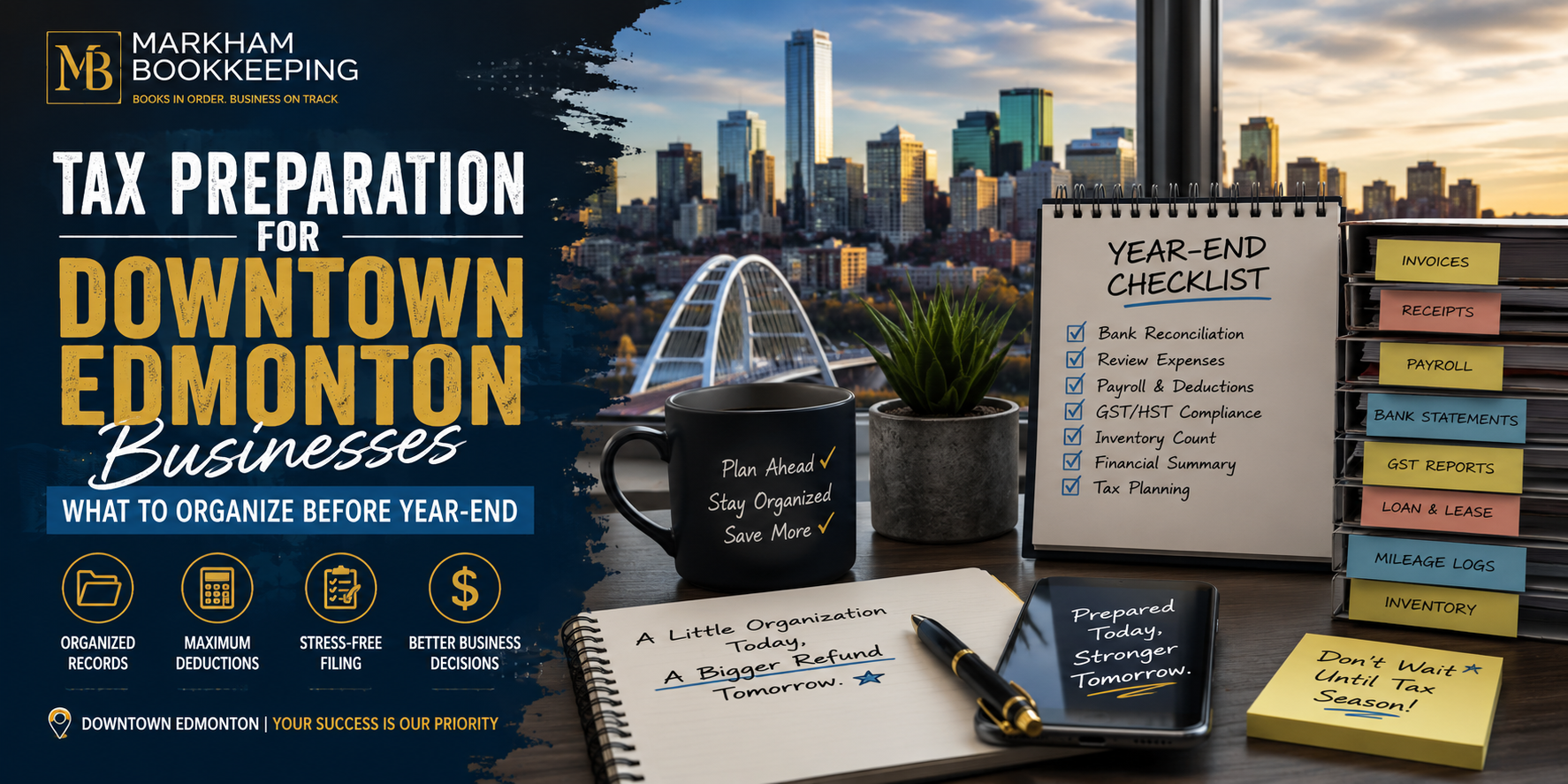
Year-end can come quickly for small business owners. One month you are focused on customers, payroll, suppliers, and daily operations. The next month, your accountant or bookkeeper is asking for receipts, bank statements, payroll records, GST reports, loan balances, mileage logs, and year-end adjustments.
For many Downtown Edmonton businesses, tax preparation becomes stressful because the work starts too late. The problem is not always the tax return itself. The real issue is disorganized records.
Good tax preparation starts before year-end. When your documents are organized, your books are cleaner, your accountant has fewer questions, and you are in a better position to understand your actual profit, cash flow, and tax obligations.
Whether you run a restaurant, retail shop, consulting business, construction trade, salon, clinic, marketing agency, nonprofit, or professional service business in Downtown Edmonton, year-end preparation matters. Clean records do not only help with taxes. They also help you make better business decisions.
Here is what Edmonton business owners should organize before year-end.
1. Bank and Credit Card Statements
The first thing every business owner should organize is bank and credit card activity.
Your bookkeeper or accountant will usually need all business bank statements, credit card statements, and loan statements for the year. This includes operating accounts, savings accounts, merchant accounts, corporate credit cards, lines of credit, and any other financial accounts used for business.
For Downtown Edmonton businesses, this is especially important because transactions often come from multiple sources. You may receive customer payments by debit, credit card, e-transfer, cash, cheque, Stripe, Square, Clover, Shopify, PayPal, or other payment processors.
If your bank feeds are connected to accounting software, that is helpful, but it does not replace proper reconciliation. Bank feeds can miss transactions, duplicate items, or categorize entries incorrectly. A year-end review should confirm that every bank and credit card account has been fully reconciled to the statement.
Before year-end, make sure you have complete statements for every month. Missing statements create delays and may lead to incomplete reporting.
2. Sales Records and Invoices
Your sales records are the foundation of your income reporting. Business owners should organize customer invoices, sales summaries, point-of-sale reports, online sales reports, deposit summaries, and any other documents that support revenue.
This is especially important for small businesses in Downtown Edmonton that use multiple sales channels. For example, a retail store may have in-person sales, online orders, gift cards, refunds, and payment processor deposits. A service business may have invoices, retainers, deposits, and project-based billing.
Your sales records should help answer:
How much revenue did the business earn?
Was GST charged properly where applicable?
Were refunds and discounts recorded correctly?
Are customer deposits or advances still unearned at year-end?
Do payment processor deposits match actual sales reports?
One common bookkeeping issue is recording only bank deposits as sales. That can be misleading because deposits may be net of fees, chargebacks, refunds, or tips. For accurate tax preparation, sales should be supported by proper sales reports, not only bank activity.
3. Business Expense Receipts
Expense receipts are one of the most common year-end problems. Many business owners know they paid for something, but they do not have the proper receipt or invoice to support it.
Before year-end, gather receipts for office expenses, rent, utilities, supplies, advertising, meals, software, repairs, insurance, professional fees, subcontractors, equipment, vehicle expenses, travel, bank charges, and other business costs.
A credit card statement shows that a payment happened, but it may not show what was purchased or whether it was business-related. A proper receipt gives the detail needed to support the expense.
For Edmonton small businesses, receipt organization can be much easier if done monthly. You can use cloud storage, folders, accounting software attachments, Dext, Hubdoc, QuickBooks attachments, Google Drive, or a simple digital receipt system.
The key is consistency. A messy receipt folder at year-end can slow down tax preparation and increase cleanup time.
4. Payroll Records
If your business has employees, payroll records should be organized before year-end. Payroll affects wages, source deductions, employer contributions, taxable benefits, vacation pay, T4 preparation, and payroll remittances.
You should review:
Payroll summaries
Employee earnings records
CPP, EI, and income tax deductions
Employer contributions
Vacation pay accrued or paid
Bonuses and commissions
Taxable benefits
Payroll remittance confirmations
T4 preparation details
For Downtown Edmonton businesses with part-time, seasonal, or hourly staff, payroll records can become complicated if hours, overtime, vacation pay, reimbursements, or deductions are not tracked properly.
Payroll should also match your general ledger. If payroll reports show one amount but your accounting records show another, those differences should be reviewed before year-end.
This is one area where waiting until the last minute can create unnecessary stress.
5. GST/HST Records
If your business is registered for GST/HST, year-end is a good time to review GST collected, GST paid, and GST/HST filing records.
Even though Alberta businesses charge GST instead of HST, your business may still deal with customers or suppliers outside Alberta. Depending on your business model, place-of-supply rules and sales tax treatment may need careful review.
Your GST records should include:
GST collected on sales
GST paid on eligible expenses
Filed GST returns
Payments made to CRA
Refunds or credits received
Adjustments for bad debts, refunds, or discounts
Sales reports that support taxable, zero-rated, or exempt revenue
A common issue is mixing GST with income. GST collected is not business revenue. It is an amount collected and later reported to CRA. If it is not tracked properly, your financial reports may overstate revenue or create confusion at filing time.
A clean GST report makes tax preparation easier and helps avoid surprises.
6. Accounts Receivable
Accounts receivable means money customers owe your business. Before year-end, review your unpaid invoices and confirm whether they are still collectible.
An accounts receivable aging report usually shows invoices that are current, 30 days overdue, 60 days overdue, 90 days overdue, or older.
This report matters because unpaid invoices can affect revenue, cash flow, and year-end reporting. If an invoice is no longer collectible, your accountant may need to review whether a bad debt adjustment is appropriate.
For service businesses, consultants, contractors, clinics, and professional firms in Downtown Edmonton, A/R review is very important. You may have earned the revenue, but if customers have not paid, your cash flow may be weaker than your profit report suggests.
Before year-end, follow up with customers, confirm balances, clear duplicate invoices, and review old receivables.
7. Accounts Payable
Accounts payable means money your business owes to suppliers, vendors, contractors, credit cards, and other parties.
Before year-end, organize unpaid bills and supplier statements. This helps your accountant confirm whether expenses belong in the correct period.
For example, if you received services in December but paid the invoice in January, the expense may still need to be recorded in the year it relates to, depending on your accounting method and situation.
A clean accounts payable report helps show:
Which bills are unpaid
Which expenses belong before year-end
Whether supplier balances match statements
Whether duplicate bills exist
Whether credits or refunds are missing
Many small business owners only track payments when cash leaves the bank. But year-end accounting often requires a better look at what was owed at the reporting date.
8. Loan, Lease, and Financing Documents
If your business has loans, vehicle financing, equipment leases, credit lines, or shareholder advances, organize those documents before year-end.
Your accountant may need loan statements, interest summaries, financing agreements, repayment schedules, and year-end balances.
This matters because loan payments are not always fully deductible expenses. A payment may include both principal and interest. The interest portion may be treated differently from the principal portion.
For example, if a business vehicle or equipment loan payment is recorded entirely as an expense, your profit and loss statement may be incorrect. Proper classification helps make your financial statements cleaner.
Downtown Edmonton businesses with equipment, delivery vehicles, office leases, or financing arrangements should review these accounts carefully before year-end.
9. Inventory Records
If your business sells products, inventory records are extremely important.
Retail stores, restaurants, e-commerce businesses, wholesalers, and trades that carry materials should review inventory before year-end. You may need a physical inventory count, inventory valuation report, purchase records, and cost of goods sold review.
Inventory affects profit because products purchased are not always fully expensed right away. Unsold inventory may still be an asset at year-end.
Before year-end, review:
Inventory on hand
Damaged or obsolete stock
Product costs
Supplier invoices
Inventory adjustments
Shrinkage or missing inventory
Cost of goods sold
For Edmonton retail and product-based businesses, inventory errors can significantly affect profit. If inventory is overstated or understated, your net income may also be wrong.
10. Vehicle and Mileage Records
If you use a vehicle for business, organize mileage logs, fuel receipts, repairs, insurance, lease payments, financing documents, parking, and maintenance records.
A proper mileage log should separate business use from personal use. It should include dates, destinations, purpose of trips, and kilometres driven.
For Downtown Edmonton businesses, this may include trips to client locations, suppliers, job sites, banks, meetings, networking events, or deliveries.
Vehicle expenses can become messy when the same vehicle is used for both business and personal purposes. Organizing these records before year-end helps your accountant determine the proper business portion.
Do not wait until tax time to estimate everything from memory. A consistent mileage log is much stronger than a rough guess.
11. Home Office and Office Expense Records
Some business owners work from home, rent office space, or use a combination of both.
If you claim home office expenses, organize utility bills, rent or mortgage interest details, property tax, internet, insurance, repairs, and the business-use calculation. If you rent office space in Downtown Edmonton, organize lease agreements, rent payments, CAM charges, utility bills, and any related office costs.
The key is separating personal and business use clearly. Not every household expense is automatically a business expense. The records should support the business portion being claimed.
For businesses with physical downtown office space, year-end is also a good time to review lease payments, deposits, rent-free periods, common area charges, and tenant improvement costs.
12. Fixed Assets and Equipment Purchases
If your business bought computers, furniture, tools, equipment, vehicles, leasehold improvements, or other major items during the year, organize those invoices separately.
Large purchases may need to be recorded as assets rather than regular expenses. Your accountant may need purchase dates, descriptions, invoice amounts, financing details, and whether the item is still being used in the business.
Examples include:
Laptops and monitors
Office furniture
Tools and machinery
Business vehicles
Restaurant equipment
POS systems
Leasehold improvements
Security systems
Proper tracking helps your accountant calculate depreciation or capital cost allowance where applicable.
13. Owner Draws, Shareholder Loans, and Personal Transactions
One of the biggest year-end cleanup issues is mixing personal and business transactions.
If the business paid for personal expenses, those amounts may need to be recorded as owner draws, shareholder loans, or reimbursements rather than business expenses.
If the owner paid business expenses personally, those amounts should also be tracked so the business records are complete.
Before year-end, review:
Personal expenses paid by the business
Business expenses paid personally
Owner withdrawals
Owner contributions
Shareholder loan balances
Reimbursements
For incorporated businesses, shareholder loan tracking is especially important. Clean records help avoid confusion between salary, dividends, repayments, contributions, and personal spending.
14. Prior-Year Issues and Adjustments
Year-end is also a good time to check whether old bookkeeping problems still exist.
Common issues include unreconciled accounts, old uncleared transactions, duplicate expenses, negative liability balances, old receivables, old payables, GST balances that do not match filings, payroll payable balances, and opening balance equity amounts that were never cleaned up.
These issues can affect current-year tax preparation. If old balances are wrong, your current financial reports may not be reliable.
A Downtown Edmonton bookkeeper can help review these accounts before tax season so the year-end process is smoother.
15. A Year-End Meeting With Your Bookkeeper or Accountant
Before year-end, schedule a review with your bookkeeper or accountant. This meeting does not have to be complicated. The goal is to identify missing documents, unusual transactions, tax planning items, payroll issues, GST concerns, and cleanup work before deadlines arrive.
A year-end review can help you discuss:
Estimated profit
Expected tax payable
GST/HST status
Payroll remittances
Major purchases
Vehicle use
Home office claims
Outstanding receivables
Unpaid supplier bills
Owner withdrawals
Cash flow concerns
Software cleanup
This gives business owners more control. Instead of being surprised at tax time, you can plan ahead.
Why Year-End Organization Matters for Downtown Edmonton Businesses
Downtown Edmonton businesses face real pressures: rent, wages, supplier costs, inflation, seasonal changes, construction disruptions, local competition, and changing customer demand.
When your records are organized, you can see your business more clearly. You can understand whether your pricing works, whether expenses are too high, whether customers are paying on time, and whether you are ready for tax season.
Tax preparation is not just about filing a return. It is about making sure your numbers are accurate.
Clean records can lead to:
Faster tax preparation
Fewer accountant questions
Better financial reports
Clearer GST and payroll tracking
Improved cash flow planning
Less year-end stress
Better business decisions
Final Thoughts
Tax preparation for Downtown Edmonton businesses should begin before year-end, not after it. The more organized your documents are, the easier it is to prepare accurate financial statements, review tax obligations, and avoid last-minute cleanup.
Start by organizing bank statements, credit card statements, sales records, receipts, payroll reports, GST/HST records, receivables, payables, loans, inventory, mileage logs, home office records, equipment purchases, and owner transactions.
You do not need to handle everything alone. A professional Edmonton bookkeeper or accountant can help you clean up your books, organize your records, reconcile accounts, prepare year-end reports, and get your business ready for tax time.
At Markham Bookkeeping, we help small business owners in Edmonton stay organized, understand their numbers, and prepare for tax season with more confidence. Whether you need monthly bookkeeping, year-end cleanup, GST support, payroll support, or small business accounting in Downtown Edmonton, organized records are the first step toward cleaner books and better decisions.
Visit: https://markhambookkeeping.ca/ to learn more about bookkeeping and accounting support for Edmonton small businesses.