
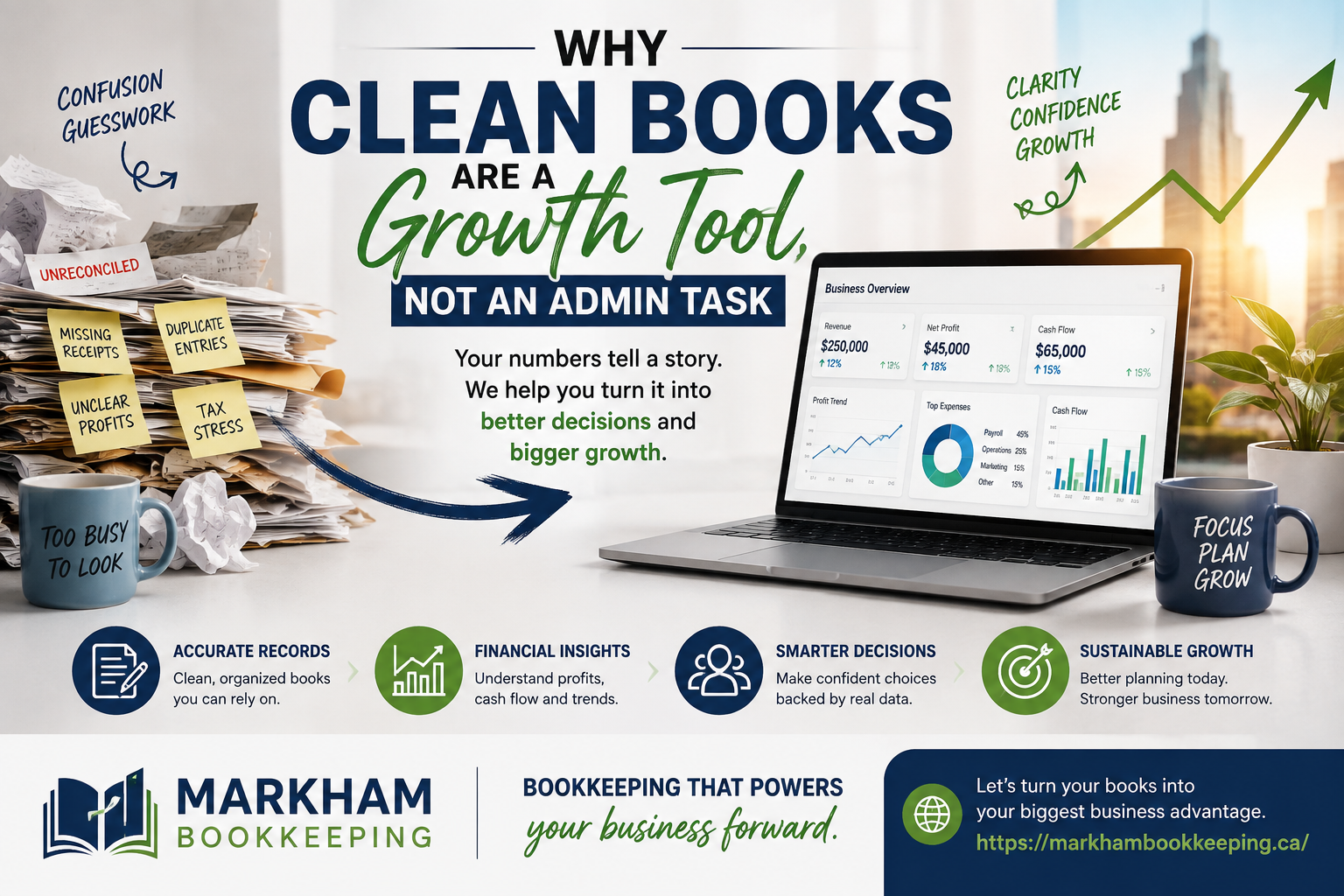
For many business owners, bookkeeping sits near the bottom of the priority list.
Sales come first. Customers need attention. Employees need to be managed. Suppliers need to be paid. New opportunities need to be pursued.
Bookkeeping can easily start to feel like an administrative obligation—something that needs to be completed for GST filings, payroll remittances, year-end taxes, or the accountant.
But that view misses much of its real value.
Clean bookkeeping is not simply about recording what already happened. It can help determine what your business should do next.
When financial records are accurate, current, and properly organized, bookkeeping becomes a source of business intelligence. It helps owners understand profitability, cash flow, pricing, spending, customer behaviour, debt, and financial capacity.
For small businesses in Edmonton, where decisions about staffing, equipment, expansion, pricing, and cash management can have significant consequences, clean books can become one of the most useful management tools available.
The difference is simple:
Messy books tell you very little. Clean books help you ask better questions—and make better decisions.
What Do “Clean Books” Actually Mean?
Clean books do not mean that every report needs to look perfect or that a business needs an overly complicated accounting system.
It means the financial records reasonably reflect what is actually happening in the business.
That generally includes:
- Bank and credit card accounts that are regularly reconciled
- Customer invoices and payments recorded correctly
- Supplier bills and expenses categorized properly
- Duplicate transactions removed
- Personal and business transactions separated
- Payroll liabilities properly recorded
- GST/HST balances reviewed
- Loans and credit facilities accurately reflected
- Accounts receivable kept current
- Accounts payable reviewed
- Supporting documents organized
- Financial reports prepared consistently
When these basics are handled properly, the accounting system becomes more than a storage place for transactions.
It becomes a management system.
Clean Books Turn Transactions Into Business Intelligence
Every transaction contains information.
A customer invoice tells you something about revenue.
A supplier bill tells you something about costs.
Payroll tells you something about labour requirements.
Credit card activity shows spending patterns.
Accounts receivable tells you how quickly customers are paying.
Inventory purchases can reveal changing demand.
The problem is that individual transactions rarely tell the complete story.
Business intelligence comes from organizing thousands of individual financial activities into patterns that management can understand.
That is one of the most valuable functions of professional bookkeeping.
Consider an Edmonton business that generates $150,000 in monthly sales.
That figure sounds impressive, but by itself it answers very few meaningful questions.
What is the gross profit?
How much is being spent on payroll?
How much revenue is still sitting in accounts receivable?
Are operating expenses increasing faster than sales?
Which services have the strongest margins?
Is cash increasing or decreasing?
How much GST needs to be reserved?
Can the company afford another employee?
Clean accounting records help turn the original $150,000 revenue number into answers.
Revenue Growth Does Not Always Mean Business Growth
One of the most dangerous assumptions in business is that increasing sales automatically means the company is becoming stronger.
Revenue can grow while profitability declines.
Suppose an Edmonton service business grows monthly revenue from $80,000 to $110,000.
That looks like substantial growth.
However, imagine that additional subcontractors, overtime, advertising, supplies, and administrative costs were required to generate the additional sales.
Revenue increased by $30,000, but expenses increased by $35,000.
The business became larger—but less profitable.
Without clean monthly financial reporting, an owner might only notice that the bank account seems tighter despite higher sales.
Clean books allow the owner to see the underlying reason.
This is why successful businesses should monitor more than revenue.
Important information can include:
- Gross profit
- Gross margin
- Operating expenses
- Payroll as a percentage of revenue
- Net profit
- Accounts receivable
- Accounts payable
- Debt obligations
- Cash reserves
Growth should strengthen the business, not simply increase its workload.
Clean Books Help You Understand Your Margins
A business can sell more and still struggle if it does not understand margins.
Consider a company offering three different services.
Service A generates $200,000 annually.
Service B generates $120,000.
Service C generates $80,000.
Looking only at sales, Service A appears to be the most important.
But once labour, materials, subcontractors, commissions, and other direct costs are considered, the picture could change significantly.
Perhaps Service A produces a 15% margin while Service B produces a 45% margin.
Suddenly, the smaller revenue stream may represent a much better growth opportunity.
Good bookkeeping allows Edmonton business owners to review revenue and costs at a more meaningful level.
Depending on the accounting system and business, reporting may be organized by:
- Product
- Service
- Project
- Customer
- Location
- Department
- Business division
The objective is not to create unnecessary accounting complexity.
It is to understand where the business actually makes money.
Better Bookkeeping Leads to Better Pricing Decisions
Pricing is often treated as a sales or marketing decision.
It is also a financial decision.
If a business does not know its actual costs, it becomes difficult to know whether prices are sustainable.
Imagine an Edmonton contractor quoting projects based mainly on competitor prices.
Materials increase.
Insurance premiums increase.
Wages increase.
Vehicle expenses increase.
Subcontractor rates increase.
The company continues using essentially the same pricing model.
Sales may remain strong, but margins slowly decline.
Accurate bookkeeping makes those cost increases visible.
Instead of thinking:
“Business seems busy, so things must be going well.”
The owner can ask:
“Our average direct cost has increased 11%. Do we need to adjust pricing?”
That is the difference between bookkeeping as administration and bookkeeping as business intelligence.
Clean Books Improve Cash Flow Management
Profit and cash are not the same thing.
This distinction becomes extremely important as a business grows.
A company may report a healthy profit while experiencing serious cash pressure.
For example, the company might:
- Sell services on 30- or 60-day payment terms
- Purchase inventory before customers pay
- Make loan principal payments
- Buy equipment
- Pay GST or payroll remittances
- Make deposits on future projects
- Carry large accounts receivable balances
The income statement may show profit while the bank account remains tight.
Clean books help business owners identify where the cash is going.
Regular cash flow monitoring can help answer:
- How much money is available right now?
- How much is expected from customers?
- Which bills are due soon?
- What payroll obligations are approaching?
- How much should be reserved for GST?
- Are customers taking longer to pay?
- Is debt consuming too much cash?
- Can the company safely make a major purchase?
For growing Edmonton businesses, cash flow visibility can be just as important as profitability.
Accounts Receivable Can Become a Growth Signal
One useful example of bookkeeping as business intelligence is accounts receivable.
An accounts receivable aging report shows how much customers owe and how long those balances have remained outstanding.
Suppose revenue is growing rapidly.
That sounds positive.
But accounts receivable is growing even faster.
That could indicate that the company is effectively financing its customers.
The business may be completing more work and reporting more revenue while waiting longer to collect cash.
Clean AR records allow management to identify the problem early.
Possible actions could include:
- Following up sooner
- Requesting deposits
- Reducing payment terms
- Requiring milestone payments
- Reviewing customer credit
- Changing collection procedures
The bookkeeping report does not make the decision.
It provides the information needed to make one.
Clean Books Help Control Expenses Before They Become Problems
Small expense increases can be difficult to notice during normal business operations.
A few additional software subscriptions.
Higher merchant processing fees.
More vehicle expenses.
Additional overtime.
Increasing advertising costs.
Rising insurance premiums.
Each increase may appear manageable individually.
Together, they can significantly reduce profitability.
Monthly financial reporting allows owners to compare expenses with previous periods and spot unusual changes.
For example:
Advertising expense increased from $4,000 to $7,500.
The next question should not automatically be:
“Can we cut advertising?”
A better question is:
“What happened to the revenue generated from that spending?”
Good bookkeeping does not simply encourage cost cutting.
It encourages smarter cost management.
Some expenses should be reduced.
Others should be increased because they generate strong returns.
Without reliable numbers, it can be difficult to distinguish between the two.
Financial Visibility Makes Hiring Decisions Stronger
Hiring is one of the biggest decisions many small businesses make.
An employee costs more than the wage printed in the employment agreement.
A business may also need to consider:
- Employer CPP contributions
- Employer EI premiums
- Vacation pay
- Workers’ compensation
- Benefits
- Equipment
- Software
- Workspace
- Training
- Management time
- Other employment costs
A growing company may genuinely need another employee.
But the decision should ideally be supported by financial capacity rather than temporary pressure.
Clean monthly books can help an Edmonton business evaluate whether revenue, margins, cash flow, and workload support the additional commitment.
The question becomes:
Can the business afford this employee consistently—not just this month?
That is a much stronger basis for hiring.
Clean Books Support Financing and Expansion
Businesses pursuing financing often discover the value of clean financial records very quickly.
Banks, lenders, investors, landlords, and other stakeholders may request financial information such as:
- Income statements
- Balance sheets
- Accounts receivable aging
- Accounts payable aging
- Cash flow information
- Debt balances
- Tax filings
- Historical financial statements
When the books are several months behind, obtaining financing can suddenly become a bookkeeping emergency.
A company with organized records can respond much faster.
More importantly, clean financial information can help the business determine whether borrowing makes sense before approaching the lender.
For example:
Is debt being used to purchase productive equipment?
Or is it covering recurring operating losses?
Those are very different situations.
Better Books Create Better Forecasts
A forecast is only as useful as the information behind it.
If historical revenue, expenses, margins, and cash movements are unreliable, projections can quickly become guesses.
Clean books give Edmonton business owners a stronger starting point for forecasting.
Historical records may reveal:
- Seasonal revenue patterns
- Regular slow periods
- Payroll trends
- Average customer collection times
- Annual insurance costs
- Tax payment cycles
- Equipment replacement requirements
- Typical gross margins
Once these patterns are visible, management can plan ahead instead of reacting afterward.
If January and February are consistently slower months, cash reserves can be built during stronger periods.
If inventory purchases normally increase before the holiday season, cash requirements can be anticipated.
That is financial planning built on bookkeeping data.
Clean Books Can Reduce Tax-Time Surprises
Tax compliance remains an important function of bookkeeping.
Businesses need accurate records for GST/HST, payroll, income tax preparation, and other reporting requirements.
However, clean books can provide another advantage: fewer surprises.
If GST balances are reviewed regularly, a business can estimate upcoming remittances.
If payroll liabilities are monitored, discrepancies can be investigated sooner.
If profit is tracked throughout the year, the owner may have a better understanding of potential tax obligations.
Waiting until year-end to understand the numbers can make planning much harder.
For Edmonton small businesses, keeping bookkeeping current throughout the year can make tax preparation more predictable and less disruptive.
Monthly Bookkeeping Creates a Feedback Loop
The biggest advantage of clean books is not the books themselves.
It is the feedback loop they create.
Business activity occurs.
Transactions are recorded.
Accounts are reconciled.
Reports are produced.
Results are reviewed.
Management makes decisions.
New business activity occurs.
Then the process repeats.
Over time, this cycle helps management understand the financial consequences of its decisions.
Did the new pricing strategy improve margins?
Did the advertising campaign generate enough revenue?
Did hiring reduce overtime?
Did the equipment purchase improve productivity?
Did the new payment policy reduce overdue receivables?
Clean books make it possible to measure the answer.
Bookkeeping Should Look Forward, Not Only Backward
Accounting records are historical by nature.
They record events that have already occurred.
But their value is often forward-looking.
The January financial statements can influence what happens in February.
A declining margin can trigger a pricing review.
Growing receivables can trigger stronger collection procedures.
Rising payroll costs can trigger productivity analysis.
Strong cash reserves can support an expansion opportunity.
Declining revenue can encourage earlier corrective action.
The numbers describe the past, but management uses them to influence the future.
That is why bookkeeping should not be viewed solely as administration.
Turning Your Bookkeeping Into a Growth Tool
A practical financial management routine does not need to be complicated.
For many small businesses, the process can include:
1. Keep transactions current
Avoid allowing months of transactions to accumulate.
2. Reconcile accounts regularly
Bank accounts, credit cards, loans, and other key accounts should agree with external records.
3. Review receivables and payables
Know who owes the business money and what the business owes others.
4. Produce monthly reports
At minimum, review the profit and loss statement and balance sheet.
5. Compare performance
Look at previous months, previous years, budgets, or targets.
6. Investigate major changes
Revenue up 20%? Find out why.
Gross margin down 8%? Find out why.
Payroll rising faster than sales? Find out why.
7. Make an action decision
Financial reporting becomes useful when it leads to action.
The Role of an Edmonton Bookkeeper Is Changing
Modern bookkeeping is increasingly connected to business management.
Cloud accounting platforms such as QuickBooks Online can organize transactions, reconcile accounts, track customers and suppliers, and produce detailed financial reports.
But software alone does not create financial clarity.
Someone still needs to ensure the information going into the system is accurate and that reports are interpreted appropriately.
An experienced Edmonton bookkeeper can help create a consistent financial process that includes bookkeeping cleanup, bank reconciliation, accounts payable, accounts receivable, payroll support, GST/HST bookkeeping, and monthly financial reporting.
For small businesses, the objective should not simply be:
“Are the books done?”
A better question is:
“What are the books telling us?”
From Administration to Business Intelligence
Clean books provide more than organized transactions.
They provide visibility.
They show where revenue comes from.
They show where money is being spent.
They reveal margins.
They highlight cash flow pressure.
They identify overdue customers.
They show growing expenses.
They provide information for hiring, pricing, financing, budgeting, and expansion.
Most importantly, they replace some of the uncertainty of running a business with measurable information.
That does not mean every business decision can be reduced to a spreadsheet.
Experience, customer relationships, market conditions, judgment, and strategy will always matter.
But those decisions become stronger when they are supported by reliable financial information.
For Edmonton entrepreneurs and small business owners, clean bookkeeping is not simply an administrative task performed for CRA or year-end taxes.
It is part of the infrastructure that helps a business understand itself.
And a business that understands its numbers is in a much stronger position to grow.
Looking for Bookkeeping Support in Edmonton?
Markham Bookkeeping helps Edmonton businesses turn day-to-day financial transactions into organized, meaningful financial information.
From bookkeeping cleanup and bank reconciliation to payroll, GST/HST support, accounts payable, accounts receivable, and monthly financial reporting, the goal is to give business owners clearer numbers and better visibility into their operations.
When your books are current and reliable, bookkeeping stops being another administrative task.
It becomes information you can use to run your business.