
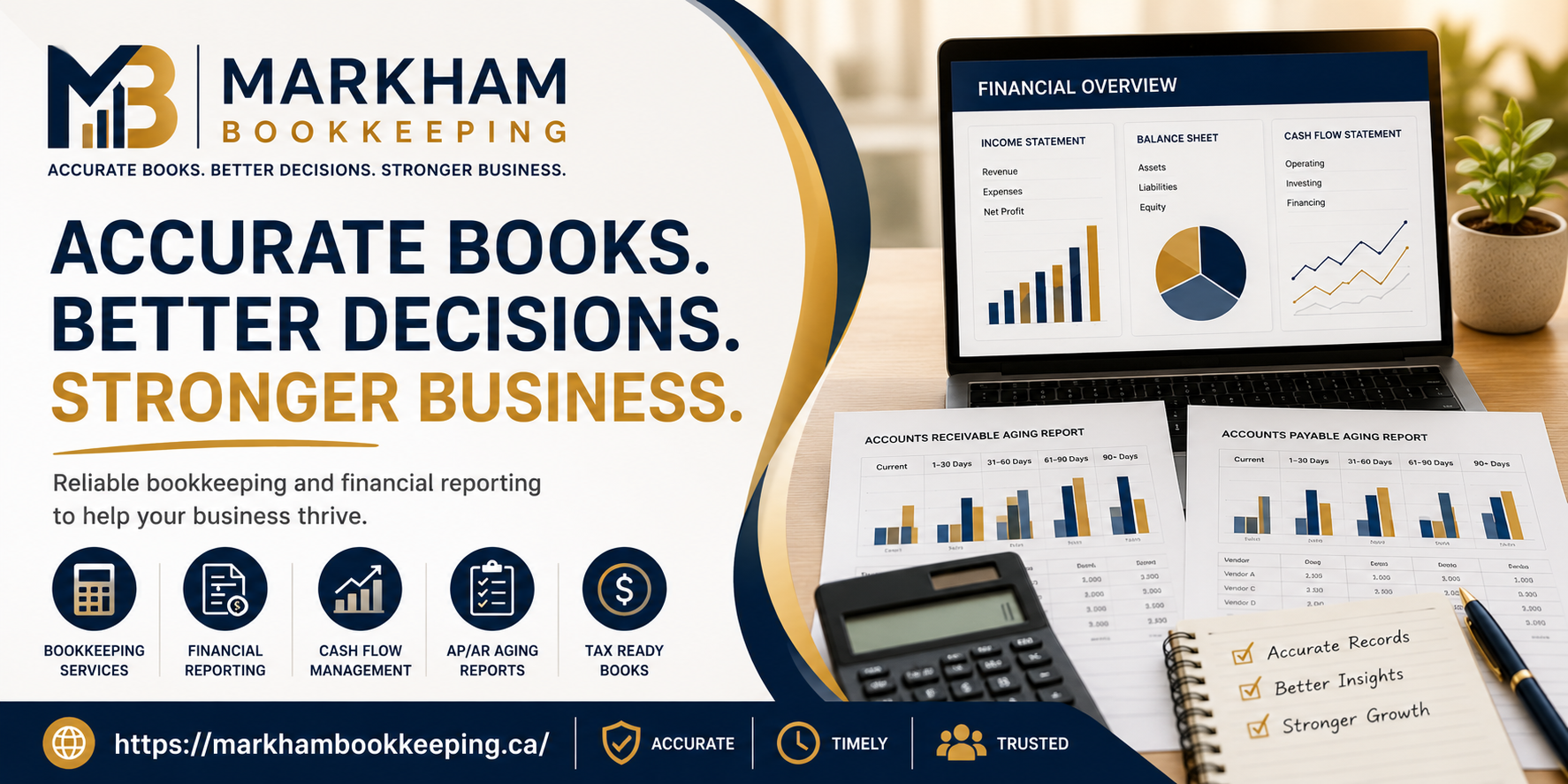
Running a successful business is not just about making sales — it is about understanding the numbers behind your business. Many Edmonton small business owners focus only on revenue, but revenue alone does not tell the full story. Your financial statements and key accounting ratios help you understand profitability, cash flow, debt, efficiency, and overall financial health.
If you ignore your financial reports, problems can build quietly in the background. Late-paying customers, unpaid bills, shrinking margins, and poor cash flow often appear in the numbers long before they become major issues.
In this guide, we will break down the most important financial statements, explain the key accounting ratios every Edmonton business owner should monitor, and show you how AP and AR aging reports can help protect your cash flow.
Why Financial Statements Matter
Financial statements are the foundation of good bookkeeping and accounting. They help business owners:
- Understand profitability
- Monitor cash flow
- Track business growth
- Prepare for tax season
- Secure financing
- Identify financial problems early
- Make smarter business decisions
Whether you own a retail store, construction company, restaurant, auto dealership, e-commerce business, or professional service company in Edmonton, accurate financial reporting is essential.
The 3 Most Important Financial Statements
1. Income Statement (Profit & Loss Statement)
The Income Statement shows:
- Revenue
- Expenses
- Net profit or loss
It tells you whether your business actually made money during a specific period.
Example
An Edmonton landscaping company may show:
- Revenue: $120,000
- Payroll expenses: $45,000
- Vehicle expenses: $12,000
- Fuel: $6,000
- Advertising: $4,000
- Net Profit: $18,000
This report helps business owners understand:
- Which months are profitable
- Which expenses are growing too quickly
- Whether pricing is high enough
- Whether the business is sustainable
Key Sections of an Income Statement
Revenue
Money earned from products or services.
Cost of Goods Sold (COGS)
Direct costs tied to producing goods or services.
Examples:
- Inventory
- Materials
- Contractor costs
- Manufacturing expenses
Operating Expenses
General business expenses such as:
- Rent
- Payroll
- Software
- Marketing
- Insurance
- Utilities
Net Profit
What remains after all expenses are deducted.
2. Balance Sheet
The Balance Sheet shows the financial position of your business at a specific point in time.
It includes:
- Assets
- Liabilities
- Equity
The formula is:
Assets=Liabilities+EquityAssets = Liabilities + EquityAssets=Liabilities+Equity
Assets
Things your business owns.
Examples:
- Cash
- Inventory
- Equipment
- Accounts receivable
- Vehicles
Liabilities
Money your business owes.
Examples:
- Loans
- Credit cards
- GST/HST payable
- Payroll liabilities
- Accounts payable
Equity
The owner’s portion of the business.
Why the Balance Sheet Matters
Many Edmonton small businesses appear profitable on paper but still struggle financially because of poor cash flow or excessive debt.
The Balance Sheet helps identify:
- Cash shortages
- Excessive borrowing
- Growing liabilities
- Inventory problems
- Weak liquidity
3. Cash Flow Statement
The Cash Flow Statement tracks actual money moving in and out of the business.
Many businesses fail because they run out of cash — not because they are unprofitable.
A company can show profit while still having no money in the bank.
This report tracks:
- Operating cash flow
- Investing activities
- Financing activities
Key Financial Ratios Every Edmonton Business Should Monitor
Financial ratios simplify complex accounting data and reveal hidden trends.
1. Current Ratio
Measures your ability to pay short-term obligations.
Formula:
Example
- Current Assets: $80,000
- Current Liabilities: $40,000
Current Ratio = 2.0
This means the business has $2 for every $1 owed.
Healthy Range
Most businesses aim for:
- 1.5 to 3.0
A very low ratio may indicate cash flow issues.
2. Gross Profit Margin
Shows how efficiently your business produces goods or services.
Formula:
Why It Matters
If margins shrink:
- Supplier costs may be rising
- Pricing may be too low
- Waste or inefficiency may exist
3. Net Profit Margin
Shows how much profit remains after all expenses.
Formula:
Net Profit Margin=Net Profit / Revenue ×100
A higher percentage usually means stronger financial health.
4. Debt-to-Equity Ratio
Measures how heavily the business relies on debt.
Formula:
Debt to Equity Ratio=Total Liabilities / Equity
High debt can create risk during slow economic periods.
5. Accounts Receivable Turnover Ratio
Measures how quickly customers pay invoices.
Formula:
Accounts Receivable Turnover=Net Credit Sales / Average Accounts Receivable
Slow collections hurt cash flow and increase financial stress.
Understanding Accounts Receivable (AR) Aging Reports
An Accounts Receivable Aging Report shows:
- Who owes you money
- How much they owe
- How long invoices have remained unpaid
This is one of the most important reports for Edmonton small businesses.
Common AR Aging Categories
Most AR aging reports divide invoices into:
- Current
- 1–30 days overdue
- 31–60 days overdue
- 61–90 days overdue
- 90+ days overdue
Why AR Aging Reports Matter
If customers stop paying on time:
- Cash flow suffers
- Payroll becomes stressful
- GST/HST obligations become difficult
- Loan payments become harder
- Profitability declines
Many businesses collapse because invoices remain unpaid for too long.
Warning Signs in AR Aging Reports
Large 90+ Day Balances
Old invoices become increasingly difficult to collect.
Overdependence on One Customer
If one client represents most receivables, your business carries concentration risk.
Rapidly Growing Receivables
Revenue may appear strong, but cash flow may actually be weak.
Best Practices for Managing Accounts Receivable
Send Invoices Immediately
Delays in invoicing often create delays in payment.
Use Clear Payment Terms
Examples:
- Net 15
- Net 30
- Due on receipt
Follow Up Early
Businesses that follow up consistently usually collect faster.
Accept Multiple Payment Methods
Easier payment options improve collections.
Review AR Aging Weekly
Do not wait until year-end bookkeeping.
Understanding Accounts Payable (AP) Aging Reports
An Accounts Payable Aging Report tracks:
- Bills your business owes
- Vendor balances
- Payment due dates
This helps businesses manage outgoing cash flow responsibly.
Why AP Aging Reports Matter
Poor AP management can lead to:
- Late fees
- Supplier relationship damage
- Credit problems
- Inventory disruptions
- Cash flow pressure
Common AP Aging Categories
- Current
- 1–30 days overdue
- 31–60 days overdue
- 61–90 days overdue
- 90+ days overdue
Best Practices for AP Management
Avoid Paying Everything Immediately
Strategic timing helps preserve cash flow.
Do Not Ignore Overdue Vendor Balances
Late supplier payments can damage relationships.
Match Bills to Cash Flow Cycles
Coordinate payments with customer collections when possible.
Review AP Reports Monthly
Consistent monitoring prevents surprises.
How Edmonton Small Businesses Can Improve Financial Reporting
Many small businesses only review their books during tax season. That is a major mistake.
Good bookkeeping should provide monthly visibility into:
- Revenue trends
- Profitability
- Cash flow
- Tax obligations
- Outstanding invoices
- Debt levels
Common Financial Reporting Mistakes
Mixing Personal and Business Expenses
This creates inaccurate reports and CRA complications.
Ignoring Reconciliations
Bank accounts should be reconciled monthly.
Poor Expense Categorization
Incorrect categories distort financial ratios.
Not Reviewing Reports Regularly
Financial problems worsen when ignored.
Waiting Until Year-End
Year-end cleanup is more expensive and stressful.
Industry-Specific Reporting Matters
Different industries require different financial tracking systems.
Examples:
Edmonton Construction Companies
- Job costing
- Equipment tracking
- Progress billing
Edmonton Restaurants
- Food cost percentages
- Inventory shrinkage
- Payroll ratios
Edmonton E-Commerce Businesses
- Platform fees
- Inventory management
- GST/HST tracking
Edmonton Auto Dealers
- Inventory financing
- Floor plan accounting
- Vehicle cost tracking
Final Thoughts
Understanding financial statements and ratios is one of the most valuable skills a business owner can develop.
Your bookkeeping should not just exist for tax filing — it should help you:
- Increase profitability
- Improve cash flow
- Reduce financial risk
- Make smarter business decisions
- Prepare for growth
Regularly reviewing your:
- Income Statement
- Balance Sheet
- Cash Flow Statement
- AP Aging Report
- AR Aging Report
can help you identify problems early and keep your Edmonton business financially healthy.
If your reports are messy, outdated, or confusing, professional bookkeeping support can make a massive difference. Accurate bookkeeping creates better decisions — and better decisions create stronger businesses.