Most Edmonton business owners check one thing constantly:
Their bank account balance.
But your bank balance alone does not tell you whether your business is actually healthy.
That’s where financial reporting matters.
Good financial reports help Edmonton small businesses understand:
- profitability
- cash flow
- expenses
- growth
- tax obligations
- financial risks
Without proper financial reporting, business decisions become guesses.
And guessing with money usually becomes expensive.
This guide explains small business financial reporting in plain English — what reports matter, how to read them, and why Edmonton entrepreneurs should stop ignoring their numbers.
What Is Financial Reporting?
Financial reporting is the process of organizing and reviewing your business financial information.
In simple terms:
it shows you what is happening financially inside your business.
Financial reports help answer questions like:
- Is the business profitable?
- Are expenses increasing?
- Is cash flow healthy?
- Are customers paying on time?
- Can the business afford growth?
- Is GST/HST being tracked properly?
Strong financial reporting creates financial clarity.
And financial clarity leads to better business decisions.
Why Financial Reporting Matters for Edmonton Small Businesses
Many Edmonton entrepreneurs focus heavily on sales and operations while ignoring financial reporting entirely.
That usually works in the beginning.
But as businesses grow:
- expenses increase
- payroll expands
- taxes become more complicated
- cash flow becomes harder to manage
- financial mistakes become more expensive
Without accurate financial reporting, businesses often:
- overspend
- underprice services
- miss profitability issues
- ignore cash flow problems
- create CRA issues
- make poor growth decisions
Good financial reports help businesses identify problems early before they become serious.
The Three Most Important Financial Reports
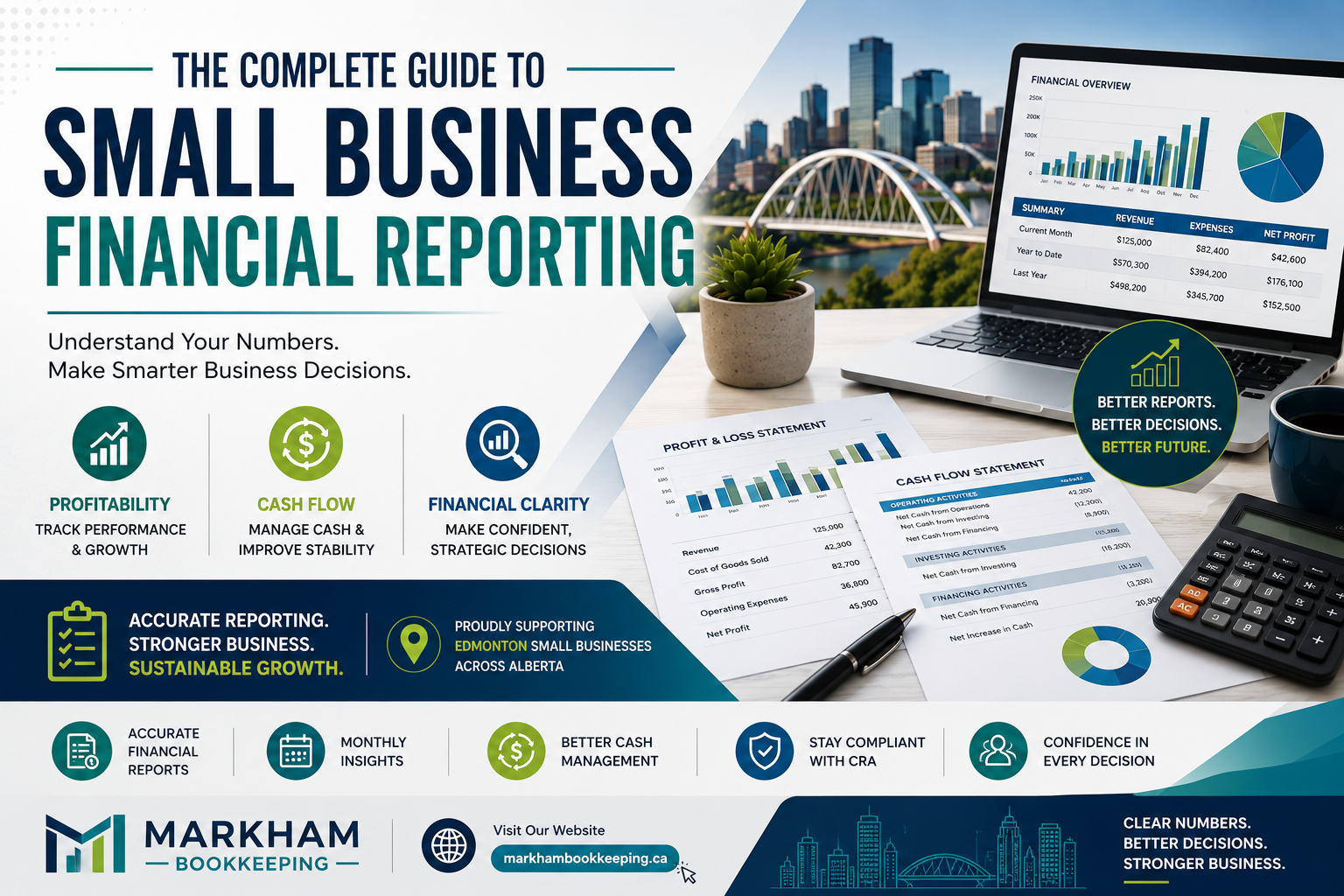
Most small businesses only need to focus on three core reports consistently:
- Profit and Loss Statement
- Balance Sheet
- Cash Flow Statement
These reports together provide a complete picture of your business finances.
1. Profit and Loss Statement (P&L)
The Profit and Loss Statement shows:
- revenue
- expenses
- profit or loss
This report answers one important question:
Is the business actually making money?
Your P&L helps track:
- sales growth
- operating expenses
- payroll costs
- software expenses
- marketing costs
- profitability trends
For Edmonton small businesses, this report is critical because it helps identify:
- overspending
- shrinking margins
- seasonal slowdowns
- rising operating costs
Many businesses generate strong revenue while quietly losing profitability underneath.
The P&L exposes that quickly.
Common P&L Mistakes
Many business owners:
- review revenue only
- ignore expense growth
- mix personal expenses into business spending
- fail to categorize expenses properly
- ignore monthly comparisons
Good bookkeeping improves the accuracy of your P&L significantly.
And accurate reports create better decisions.
2. Balance Sheet
The Balance Sheet shows:
- assets
- liabilities
- owner equity
This report answers another important question:
What does the business financially own and owe right now?
Assets include:
- cash
- inventory
- equipment
- accounts receivable
Liabilities include:
- loans
- credit cards
- payroll liabilities
- GST/HST owing
- taxes payable
The Balance Sheet helps Edmonton business owners understand:
- debt levels
- business stability
- available cash
- financial risk
- working capital
Many small businesses ignore the Balance Sheet completely.
That’s a mistake.
Because businesses can appear profitable while carrying dangerous debt levels underneath.
3. Cash Flow Statement
The Cash Flow Statement tracks:
- money entering the business
- money leaving the business
This report explains why businesses sometimes:
- look profitable
- but still feel financially stressed
Cash flow reporting helps identify:
- late-paying customers
- overspending
- inventory problems
- payroll pressure
- seasonal financial fluctuations
Many Edmonton small businesses struggle with cash flow not because of low sales — but because cash timing is poorly managed.
The Cash Flow Statement exposes those issues.
Why Financial Reporting Helps Business Growth
Growth without financial reporting creates chaos.
As businesses expand:
- payroll increases
- software costs rise
- taxes grow
- operational expenses multiply
Without accurate reports, owners often:
- scale too fast
- hire too quickly
- overspend
- underestimate taxes
- create cash flow pressure
Financial reporting creates visibility.
And visibility creates control.
Monthly Financial Reporting Matters
Most small business owners only review financial reports during tax season.
That’s far too late.
Monthly reporting helps Edmonton entrepreneurs identify:
- declining profitability
- unusual expenses
- payroll growth
- weak collections
- tax obligations
- shrinking margins
- cash shortages early
Small monthly adjustments prevent major financial problems later.
The Role of Bookkeeping in Financial Reporting
Financial reports are only as accurate as the bookkeeping behind them.
Poor bookkeeping creates:
- inaccurate reports
- incorrect balances
- duplicate transactions
- broken reconciliations
- bad financial decisions
This is why clean bookkeeping matters so much.
Good bookkeeping supports:
- accurate reporting
- CRA compliance
- GST/HST tracking
- payroll management
- financial forecasting
- business planning
Without proper bookkeeping, financial reports become unreliable.
Why Edmonton Businesses Need Better Financial Visibility
Many Edmonton small business owners operate reactively instead of strategically.
They:
- check bank balances constantly
- stress during tax season
- avoid financial reports
- guess profitability
- delay bookkeeping reviews
Financial visibility changes that completely.
Strong reporting helps businesses:
- make confident decisions
- reduce financial stress
- improve profitability
- prepare for slow seasons
- manage growth properly
Financial visibility creates confidence.
Common Financial Reporting Mistakes
Ignoring reports completely
Many entrepreneurs only focus on sales activity.
Reviewing reports too late
Waiting until year-end hides problems for months.
Poor expense categorization
Incorrect bookkeeping creates misleading reports.
Mixing personal and business expenses
This destroys reporting accuracy.
Ignoring cash flow reports
Profit alone does not guarantee financial stability.
Failing to reconcile accounts monthly
Broken reconciliations create inaccurate numbers.
Financial Reporting and CRA Compliance
Strong financial reporting also improves CRA compliance.
Accurate reports help businesses:
- track GST/HST correctly
- manage payroll liabilities
- prepare tax returns properly
- avoid filing mistakes
- support expense claims
Poor reporting increases the risk of:
- penalties
- incorrect filings
- financial confusion
- CRA letters
- audit problems
Good financial systems reduce stress significantly during tax season.
How Financial Reporting Improves Decision-Making
Financial reports help answer important business questions:
- Can the business afford new hires?
- Is pricing profitable enough?
- Are expenses growing too quickly?
- Is inventory moving efficiently?
- Is cash flow stable?
- Can the business survive slower months?
Without reporting, decisions become emotional instead of strategic.
Numbers create clarity.
Clarity improves decision-making.
Signs Your Financial Reporting Needs Improvement
Warning signs include:
- constantly checking bank balances
- uncertainty about profitability
- messy bookkeeping
- avoiding financial reports
- surprise tax balances
- cash flow stress
- unclear expense tracking
- inaccurate reports
- delayed bookkeeping
These problems usually indicate weak financial systems underneath.
The Goal of Financial Reporting
Financial reporting is not just about taxes.
It’s about understanding your business financially.
Good reports help Edmonton small businesses:
- grow sustainably
- improve profitability
- reduce financial stress
- prepare for taxes properly
- improve cash flow
- make smarter decisions
Financial reporting creates business stability.
And stability creates long-term growth.
Final Thoughts
Most businesses do not fail because owners lack motivation.
They fail because owners lack financial visibility.
Financial reporting helps you:
- understand your numbers
- track profitability
- monitor cash flow
- control expenses
- prepare for growth
- reduce financial risk
The goal is not complicated accounting.
The goal is financial clarity.
Because businesses that understand their numbers usually make better long-term decisions.
Ready to improve your bookkeeping and financial reporting systems?
Markham Bookkeeping helps Edmonton small businesses manage bookkeeping, financial reporting, GST/HST tracking, payroll, reconciliations, and business financial systems that create clarity and long-term stability.
Visit markhambookkeeping.ca to learn more.