When a business is small, its accounting structure can be simple.
Sales go into a revenue account. Purchases go into expenses. Payroll is recorded. Bank transactions are reconciled. At the end of the month, the owner looks at the profit and loss statement and gets a general idea of how the business performed.
That may work perfectly well at the beginning.
Then the business grows.
One location becomes three.
Five employees become thirty.
The company adds new products, departments, programs, projects, funding sources or service lines.
More people start entering transactions.
Management begins asking questions such as:
Which division is actually profitable?
Which location is losing money?
How much are we spending on this particular program?
What did this project actually cost us?
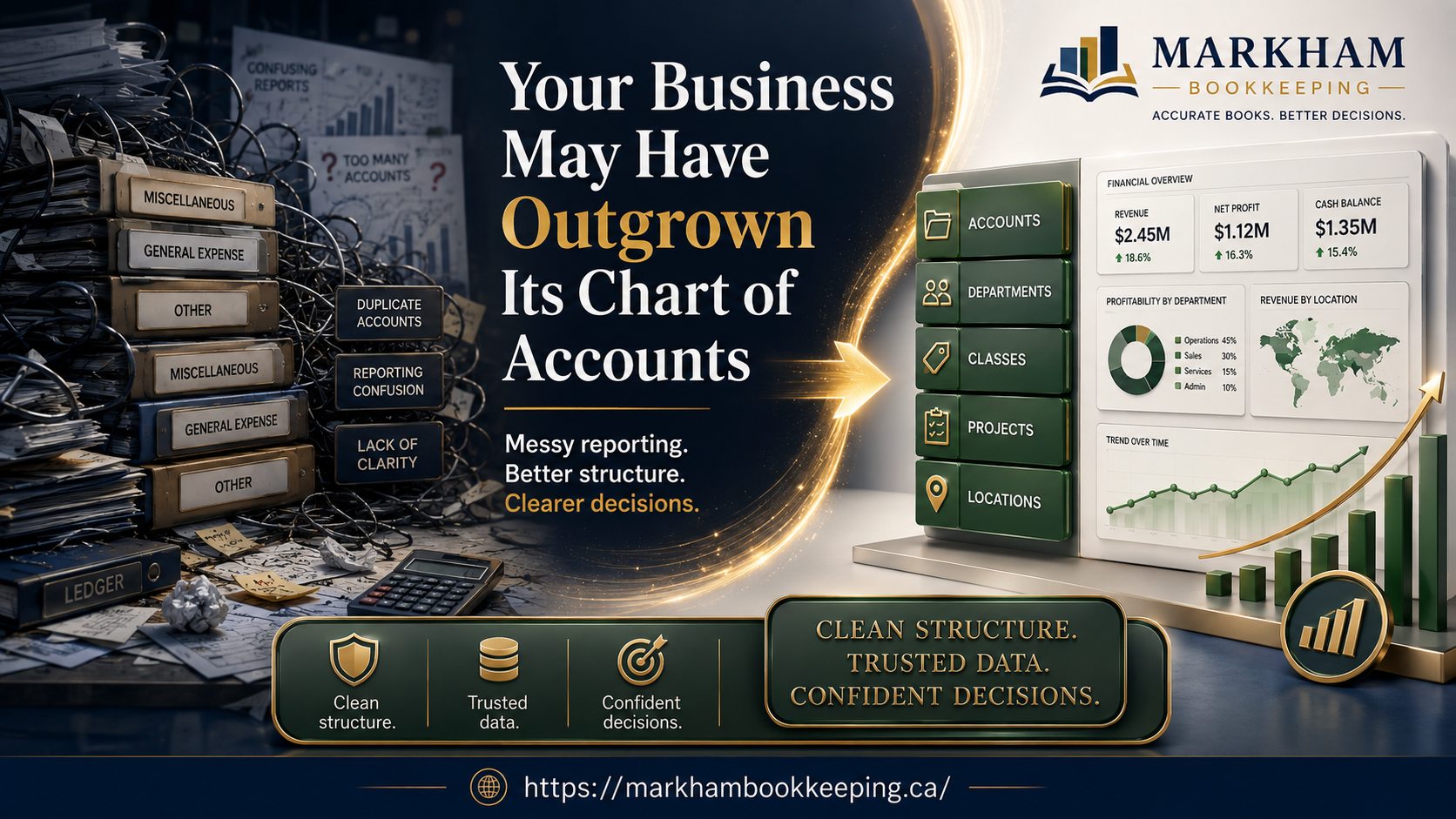
Why is half the profit and loss statement sitting inside “Miscellaneous” or “General Expenses”?
At that point, the problem may not be the bookkeeping itself.
The business may have simply outgrown its chart of accounts.
For growing Edmonton businesses, a well-designed chart of accounts is one of the foundations of useful financial reporting. The goal is not to create hundreds of accounts. The goal is to organize financial information in a way that helps management understand what is happening inside the business.
If your financial statements technically balance but do not answer meaningful business questions, your accounting structure may need a redesign.
What Is a Chart of Accounts?
The chart of accounts, often called the COA, is the organized list of accounts used to record a company’s financial transactions.
Typical categories include:
- assets
- liabilities
- equity
- revenue
- cost of goods sold
- payroll
- operating expenses
- other income
- other expenses
Within those categories, a business may have accounts such as:
- Bank
- Accounts Receivable
- Inventory
- Equipment
- Accounts Payable
- GST Payable
- Sales Revenue
- Cost of Materials
- Wages
- Advertising
- Rent
- Repairs and Maintenance
- Insurance
- Professional Fees
A chart of accounts provides the basic structure behind the company’s financial statements.
The difficulty is that the structure that works today may not work three years from now.
Growth Creates Reporting Questions
Imagine an Edmonton company that originally provided one type of service.
Its revenue structure might have been:
Sales Revenue
Simple enough.
Then the company expands into three service lines.
Now management wants to know which area is performing best.
If every invoice continues posting into one Sales Revenue account, the accounting system can tell management total revenue, but not necessarily the information required to understand the components of that revenue.
The immediate reaction is often to create more accounts:
- Service A Revenue
- Service B Revenue
- Service C Revenue
That may work.
Then the company opens another location.
Management now wants profitability by service and by location.
Soon someone starts creating accounts like:
- Edmonton Service A Revenue
- Edmonton Service B Revenue
- Edmonton Service C Revenue
- Sherwood Park Service A Revenue
- Sherwood Park Service B Revenue
- Sherwood Park Service C Revenue
Then payroll expenses get duplicated by location.
Advertising gets duplicated.
Repairs get duplicated.
Office expenses get duplicated.
Before long, the chart of accounts becomes enormous.
The business has more information, but the reporting structure is becoming harder to maintain.
This is where businesses need to understand an important principle:
Not every reporting dimension belongs in the chart of accounts.
Your Chart of Accounts Should Answer “What?”
A useful way to think about accounting structure is that different tools should answer different questions.
The chart of accounts generally answers:
What type of transaction is this?
For example:
- revenue
- wages
- advertising
- rent
- repairs
- utilities
- equipment
- accounts receivable
Other tracking dimensions can help answer questions such as:
Where did it happen?
Which department was responsible?
Which program did it relate to?
Which customer or project generated it?
Trying to force every possible question into the chart of accounts is one of the fastest ways to create messy financial reporting.
For a growing Edmonton small business, the better approach is usually to design the accounting structure so that accounts, departments, locations, classes, projects or similar tracking tools each serve a clear purpose.
Sign #1: You Have Too Many Generic Accounts
One warning sign is the opposite problem: the chart of accounts is too simple.
You may see accounts such as:
- General Expense
- Miscellaneous
- Other Expenses
- Office Expense
- Business Expenses
- Purchases
These accounts often become dumping grounds.
A $15 purchase may go there.
So might a $15,000 payment.
By year-end, management sees $180,000 in “General Expenses” and has no idea what actually caused it.
The accounting records may technically contain every transaction, but the reporting has very little management value.
A useful chart of accounts should provide enough detail to identify meaningful expense categories without forcing the owner to open every individual transaction.
For example, instead of placing everything into “General Expense,” a growing company may benefit from separating significant categories such as:
- advertising and marketing
- software and subscriptions
- repairs and maintenance
- professional fees
- insurance
- office supplies
- travel
- vehicle expenses
- training
- bank and merchant fees
The appropriate level of detail depends on the company.
The goal is useful information, not complexity for its own sake.
Sign #2: You Have Far Too Many Accounts
The opposite problem can be just as damaging.
Some businesses create a separate account for almost everything.
Instead of one reasonable Supplies account, they may have:
- Printer Supplies
- Office Paper
- Pens
- General Stationery
- Cleaning Supplies
- Kitchen Supplies
- Staff Room Supplies
- Miscellaneous Supplies
Technically, this provides more detail.
Practically, it may provide no additional decision-making value.
The profit and loss statement becomes several pages long, bookkeeping becomes inconsistent, and employees begin guessing which account to use.
When two accounts mean almost the same thing, different people may classify identical transactions differently.
One person posts printer ink to Office Supplies.
Another posts it to Printer Supplies.
A third posts it to General Administrative Expense.
Now the reporting looks precise, but the underlying classifications are inconsistent.
Good accounting structure balances detail with usability.
Sign #3: Your Departments Are Hidden Inside Expense Accounts
Growing organizations often want reporting by department.
Perhaps an Edmonton organization operates:
- Administration
- Operations
- Sales
- Human Resources
- Maintenance
A common mistake is to create separate accounts such as:
- Administration Wages
- Operations Wages
- Sales Wages
- HR Wages
- Maintenance Wages
Then repeat the structure for:
- supplies
- travel
- training
- telephone
- repairs
- professional fees
The chart of accounts can quickly multiply.
If the accounting software supports appropriate departmental or dimensional tracking, a cleaner structure may keep Wages as the expense account while separately identifying which department incurred the wage expense.
That provides two useful pieces of information:
What was spent?
Wages.
Where was it spent?
Operations.
That separation can dramatically improve reporting.
Sign #4: You Cannot Produce a Meaningful Profit and Loss by Business Segment
Total company profitability is important.
But as a business grows, total profitability may hide significant differences within the organization.
Suppose an Edmonton company generates:
- Division A: $500,000 revenue
- Division B: $350,000 revenue
- Division C: $300,000 revenue
Total revenue looks strong.
But what if:
- Division A earns $120,000
- Division B earns $40,000
- Division C loses $90,000
The company’s consolidated financial statements may still show a profit.
Without segment reporting, however, management may never realize that one part of the business is consistently destroying value.
A properly structured accounting system should make it easier to analyze profitability by whatever dimensions matter most to the business.
Depending on the organization, those might include:
- department
- location
- program
- product line
- service line
- funding source
- customer
- project
This is where bookkeeping moves beyond transaction entry and becomes management information.
Sign #5: Projects Are Being Turned Into Accounts
Project-based businesses frequently run into this problem.
Imagine a contractor with 60 projects during the year.
Creating separate expense accounts for every project would make little sense.
You could end up with accounts such as:
- Materials – Project 101
- Materials – Project 102
- Materials – Project 103
- Labour – Project 101
- Labour – Project 102
- Labour – Project 103
Multiply that across dozens of projects and the chart of accounts becomes almost unusable.
Projects are generally a separate reporting dimension.
The account should describe what the cost was.
The project tracking should identify where the cost belongs.
For example:
Account: Materials
Project: Customer Renovation – Project 103
This creates far more flexible reporting.
Management can review total materials across the company or total costs for Project 103 without maintaining hundreds of project-specific accounts.
For construction companies, consultants, trades, agencies and other project-based businesses looking for bookkeeping services in Edmonton, this distinction can significantly improve job-costing information.
Sign #6: Your Reports Have Become Too Long to Read
A financial report should make important information easier to see.
If the monthly profit and loss statement contains 200 lines, management may stop reading it altogether.
That defeats the purpose.
An overly detailed chart of accounts can create reports that are technically comprehensive but practically useless.
Important information becomes buried.
A business owner may need to scroll through dozens of accounts before reaching the numbers that actually matter.
Financial reporting should create hierarchy.
Major categories should be visible.
Supporting detail should be available when needed.
Not every transaction category needs its own headline on the main financial statements.
Sign #7: Nobody Knows Which Account to Use
Another indication that the chart of accounts needs work is constant uncertainty.
Employees ask:
“Does this go to Repairs or Maintenance?”
“Is this Software or Office Expense?”
“Should this be Equipment or Supplies?”
“Which one of these five marketing accounts do I use?”
Some judgment is unavoidable in bookkeeping.
But frequent confusion may indicate that the account structure itself is poorly designed.
If similar transactions are routinely recorded differently, reporting consistency deteriorates.
A well-designed chart of accounts should have:
- clearly defined categories
- limited duplication
- logical naming
- consistent account numbering where useful
- written guidelines for unusual transactions
For larger organizations, even a short accounting policy or coding guide can dramatically improve consistency.
Avoid the “More Accounts = Better Reporting” Trap
More detail feels like better information.
It is not always.
Suppose management wants to know spending by:
- 10 departments
- 12 programs
- 3 locations
- 8 major expense categories
If every combination becomes a separate general ledger account, the business could theoretically need hundreds or thousands of accounts.
That is unnecessary.
Modern accounting systems can often track multiple dimensions without turning every possible combination into a new account.
The key is designing the system deliberately.
You might use:
Accounts to identify the nature of the transaction.
Departments or classes to identify organizational responsibility.
Locations to identify where activity occurred.
Projects to track specific jobs or engagements.
The exact terminology varies by accounting software and business requirements, but the principle remains the same.
Separate the nature of the transaction from the management dimension you want to analyze.
When Should You Create a New Account?
A new account should generally provide information that is useful enough to justify maintaining it separately.
Ask:
Will management actually review this number?
Is the amount significant?
Does this category behave differently from existing accounts?
Is separate reporting required for tax, compliance, funding or management purposes?
Would combining it with another account hide something important?
If the answer is no, a separate account may not be necessary.
For example, management may benefit from separating:
- wages from employer payroll costs
- repairs from capital assets
- advertising from charitable donations
- bank charges from loan interest
- operating revenue from other income
But splitting office supplies into twelve separate accounts probably does not help most small businesses make better decisions.
Clean Reporting Requires a Clean Balance Sheet Too
Chart-of-accounts problems are not limited to the profit and loss statement.
The balance sheet can become even messier.
Common issues include:
- old bank accounts that are no longer used
- duplicate credit card accounts
- outdated loans
- stale receivables
- negative asset balances
- unidentified clearing accounts
- old shareholder or related-party balances
- accounts called “Ask My Accountant”
- old suspense accounts
- duplicated GST accounts
These balances can survive for years because the focus is often placed almost entirely on income and expenses.
But a reliable balance sheet is essential.
A company can show a healthy profit while carrying serious balance-sheet problems.
An experienced Edmonton bookkeeper should review both.
A Chart of Accounts Should Reflect How Management Runs the Business
There is no universal perfect chart of accounts.
A restaurant does not need the same structure as a construction company.
A nonprofit does not need the same structure as an automotive dealer.
A professional-services firm does not need the same structure as a retail business.
The accounting system should reflect how management thinks about the organization.
For example:
A restaurant might care about food cost, beverage cost and labour.
A contractor may care about materials, subcontractors, labour and job profitability.
A nonprofit may need reporting by program, department and funding source.
An auto dealership may need inventory, vehicle sales, parts, reconditioning and finance-related reporting.
A multi-location business may need location-level profitability.
Good small business bookkeeping in Edmonton should therefore be designed around the actual reporting needs of the business rather than copied blindly from a generic template.
Don’t Rebuild the Chart of Accounts Without a Plan
Cleaning up a chart of accounts does not mean randomly deleting or merging accounts.
Historical reporting matters.
Tax reporting matters.
Existing integrations may depend on certain accounts.
Payroll systems, payment platforms, inventory systems or apps may already map transactions to specific categories.
Before restructuring, businesses should consider:
- What reports management currently uses.
- What reports management wishes it had.
- Which accounts are duplicated or unused.
- Which accounts are too broad.
- Whether departments, locations, classes or projects would work better than additional accounts.
- How historical reporting will be preserved.
- Whether old accounts should be made inactive rather than removed.
- How transactions will be coded consistently going forward.
A thoughtful cleanup produces better reporting.
An impulsive cleanup can create a different kind of mess.
The Goal Is Better Decisions, Not a Prettier Account List
A well-organized chart of accounts should help business owners answer questions.
Where is profit coming from?
Which expense categories are increasing?
Which departments cost the most?
Which locations are performing?
Which projects are profitable?
How much are we spending on labour?
What portion of revenue is being consumed by direct costs?
Where are costs drifting upward?
If the accounting structure cannot answer the questions management cares about, the problem may not be the financial statements.
The structure behind them may need to change.
Edmonton Businesses Often Outgrow Their Accounting Systems Quietly
Growth usually happens gradually.
Nobody wakes up one morning and announces:
“Our chart of accounts stopped working today.”
Instead, little compromises accumulate.
Another account gets added.
Then another.
A generic expense account becomes the default.
Departments begin using different coding.
Projects are tracked in spreadsheets outside the accounting system.
Management starts exporting reports into Excel just to reorganize them before they are understandable.
That is usually the signal.
The business has outgrown the accounting structure that once worked perfectly well.
Final Thought
Your chart of accounts is not supposed to record every detail about your business by itself.
Its job is to create a logical financial foundation.
When combined with appropriate departmental, location, class, project or other tracking, it can turn bookkeeping data into useful management information.
For Edmonton business owners, the question is not whether the chart of accounts technically works.
The better question is:
Does it still reflect the business you operate today?
If your company has added employees, programs, locations, projects or new revenue streams while the accounting structure has remained unchanged, it may be time to review it.
And if your financial statements contain too many generic accounts, too many duplicate accounts, or too little information about where profits and costs actually come from, adding more accounts may not be the answer either.
Sometimes the best accounting cleanup is not about adding more detail.
It is about creating better structure.
For businesses looking for bookkeeping services in Edmonton, a properly organized chart of accounts can improve month-end reporting, financial analysis, job costing, departmental reporting and overall visibility into the business.
Because good bookkeeping should not simply tell you that money was spent.
It should help you understand what it was spent on, where it was spent, and whether it helped the business succeed.