
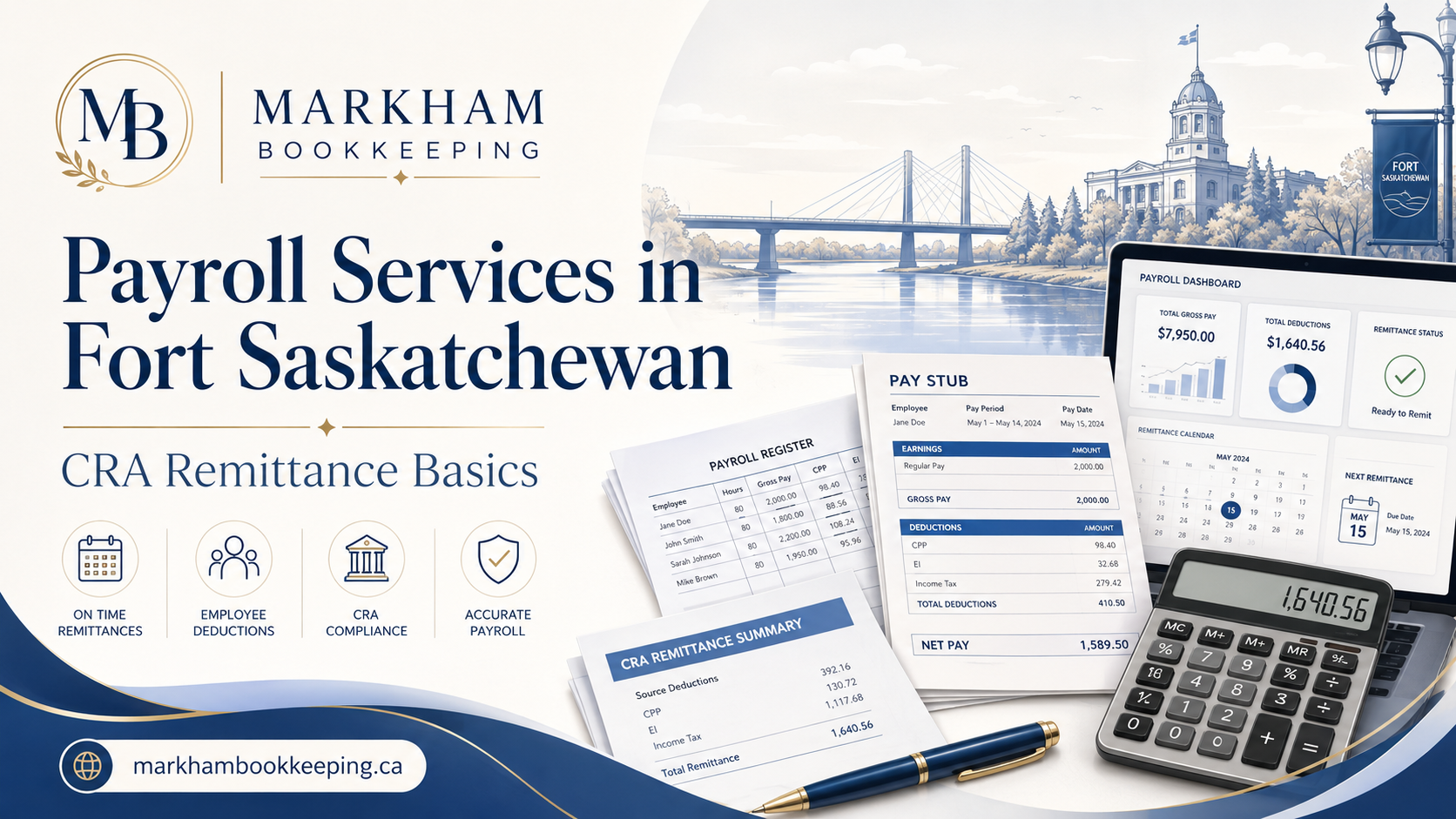
Running payroll is one of the most important responsibilities for any employer. When you hire employees, payroll is no longer just about paying wages. You also need to calculate deductions, track employer costs, remit amounts to CRA, keep proper records, and prepare year-end slips.
For Fort Saskatchewan business owners, payroll can become stressful quickly if the system is not set up properly from the beginning.
Whether you run a trades company, construction business, retail shop, restaurant, trucking company, professional service firm, or growing local startup, payroll needs to be accurate and on time. A mistake with payroll can affect employees, cash flow, bookkeeping reports, and CRA compliance.
This guide explains the basics of CRA payroll remittances and why payroll services in Fort Saskatchewan can help business owners stay organized.
What Are Payroll Remittances?
Payroll remittances are the amounts an employer sends to the Canada Revenue Agency after paying employees.
When you run payroll, you usually deduct certain amounts from an employee’s gross pay. These may include Canada Pension Plan contributions, Employment Insurance premiums, and income tax. CRA also explains that employers may need to withhold CPP contributions, additional CPP contributions, EI premiums, and income tax from taxable, pensionable, and insurable employment income.
The employer does not simply keep those deductions. They must be remitted to CRA.
In many cases, the employer also has its own portion to pay, such as employer CPP contributions and employer EI premiums. This means payroll costs are more than just the employee’s hourly wage or salary.
For example, if an employee earns wages, the employer may need to calculate:
Employee CPP
Employer CPP
Employee EI
Employer EI
Federal and provincial income tax deductions
Vacation pay
Taxable benefits, if applicable
Other deductions or reimbursements
Payroll services help make sure these amounts are calculated, recorded, and remitted correctly.
Why Payroll Matters for Fort Saskatchewan Businesses
Payroll mistakes can create serious problems for small businesses.
If employees are paid incorrectly, it can damage trust. If source deductions are late, CRA may charge penalties and interest. If payroll is not recorded properly in the books, your profit and loss report may be misleading. If vacation pay, benefits, or deductions are handled incorrectly, year-end reporting can become messy.
For Fort Saskatchewan employers, payroll can also be time-consuming. Many owners already handle sales, operations, suppliers, staffing, customer service, equipment, and bookkeeping. Adding payroll deadlines on top of that can become overwhelming.
That is why many local businesses look for payroll services in Fort Saskatchewan. A payroll bookkeeper can help with payroll setup, pay runs, CRA remittances, payroll journal entries, T4 preparation support, and employee records.
Step 1: Open a Payroll Program Account
Before remitting payroll deductions, a business generally needs a CRA payroll program account. CRA says new employers have to register for a payroll program account before the first remittance due date.
This payroll account is connected to the business number and is used for payroll deductions and remittances.
A common mistake is hiring the first employee, running payroll, and only later realizing the payroll account was never opened. That can create confusion when trying to remit source deductions.
Before your first payroll, you should confirm:
Your business number
Your payroll program account
Pay frequency
Employee information
TD1 forms
Payroll software or calculation method
CRA remittance schedule
Bookkeeping setup for payroll entries
A clean setup from the beginning makes payroll much easier to manage.
Step 2: Understand Gross Pay vs Net Pay
Payroll starts with gross pay.
Gross pay is the employee’s earnings before deductions. This may include regular wages, salary, overtime, vacation pay, bonuses, commissions, taxable allowances, or taxable benefits.
Net pay is what the employee actually receives after deductions.
For example, an employee may earn $2,000 gross pay, but after CPP, EI, income tax, and other deductions, the actual deposit may be lower.
For bookkeeping purposes, it is important not to record only the net pay as wage expense. Payroll needs to be recorded properly so the books show gross wages, employer payroll expenses, deductions payable, and remittances to CRA.
If payroll is recorded incorrectly, financial statements may not show the true cost of labour.
Step 3: Know What Gets Remitted to CRA
CRA payroll remittances usually include employee deductions plus employer contributions.
The main items are:
CPP contributions deducted from employees
Employer CPP contributions
EI premiums deducted from employees
Employer EI premiums
Income tax deducted from employees
These amounts are often called source deductions. Employers are responsible for calculating and sending them to CRA.
This is one of the biggest differences between paying a contractor and paying an employee. With employees, the employer has payroll withholding and remittance obligations. With contractors, the payment process may be different, but the worker classification must be correct.
Fort Saskatchewan businesses should be careful when deciding whether someone is an employee or self-employed contractor. Misclassification can create CRA issues later.
Step 4: Know Your CRA Remittance Frequency
Not every employer remits payroll deductions on the same schedule.
CRA assigns remitter types, and the remittance frequency generally depends on the employer’s average monthly withholding amount, also called AMWA. CRA explains that remitter type is generally based on the AMWA from two calendar years ago.
Common remitter types include:
Quarterly remitter
Regular remitter
Accelerated remitter threshold 1
Accelerated remitter threshold 2
Many small employers start as regular remitters, but this can depend on the situation. Some small employers with a perfect compliance record may qualify for quarterly remitting. CRA lists quarterly due dates as April 15, July 15, October 15, and January 15.
For regular remitters, CRA’s payroll guide states that the remittance is generally due by the 15th day of the month after the month in which employees were paid. Accelerated remitters have more frequent deadlines depending on their threshold.
This is why payroll due dates should be part of your monthly bookkeeping calendar.
Step 5: Do Not Treat Payroll Deductions as Business Cash
One of the most dangerous payroll mistakes is spending source deductions.
When payroll deductions are withheld from employees, that money is not really available business cash. It belongs to CRA and must be remitted.
For example, if you deduct income tax, CPP, and EI from employee wages, those amounts may still be sitting in your bank account temporarily. But they should not be used for rent, inventory, supplier payments, or owner draws.
A good payroll system helps business owners track payroll liabilities clearly. Your books should show what is owed to CRA after each pay run.
This is one reason payroll services in Fort Saskatchewan can be valuable. A bookkeeper can help make sure payroll deductions payable are visible in your accounting system, so CRA remittances do not become a surprise.
Step 6: Record Payroll Correctly in the Books
Payroll affects both the income statement and the balance sheet.
The income statement may show:
Gross wages
Employer CPP expense
Employer EI expense
Employee benefits
Vacation pay expense
Payroll service fees
The balance sheet may show:
Payroll deductions payable
CPP payable
EI payable
Income tax payable
Vacation payable
Wages payable
When CRA is paid, the payable balances should reduce.
If payroll is recorded only as one bank withdrawal, the reports may be incomplete. You may not know the real wage expense, employer payroll cost, or outstanding CRA liability.
For Fort Saskatchewan business owners, clean payroll bookkeeping helps with cash flow planning, job costing, tax filing, and management reporting.
Step 7: Use Reliable Payroll Calculations
Payroll calculations should not be guessed.
CRA provides payroll resources, including the Payroll Deductions Online Calculator, which calculates CPP, EI, and tax deductions based on payroll information entered.
Many businesses use payroll software or a payroll provider to calculate deductions automatically. However, the setup still matters. Incorrect employee province, pay frequency, taxable benefits, pension settings, or TD1 information can affect payroll results.
Before each pay run, employers should confirm:
Pay period dates
Hours worked
Salary or hourly rate
Overtime, if applicable
Vacation pay
Bonus or commission amounts
Taxable benefits
Employee deductions
Reimbursements
Termination pay, if applicable
A payroll service can help organize this process so payroll is consistent and easier to review.
Step 8: Avoid Late Payroll Remittances
Late payroll remittances can become expensive.
CRA states that if required CPP, EI, and income tax are not deducted, penalties and interest may apply. CRA lists a penalty of 10% of the amounts not deducted, and 20% for a second or later failure in a calendar year if made knowingly or under circumstances of gross negligence.
CRA also notes that if you under-remit, you must remit the required amount immediately, and a penalty plus interest may be charged for late payment.
This is why payroll should be treated as a priority. The due date should be tracked before the month ends, not after a CRA notice arrives.
Step 9: Keep Payroll Records Organized
Payroll records should be easy to access.
A proper payroll file may include:
Employee names and addresses
Social Insurance Numbers
TD1 forms
Employment agreements
Pay rates
Hours worked
Vacation pay records
Taxable benefit records
Payroll summaries
CRA remittance confirmations
ROE records, if applicable
T4 summaries and slips
These records support payroll reporting and help answer questions from employees, accountants, or CRA.
For growing Fort Saskatchewan businesses, payroll recordkeeping becomes even more important as staff count increases.
Step 10: Prepare for Year-End Payroll Reporting
Payroll does not end with the final paycheque of the year.
Employers usually need to prepare year-end payroll reporting, including T4 slips and a T4 summary. The amounts reported should match the payroll records and CRA remittances.
If payroll was not recorded properly throughout the year, year-end can become stressful. You may need to reconcile wages, deductions, taxable benefits, remittances, and employee records.
Good monthly payroll bookkeeping makes year-end easier.
Common Payroll Mistakes Fort Saskatchewan Employers Should Avoid
Many small businesses run into similar payroll problems.
Common mistakes include:
Opening the payroll account late
Missing CRA remittance deadlines
Using net pay instead of gross pay in the books
Forgetting employer CPP and EI costs
Not tracking vacation pay
Misclassifying employees as contractors
Not saving payroll reports
Recording CRA payments to the wrong account
Missing taxable benefits
Not reconciling payroll liabilities monthly
Waiting until year-end to fix payroll records
Most of these issues can be prevented with a proper payroll system.
How Payroll Services in Fort Saskatchewan Can Help
Payroll services can help business owners save time and reduce errors.
A payroll bookkeeper can assist with:
Payroll setup
Employee record organization
Pay run processing
CPP, EI, and income tax calculations
CRA remittance tracking
Payroll journal entries
Payroll liability reconciliation
Vacation pay tracking
T4 preparation support
Payroll cleanup
Coordination with your accountant
For business owners, the biggest benefit is peace of mind. You know payroll is being handled consistently, employees are being paid correctly, and CRA obligations are being tracked.
Final Thoughts
Payroll services in Fort Saskatchewan are not just about issuing paycheques. Payroll affects employee trust, CRA compliance, bookkeeping accuracy, cash flow, and year-end tax reporting.
Once you become an employer, you take on responsibilities that must be handled carefully. You need to calculate deductions, remit source deductions, record employer costs, track payroll liabilities, and keep proper records.
The best payroll system is one that is set up before problems happen.
For Fort Saskatchewan business owners, clean payroll bookkeeping means fewer surprises, better reporting, and more confidence when CRA deadlines arrive.
If you are hiring employees, growing your team, or falling behind on payroll records, now is the right time to organize the process.
Payroll should not be a guessing game.
It should be accurate, timely, and properly connected to your books.