
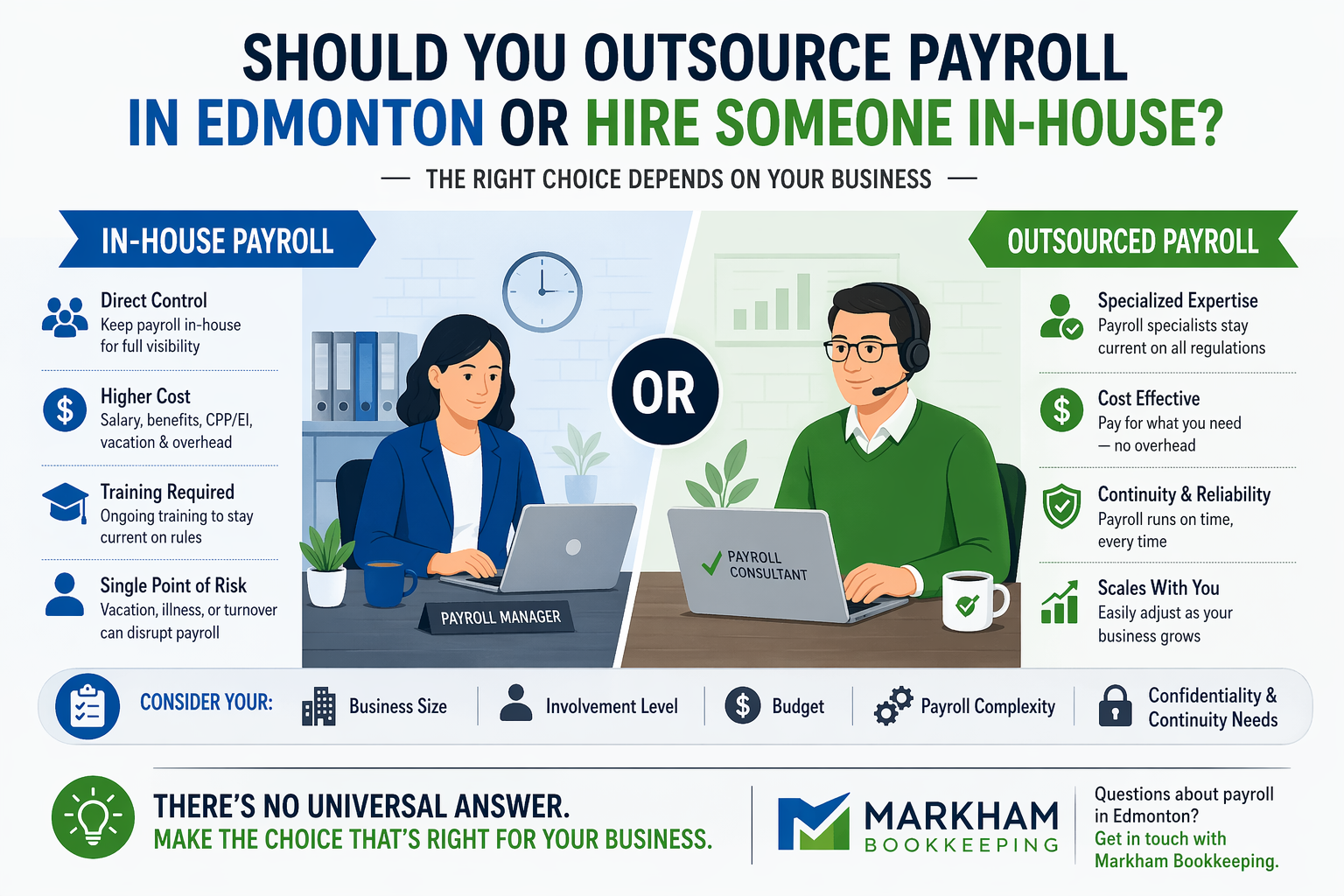
Payroll is one of the most technical areas of running a business — and one of the most consequential. Get it wrong and you’re dealing with CRA penalties, unhappy employees, and compliance headaches. So who should actually be handling it?
Here’s something most business owners don’t know: there are over 200,000 CPAs in Canada, but fewer than 40,000 certified payroll specialists. That gap tells you everything about how specialized this field really is — and how hard it can be to find someone who truly knows what they’re doing.
Certification gives you a baseline of reliability. But payroll isn’t a one-size-fits-all discipline. A specialist who’s handled 20-person payrolls their entire career may not be equipped for a 120-person operation with multiple pay grades, overtime rules, and commission structures — and vice versa. Match matters.
So — in-house or outsourced payroll services in Edmonton?
There’s no universal answer. Here are the factors that should drive the decision for your business.
1. Size of your organization
This is usually the most straightforward factor. For a workforce of 10–15 people, hiring a full-time payroll specialist is hard to justify unless you have the budget and additional HR responsibilities to fill the role. The math rarely works out.
As headcount grows — and especially once you’re managing multiple departments, pay structures, or locations — the calculus shifts. At that point, whether you go in-house or outsource depends more on the factors below.
2. Your level of involvement in the business
Owners who are deeply hands-on sometimes prefer to keep payroll internal so they maintain direct visibility. That’s a legitimate choice — but it comes with a cost. Someone in-house still needs to stay current on CRA remittance schedules, T4 deadlines, ROE requirements, and WCB reporting. That knowledge doesn’t maintain itself.
If you’re already stretched thin running the business, adding payroll oversight to your plate — or to a generalist employee’s plate — is where mistakes tend to happen.
3. Cost
A full-time payroll hire in Edmonton typically runs $50,000–$65,000 per year in salary alone, before you factor in CPP and EI contributions, vacation pay, benefits, and onboarding time. For most small and mid-sized businesses, outsourcing to a payroll consultant in Edmonton costs a fraction of that — and you’re only paying for what you actually need.
| In-house hire | Outsourced consultant |
|---|---|
| $50,000–$65,000+ annual salary | Pay for what you need |
| CPP / EI / vacation on top | No overhead or benefits |
| Benefits and onboarding costs | Specialist stays current on rules |
| Risk if they leave mid-quarter | No continuity risk |
| Ongoing training required | Scales with your headcount |
4. Familiarity with your payroll software
Whether you’re using Ceridian, Payworks, QuickBooks Payroll, or something else — whoever handles your payroll needs to know it well. An in-house hire who’s unfamiliar with your platform will have a learning curve that costs you time and introduces risk. A consultant who already works in that software daily will hit the ground running.
5. Confidentiality concerns
Some organizations prefer to keep payroll in-house precisely because of how sensitive the data is — employee salaries, banking details, benefits. That instinct is understandable.
But it’s worth examining the assumption carefully. Reputable payroll consultants handle confidential data as a core part of their practice and are bound by professional and contractual obligations. A well-drafted confidentiality agreement with a consultant can actually give you stronger legal recourse than the informal trust placed in an employee.
In-house doesn’t automatically mean safer. There are well-documented cases of internal employees manipulating payroll — paying unauthorized benefits, inflating hours, or worse — precisely because they had unchecked access. An external consultant with a clear contract and no stake in the organization removes that conflict of interest entirely.
6. Continuity and reliability
What happens when your in-house payroll person goes on vacation, calls in sick, or resigns two weeks before a remittance deadline? That single point of failure is a real operational risk that businesses underestimate until it happens.
Outsourcing to a consultant eliminates that dependency. Payroll runs on schedule regardless of what’s happening internally.
7. Complexity of your payroll
Weekly versus biweekly versus semi-monthly cycles, multiple pay grades, commissions, overtime, union rules, and multi-province employees all add layers of complexity. The more variables involved, the more important it is that whoever handles your payroll has direct experience with that level of complexity — not just the basics.
Before you hire anyone — in-house or outsourced — ask specifically about their experience with organizations of your size and structure. A general “yes I do payroll” answer isn’t enough.
Bottom line
For most Edmonton small and mid-sized businesses, outsourcing payroll to a qualified consultant makes more financial and operational sense than a full-time hire. You get specialized expertise, continuity, and compliance coverage — without the overhead.
That said, the right answer depends on your specific size, structure, and how involved you want to be in the process. If you’re unsure, it’s worth having a conversation with a payroll consultant in Edmonton who can give you an honest assessment based on your actual situation — not a sales pitch.
What to look for in your next payroll hire — in-house or outsourced
Once you’ve decided which direction to go, the next question is who. Whether you’re hiring an employee or bringing on a consultant, here’s what actually matters when evaluating payroll candidates in Edmonton.
1. Relevant certification
The benchmark designation for payroll in Canada is the PCP — Payroll Compliance Practitioner — issued by the National Payroll Institute. It’s the closest thing to a professional standard the field has. Given that there are fewer than 40,000 certified payroll specialists in the country compared to 200,000+ CPAs, finding someone with a PCP designation is a meaningful signal — not just a checkbox.
That said, certification is a starting point, not the whole picture. Always pair it with the next factor.
2. Experience at your scale
Ask specifically about the size of payrolls they’ve managed — number of employees, pay frequency, and complexity. Someone who’s handled 10-person payrolls for years may not be the right fit for an 80-person operation with multiple departments, overtime structures, and commission-based employees. The reverse is also true — an enterprise-level payroll specialist may be overkill (and overpriced) for a small team.
A good question to ask: “What’s the largest payroll you’ve managed, and what did that involve?” The answer tells you a lot more than a resume bullet point.
3. Software proficiency
Payroll software is not interchangeable. Someone fluent in Ceridian Dayforce may have never touched Payworks, and vice versa. Ask specifically which platforms they’ve worked in — not just whether they’re “familiar with payroll software.” In Alberta, Payworks and Ceridian are widely used. QuickBooks Payroll is common among smaller businesses. Make sure whoever you hire knows your platform, or has a credible plan to get up to speed quickly.
4. Knowledge of Alberta-specific requirements
Federal CRA rules apply everywhere, but Alberta has its own layer of requirements — WCB premiums and reporting, provincial employment standards, and specific rules around termination pay and vacation entitlements. Someone with payroll experience exclusively in Ontario or BC will have a learning curve. Ask directly: have they filed WCB for Alberta employers? Have they dealt with Alberta-specific termination scenarios?
5. Verifiable track record
For an in-house hire, references from previous employers are standard. For an outsourced consultant, ask for client references you can actually contact — not just logos on a website. A consultant who’s been doing this for years should have no hesitation providing references from businesses of similar size to yours.
Be cautious of anyone who can’t point to specific, verifiable experience. Payroll errors are expensive — CRA penalties, employee disputes, and missed remittances can cost far more than the fee you saved by going with the cheapest option.
6. A clear contract or engagement letter
Whether in-house or outsourced, the scope of work should be in writing. For a consultant, this means a formal engagement letter covering what’s included, turnaround times, confidentiality obligations, and what happens if something goes wrong. For an in-house hire, a clear job description with defined responsibilities. Vague arrangements lead to gaps — and in payroll, gaps show up as missed deadlines or misfiled remittances.
7. Communication style
Payroll touches every employee in your organization. Whoever handles it needs to communicate clearly — with you, and when necessary, with your team. If they can’t explain a T4 discrepancy or a CPP calculation in plain language, that’s a problem. Pay attention to how they communicate before you hire them. It rarely improves after.
Questions about whether outsourcing payroll makes sense for your Edmonton business? Get in touch with Markham Bookkeeping.